Skip to content
Manufacturing Operations11 min readPublished 2026-09-18

Paperless Shop Floor Management: Replacing Physical Job Cards with Digital Work Order Travelers

How Indian factories move from paper route cards to digital work order travelers — cutting operator reporting delays and improving WIP visibility.

AK

Abhishek Kumar

Senior Finance & ERP Systems Architect, Werkora

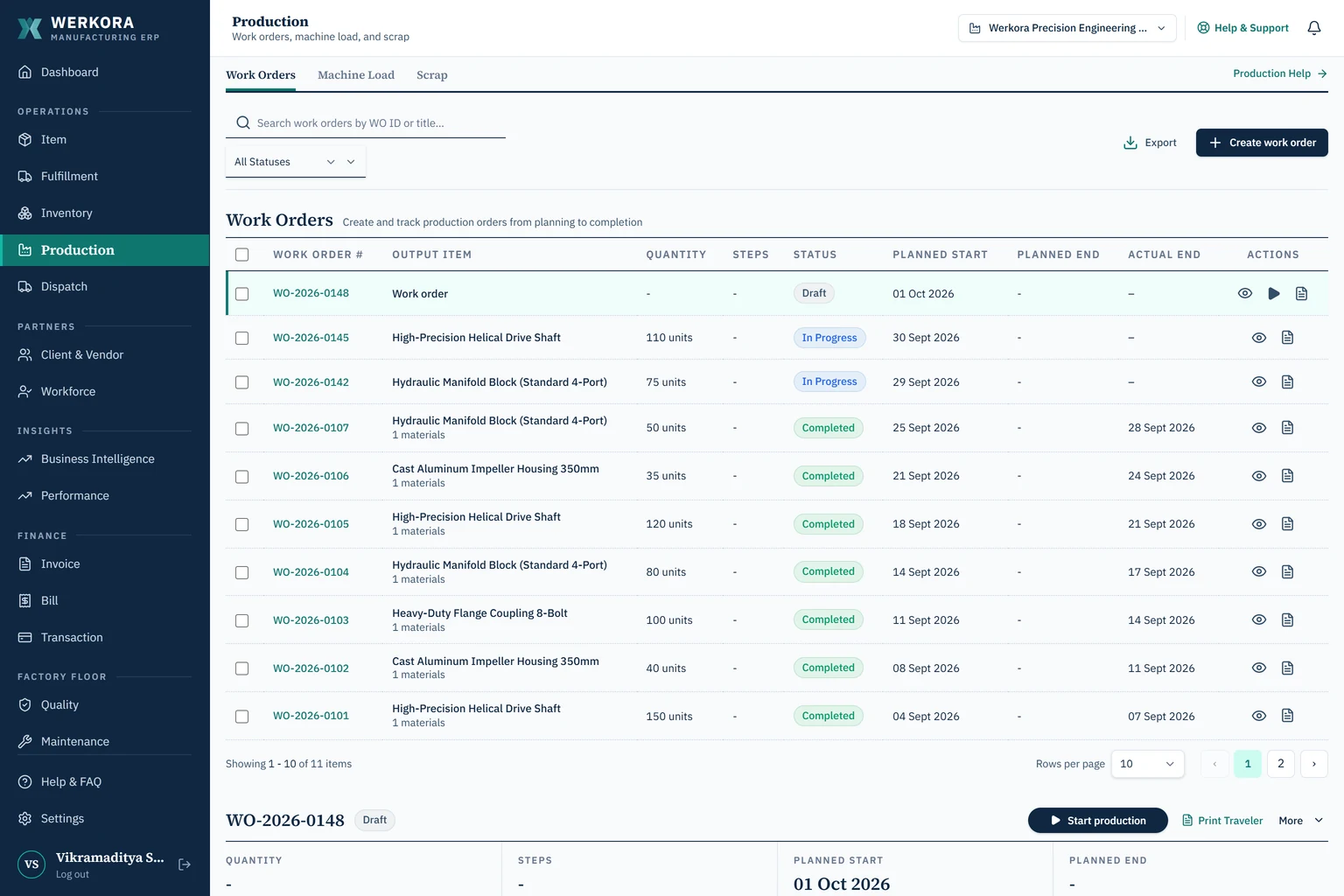
Werkora production module — work orders, BOMs and machine load
AEO Quick Answer & Key Takeaway

A digital job card traveler replaces handwritten paper route sheets with digital records assigned to each production batch. Supervisors and machine operators update the job card at each workstation using rugged tablets or mobile screens to record stage status, pieces completed, and scrap quantities in real time. Werkora updates plant-wide WIP counts and order progress instantly.

The Problem with Paper Clipboard Route Cards

In traditional Indian engineering job shops, sheet metal fabrication units, and plastics plants, every production lot travels with a paper route card tucked into a plastic sleeve. As the batch moves from shearing to CNC bending, welding, powder coating, and final assembly, operators write down:

  • The operator employee code
  • Date and shift number
  • Total pieces processed
  • Rejected piece count and reason
  • Machine number

While simple, this manual paper system creates three major operational problems:

  1. Shift-End Data Latency: Supervisors collect paper cards at the end of the shift or the next morning. Production figures are entered into computer spreadsheets hours or days after the parts have moved. If a machine runs 15% out of tolerance at 10:00 AM, management discovers the defect batch 24 hours later.
  2. Lost or Damaged Route Cards: In harsh plant environments with coolant spray, welding sparks, and grease, paper sheets tear, get stained, or disappear. Reconstructing the history of a half-finished lot requires guesswork.
  3. Falsified Piece Counts: When piece-rate wages depend on self-reported output written on paper, operators may inflate completed counts and conceal rejected parts under scrap bins. Reconciliation disputes occur between production and warehouse stores during final dispatch.
Audit Risk

Missing or illegible handwritten route cards during an ISO 9001 or customer quality audit trigger immediate major non-conformances (NC) that jeopardize preferred supplier status.

How a Digital Work Order Traveler Works

A digital job card traveler replaces paper clipboards with a persistent electronic record tied to the batch work order.

When a work order is generated in Werkora, the system assigns a unique Batch ID and formats a clean digital traveler showing:

  • Work Order Number and Part Description
  • Customer Part Number and Order Reference
  • Planned Batch Quantity
  • Ordered Operations Sequence (e.g., Op 10 Cutting, Op 20 Turning, Op 30 Grinding, Op 40 Inspection)
  • Live status and operator assignment

When an operator or supervisor accesses the work order on a tablet or workstation, the screen displays item specifications, setup notes, and operation routing for that specific stage.

Tracking Work-in-Progress (WIP) Between Workstations

One of the largest drains on factory cash flow is invisible Work-in-Progress. In multi-stage discrete manufacturing, half-finished components sit in transit aisles waiting for secondary operations. Without digital tracking, plant managers cannot determine whether an order is at the milling center, heat treatment plant, or outside job work contractor.

Digital job cards update stage transitions the moment an operator finishes their cycle:

  • Operation Start: The operator scans the traveler. The status changes to 'In Progress', capturing the exact machine runtime and operator ID.
  • Operation Pause / Changeover: If tooling needs replacement or an unexpected power cut occurs, the operator taps 'Pause' and selects the reason code. The system logs downtime hours for Overall Equipment Effectiveness (OEE) calculations.
  • Operation Finish: The operator enters the quantity of completed parts and scrap. The system marks that stage closed and automatically advances the lot to the next routing step in the sequence.

Production heads can view a live plant floor dashboard showing exactly how many units are queued at each workstation, identifying bottlenecks before assembly lines stall.

AttributePaper Route CardDigital Work Order Traveler
Data Entry TimeEnd of shift or next morning (12-24 hr delay)Real-time at workstation update (0 delay)
WIP Location TrackingPhysical walking across aisles to count binsInstant screen visibility of station queues
Scrap AccountingEstimated at month-end stock takesLogged per machine operation with defect code
Drawing Version ControlRisk of operator using obsolete paper printsLatest specifications accessible on tablet
Operator AccountabilityUnverified handwritten initialsAuthenticated role-based user login

Immediate Scrap Recording and Root Cause Capture

Scrap accounting is often treated as an afterthought in factory accounting. At month-end, accountants take physical inventory, discover a 6% weight variance, and write it off to generic production loss.

Digital job cards require operators to log defective pieces at the station where the defect occurs. When an operator records 4 scrapped pieces out of a 100-piece batch, the interface prompts for a rejection category:

  • Material Defect: Internal porosity, sheet cracking, dimensional variance from mill supplier.
  • Machine Tooling Error: Tool breakage, calibration drift, feed rate error.
  • Operator Setup Error: Incorrect clamping, datum mismatch.
  • Process Rejection: Incomplete weld penetration, paint run.

If the scrap rate exceeds a preconfigured threshold (e.g., 3%), Werkora immediately sends an alert to the quality engineer's mobile device to inspect the machine setup before the remainder of the batch is damaged.
Automating Operator Piece-Rate Wages and Shift Logbooks

In textile mills, auto ancillary units, and footwear plants, a significant portion of the workforce is paid on piece-rate production rather than fixed monthly salaries. Reconciling handwritten operator books against production output is time-consuming and leads to frequent wage disputes.

Digital job cards record verified piece output linked directly to the operator's verified login or supervisor sign-off:

  • Standard Piece-Rate Allocation: The system calculates operator earnings based on completed, quality-approved pieces multiplied by the operation piece rate (e.g., ₹2.40 per turned bush).
  • Rejected Piece Deduction: Depending on company policy, rework or scrap resulting from operator negligence can be flagged for supervisor review before wage approval.
  • Shift Efficiency Reports: Plant HR and production supervisors receive automated daily shift reports comparing expected standard hours against actual logged hours for each operator.

This automated calculation eliminates duplicate claims where two operators claim credit for the same production lot across shift changeovers.

Labor Reconciliation

Linking operator credentials and supervisor sign-offs to job card completion stops double-entry errors and speeds up contractor piece-rate reconciliation.

Deploying Paperless Job Cards with Werkora

Werkora provides a lightweight, touch-optimized shop floor interface built for standard commercial tablets and smartphones:

  1. Low-Cost Hardware Support: Deploy affordable Android tablets mounted on magnetic machine brackets or use low-cost USB barcode scanners connected to existing shop floor PCs.
  2. Offline-Tolerant Scanning: If factory Wi-Fi drops momentarily during crane movement or heavy electrical discharge, scans are cached locally and synchronized the instant connectivity resumes.
  3. Role-Based Access: Machine operators only see the 'Scan & Log' screen, preventing accidental modifications to customer orders or cost data.
  4. Transparent Pricing: Because Werkora provides 10 user accounts per unit under its ₹4,999/month unit pricing model (minimum 3 units, ₹14,997 base for 30 users), companies can equip all shop floor supervisors and workstation terminals without paying enterprise per-seat license fees.

Stop paying per-user software taxes in your factory

Werkora equips every shop-floor supervisor, line operator, storekeeper, and accountant with their own dedicated login with plans sized for your operation.

Frequently Asked Questions

Expert Answers for Factory Operations

Do factory operators need high computer literacy to use digital job cards?

No. Digital job card interfaces are designed for simple operational actions: selecting an assigned work order, pressing 'Start Job', entering the count of good parts and scrap, and pressing 'Complete'. The interface uses clear status badges and clean layouts.

What hardware is required on the shop floor to run Werkora job cards?

Werkora runs in any standard modern web browser on Android tablets, industrial touch panels, laptops, or mobile phones. No expensive proprietary PLC terminals or custom hardware are required.

How does digital job card tracking help during customer audits?

Automotive and industrial equipment OEMs require full traceability under IATF 16949 and ISO 9001. A digital job card provides an unalterable timestamped history showing the exact machine, operator, raw material heat lot, and quality inspection reading for every finished serialized component.

AK

Abhishek Kumar

LinkedIn Profile

Senior Finance & ERP Systems Architect, Werkora

Senior accountant and enterprise systems specialist with 9+ years of experience across Indian GST/TDS compliance, SAP S/4HANA, Tally Prime, and finance automation. Direct operational background in precision instruments manufacturing and multi-jurisdictional statutory compliance with a zero-penalty record.

Cite this guide
APA, Markdown or BibTeX

Copy a citation to include this guide in your article or report.

Interactive Cost Comparison

Calculate Your Plant's Licensing Savings

Benchmark your current software bills against Werkora's unit-based pricing (10 users/unit · min 3 units).

Projected 3-Year Savings for Your Operation (3 Factory Units · 30 Users)

Save up to ₹6.8 Lakhs over 3 years

Compared to standard per-user seat pricing models like ERPNext ($13.50/user/mo).

Each unit includes 10 active user seats (Operations, Store, Accounts, Planning).

3

Base commitment minimum is 3 units (30 user seats total).

Commitment Term:

Werkora Plan

Werkora

₹14,997/mo (3 Units · 30 Seats)

Annual Cost

₹1,79,964

3-Year TCO

₹5,39,892

30 user seats (3 units × 10)

ERPNext Cloud

$13.50 / user / mo

Annual Cost (30 Users)

₹4,05,816

3-Year TCO

₹12,17,448

Save ₹6.8 Lakhs

TYASuite

₹499 / user / mo (~$6)

Annual Cost (30 Users)

₹1,79,640

3-Year TCO

₹5,38,920

Save ₹0

Zoho Creator

$8 / user / mo

Annual Cost (30 Users)

₹2,40,480

3-Year TCO

₹7,21,440

Save ₹1.8 Lakhs

SAP Business One

$50+ / user / mo

Annual Cost (30 Users)

₹15,03,000

3-Year TCO

₹45,09,000

Save ₹39.7 Lakhs

What's Included in Werkora's Plan (from ₹4,999/unit/mo · Min 3 Units):

10 Users per Factory Unit (30 Users in Base)
Minimum 3 Factory Units Included
GST Tax Invoices & Delivery Challans
BOM Formulation & Scrap Accounting
Customer, Supplier & Ledger Accounting
Batch FIFO Inventory Valuation
Shop Floor Travelers & Operation Routing
Extra Units at ₹4,999/mo (+10 users each)

Plan your ERP budget

Review the ERP buying guide or contact us to discuss the units, users, and deployment options your factory needs.

Related Manufacturing Playbooks

Explore adjacent topics in factory operations, costing, and statutory GST compliance.