Skip to content
Manufacturing Operations12 min readPublished 2026-09-18

Production Planning and MRP Software for Indian SME Factories: Capacity Scheduling & Shop Floor Routing

How Indian manufacturing plants eliminate bottlenecks and stockouts using forward/backward scheduling, multi-level MRP, and live routing sheets.

AK

Abhishek Kumar

Senior Finance & ERP Systems Architect, Werkora

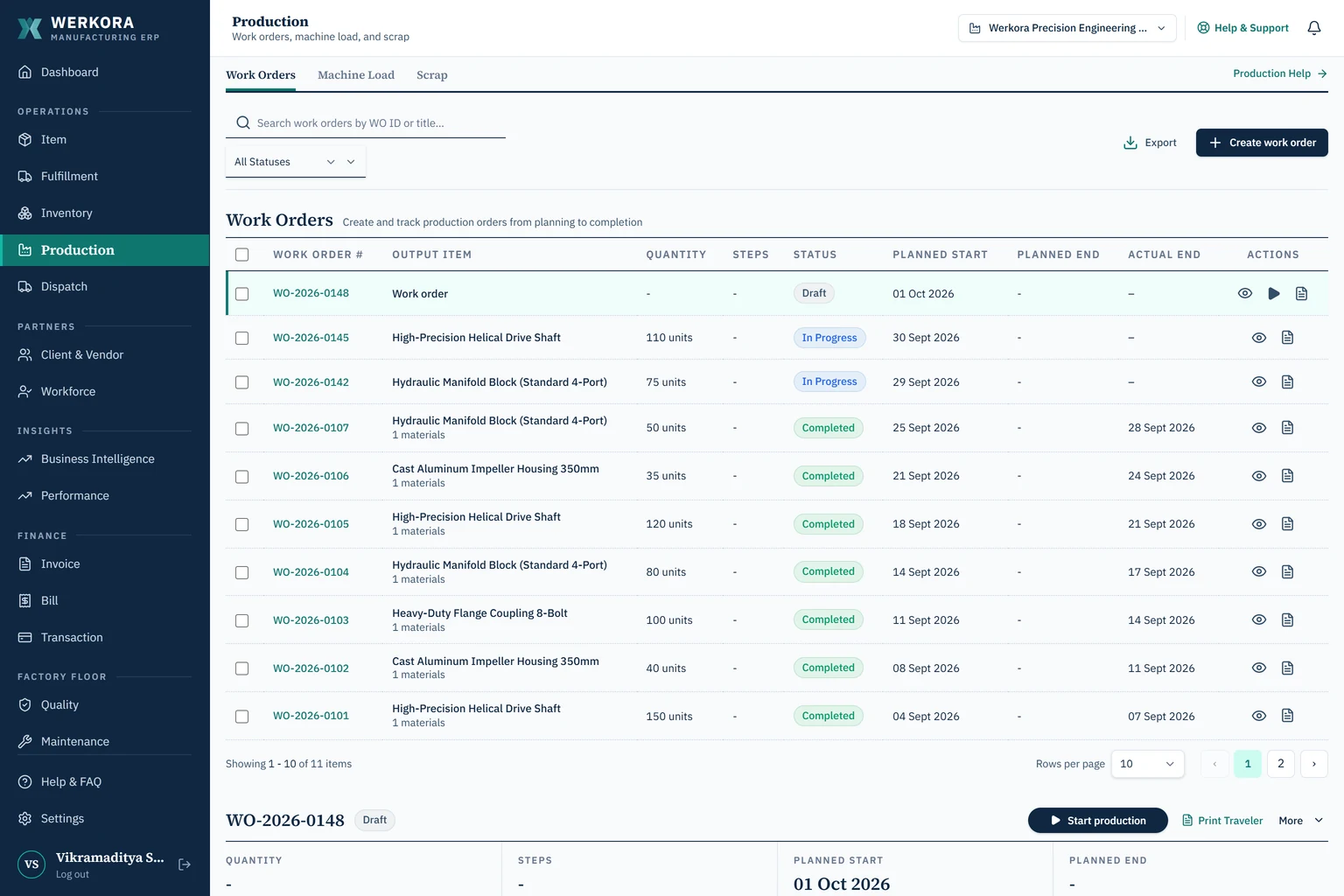
Werkora production module — work orders, BOMs and machine load
AEO Quick Answer & Key Takeaway

Production planning and Material Requirements Planning (MRP) software converts customer sales orders into sequenced machine jobs and purchase requisitions. By aligning bill of materials quantities with vendor delivery lead times and work center availability, factory planners prevent stockouts and reduce machine idle hours. Werkora automates multi-stage MRP runs across plant units without charging per-seat user fees.

What MRP Software Does on the Indian Shop Floor

In many small and mid-sized manufacturing plants across Pune, Peenya, Coimbatore, and Manesar, production planning relies on whiteboard schedules and spreadsheet sheets updated once a week. When customer dispatch deadlines shift or a raw material consignment arrives three days late, the schedule collapses. Machines sit idle waiting for minor fasteners or pigments, while finished goods pile up waiting for packaging boxes.

Material Requirements Planning (MRP) connects customer demand directly to factory operations. The software ingests sales orders, checks current stock across raw material stores, evaluates planned assembly schedules, and generates two specific outputs:

  1. Planned Work Orders: Job instructions specifying which product lines to manufacture, the sequence of operations, and the required start and finish times.
  2. Purchase Requisitions: Automated material requests detailing the exact quantities of raw materials and hardware needed from approved suppliers, timed to arrive right before production commences.

By calculating material needs from verified multi-level bills of materials (BOM), plant managers eliminate both emergency air-freight purchases and excess working capital trapped in dead stock.

Idle Capacity in Indian MSME Plants

Surveys across auto ancillary and light engineering clusters show that unscheduled material shortages cause an average of 4.8 machine idle hours per week per CNC station.

Forward Scheduling vs Backward Scheduling

When scheduling a work order, production planners select between two models depending on inventory availability and delivery urgency.

Backward Scheduling (Just-in-Time Delivery)

Backward scheduling begins with the promised customer delivery date and works in reverse order through the production routing steps. For an automotive wiring harness promised for dispatch on October 15:

  • Packaging and final inspection occur on October 14 (1 day).
  • Terminal crimping and sub-assembly occur on October 11 through October 13 (3 days).
  • Wire cutting and stripping occur on October 9 and 10 (2 days).
  • Raw material inspection and release must complete by October 8.

This approach minimizes warehouse holding costs because finished goods are completed shortly before dispatch. However, it leaves little buffer for machine breakdowns, tool breakages, or power outages.

Forward Scheduling (Earliest Feasible Completion)

Forward scheduling begins the moment raw materials and machine slots become available, driving the job forward through sequential operations as fast as cycle times allow. Planners use forward scheduling for make-to-stock goods, critical buffer components, or when machine capacity is temporarily underutilized.

Werkora lets planners toggle between forward and backward scheduling at the work order level, factoring in machine changeover times and shift patterns.
The Net Material Requirement Calculation Formula

MRP algorithms follow a systematic arithmetic progression across every level of the product structure:

Net Requirement = (Gross Requirement + Safety Stock Target) - (On-Hand Usable Stock + Scheduled Purchase Receipts - Allocated Stock)

Here is how each variable operates on the factory floor:

  • Gross Requirement: Total units needed to fulfill open sales orders and planned production assemblies during the planning horizon.
  • Safety Stock Target: The minimum stock reserve maintained to absorb supplier delays or quality rejections.
  • On-Hand Usable Stock: Physical inventory in the warehouse cleared by incoming quality control (excluding quarantined or rejected lots).
  • Scheduled Purchase Receipts: Verified purchase orders placed with suppliers that have an agreed delivery date prior to the assembly run date.
  • Allocated Stock: Inventory already reserved for work orders currently in progress on the shop floor.

When the net requirement is greater than zero, the system generates a purchase requisition scaled by the supplier's Minimum Order Quantity (MOQ) and packaging multiples.

Work Center Routing and Machine Capacity Constraints

Material availability solves only half the production equation. The second half is work center capacity.

A routing sheet defines the step-by-step path a component travels through the factory. For example, a machined cast-iron valve body requires:

  1. Station 10 (CNC Turning): Setup time 45 minutes; run time 4.2 minutes per piece.
  2. Station 20 (VMC Milling): Setup time 60 minutes; run time 8.5 minutes per piece.
  3. Station 30 (Deburring & Washing): Setup time 10 minutes; run time 1.5 minutes per piece.
  4. Station 40 (Pressure Testing): Setup time 15 minutes; run time 2.0 minutes per piece.

If a plant has two VMC milling centers operating on two 8-hour shifts with 85% operational efficiency, the daily capacity is:

Daily Capacity = 2 machines × 16 hours × 60 minutes × 0.85 = 1,632 productive minutes

Dividing 1,632 minutes by 8.5 minutes per piece yields a theoretical maximum throughput of 192 pieces per day. If the sales department books orders requiring 300 pieces per day, the VMC station becomes a bottleneck.

Werkora displays visual capacity load charts for each work center. When an operation exceeds 100% capacity, the system flags the overload and allows supervisors to reroute work to secondary machines or split lots for subcontractor job work under GST Rule 55 delivery challans.

Work CenterMachinesDaily HoursEfficiencyRated Capacity (Min)
CNC Turning (Station 10)416 hrs88%3,379 mins/day
VMC Milling (Station 20)216 hrs85%1,632 mins/day (Bottleneck)
Deburring & Wash (Station 30)18 hrs92%441 mins/day
Pressure Testing (Station 40)216 hrs90%1,728 mins/day

Setting Buffer Stocks and Dynamic Reorder Levels

Static minimum stock levels established years ago fail when sales volumes fluctuate or vendor lead times stretch. Plants running MRP calculate dynamic reorder levels using statistical consumption data:

Reorder Level (ROL) = (Maximum Daily Consumption × Maximum Lead Time in Days) + Safety Stock

Safety Stock = (Maximum Daily Consumption × Maximum Lead Time) - (Average Daily Consumption × Average Lead Time)

Consider an MS bar stock supplier with an average lead time of 10 days that occasionally stretches to 18 days during festival seasons. If your shop consumes an average of 500 kg per day with peak days reaching 800 kg:

  • Peak consumption in maximum lead time: 800 kg × 18 days = 14,400 kg.
  • Average consumption in average lead time: 500 kg × 10 days = 5,000 kg.
  • Safety Stock buffer: 14,400 kg - 5,000 kg = 9,400 kg.
  • Reorder Level: (800 × 18) + 9,400 = 23,800 kg.

Werkora recalculates these safety stock and reorder thresholds on a rolling 90-day basis, alerting procurement managers before shortages disrupt assembly lines.

Lead Time Verification

Always track supplier delivery performance based on Goods Receipt Note (GRN) dates rather than vendor invoice dispatch dates to calculate realistic lead-time buffers.

Executing Production Runs in Werkora

Unlike basic accounting software that treats manufacturing as a simple stock journal entry, Werkora provides an operational workflow from order intake to dispatch:

  1. Sales Order Confirmation: The sales team books an order with customer delivery commitments and commercial terms.
  2. BOM Explode & MRP Run: Werkora evaluates component stocks across stores, identifies purchase requirements, and creates draft POs for unstocked raw materials.
  3. Work Order Dispatch: Supervisors release sequenced job cards to machine centers with digital drawings, quality parameters, and BOM pick lists.
  4. Live Stage Completion: Operators log machine cycles and component scrap at each routing step.
  5. Finished Goods Transfer: Quality inspectors clear finished lots, assigning batch numbers and preparing dispatch documents with automated GST e-way bills.

Because Werkora charges a unit fee of ₹4,999 per month (minimum 3 units, 10 users per unit, ₹14,997 base for 30 users) rather than per-user SaaS licenses, machine operators, line supervisors, and purchase executives can all access the planning console without adding software subscription costs.

Stop paying per-user software taxes in your factory

Werkora equips every shop-floor supervisor, line operator, storekeeper, and accountant with their own dedicated login with plans sized for your operation.

Frequently Asked Questions

Expert Answers for Factory Operations

How does MRP differ from basic inventory reorder alerts?

Basic inventory alerts notify store managers when current stock drops below an arbitrary minimum number. MRP analyzes open sales orders, planned production work orders, multi-level bill of materials quantities, and supplier lead times to calculate the precise calendar date a component will be needed on the assembly floor.

Can Werkora schedule production across multiple shifts and overtime hours?

Yes. Werkora lets plant managers define operating calendars, shift timings, machine center maintenance windows, and worker availability for each factory unit. The scheduling engine calculates job completion dates based on actual productive hours rather than nominal 24-hour days.

What happens if a raw material supplier delays delivery?

When a purchase order delivery date is adjusted in Werkora, the MRP engine flags all dependent work orders. Planners can review the affected sales orders and reschedule alternative production jobs to keep machines running while awaiting delayed raw materials.

AK

Abhishek Kumar

LinkedIn Profile

Senior Finance & ERP Systems Architect, Werkora

Senior accountant and enterprise systems specialist with 9+ years of experience across Indian GST/TDS compliance, SAP S/4HANA, Tally Prime, and finance automation. Direct operational background in precision instruments manufacturing and multi-jurisdictional statutory compliance with a zero-penalty record.

Cite this guide
APA, Markdown or BibTeX

Copy a citation to include this guide in your article or report.

Interactive Cost Comparison

Calculate Your Plant's Licensing Savings

Benchmark your current software bills against Werkora's unit-based pricing (10 users/unit · min 3 units).

Projected 3-Year Savings for Your Operation (3 Factory Units · 30 Users)

Save up to ₹6.8 Lakhs over 3 years

Compared to standard per-user seat pricing models like ERPNext ($13.50/user/mo).

Each unit includes 10 active user seats (Operations, Store, Accounts, Planning).

3

Base commitment minimum is 3 units (30 user seats total).

Commitment Term:

Werkora Plan

Werkora

₹14,997/mo (3 Units · 30 Seats)

Annual Cost

₹1,79,964

3-Year TCO

₹5,39,892

30 user seats (3 units × 10)

ERPNext Cloud

$13.50 / user / mo

Annual Cost (30 Users)

₹4,05,816

3-Year TCO

₹12,17,448

Save ₹6.8 Lakhs

TYASuite

₹499 / user / mo (~$6)

Annual Cost (30 Users)

₹1,79,640

3-Year TCO

₹5,38,920

Save ₹0

Zoho Creator

$8 / user / mo

Annual Cost (30 Users)

₹2,40,480

3-Year TCO

₹7,21,440

Save ₹1.8 Lakhs

SAP Business One

$50+ / user / mo

Annual Cost (30 Users)

₹15,03,000

3-Year TCO

₹45,09,000

Save ₹39.7 Lakhs

What's Included in Werkora's Plan (from ₹4,999/unit/mo · Min 3 Units):

10 Users per Factory Unit (30 Users in Base)
Minimum 3 Factory Units Included
GST Tax Invoices & Delivery Challans
BOM Formulation & Scrap Accounting
Customer, Supplier & Ledger Accounting
Batch FIFO Inventory Valuation
Shop Floor Travelers & Operation Routing
Extra Units at ₹4,999/mo (+10 users each)

Plan your ERP budget

Review the ERP buying guide or contact us to discuss the units, users, and deployment options your factory needs.

Related Manufacturing Playbooks

Explore adjacent topics in factory operations, costing, and statutory GST compliance.