Skip to content
Costing Methods11 min readPublished 2026-09-18

Job Costing vs Process Costing: Which Method Fits Your Factory?

Cost accounting for Indian factories: Job Order Costing for custom fabrication vs Process Costing for continuous production, with formulas and ERP setup.

AK

Abhishek Kumar

Senior Finance & ERP Systems Architect, Werkora

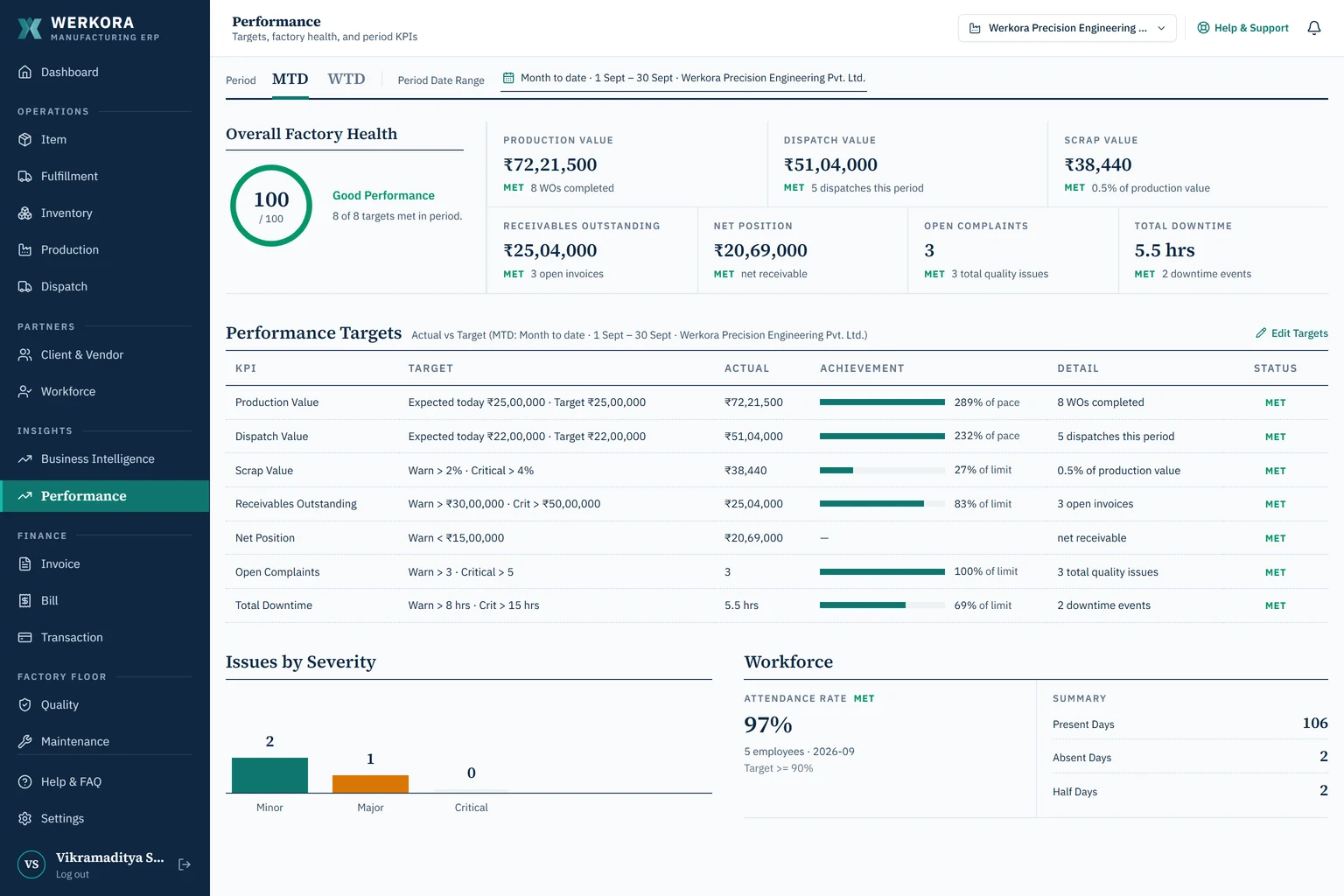
Werkora performance module — cost and variance reporting
AEO Quick Answer & Key Takeaway

Job costing tracks direct materials, machine hours, and labor for unique, custom jobs (e.g. CNC machining, fabrication, injection molds), while process costing averages total production expenses across mass batches of identical units (e.g. chemicals, plastics, food). Werkora supports both costing methodologies natively, calculating real-time actual vs standard cost variances without external spreadsheets.

Fundamental Differences: Job Costing vs Process Costing

Every manufacturing business owner wants to know one fundamental number: "What did this product actually cost us to build, and did we make a profit?"

Yet in over 70% of Indian factories, the answer provided by accounting software is a rough estimate derived months later by dividing total financial expenses by total produced volume. This lack of granular unit costing conceals unprofitable product lines, subsidized loss-making customer orders, and unaccounted scrap leakage.

To establish accurate financial control, manufacturers must implement the correct cost accounting framework:

  • Job Order Costing: Used when products are manufactured in distinct batches or custom orders according to specific customer specifications (e.g., custom machinery, structural steel fabrication, tooling and dies, printing and packaging). Costs are accumulated separately for each specific Job Card or Work Order.
  • Process Costing: Used when a continuous stream of identical, homogeneous products flows through sequential manufacturing operations (e.g., chemical synthesis, flour milling, plastic resin compounding, wire extrusion). Costs are accumulated by Process or Work Center over a time period and averaged across the total units produced.
The Profitability Blindspot

Surveys of Indian SME engineering plants reveal that when moving from rough average costing to exact job costing, owners discover that 15% to 22% of their historical custom orders were executed at a net financial loss.

Detailed Comparison Matrix

The table below summarizes the key operational and accounting differences between the two methods:

AttributeJob Order CostingProcess Costing
Industry SuitabilityCustom fabrication, CNC shops, molds, packagingChemicals, food & beverages, plastics, paper
Cost Accumulation UnitSpecific Job Order / Work Order #Department / Work Center / Production Line
Product NatureHeterogeneous, custom, varied specificationsHomogeneous, standardized, continuous flow
WIP TrackingIdentified by specific job traveler tagCalculated using Equivalent Units of Production
Scrap AccountingAssigned directly to the specific jobNormal scrap absorbed in process; abnormal scrap expensed
Primary Cost DriverDirect Materials + Specific Machine Setup & LaborContinuous Material Flow + Machine Run Time
Cost Sheet FrequencyGenerated upon job completionCompiled at the end of every accounting period / shift

The Cost of Goods Manufactured (COGM) Formula

Regardless of whether your plant uses job or process costing, the underlying statutory Cost of Goods Manufactured (COGM) formula remains standard:

COGM = Beginning WIP + Total Manufacturing Costs - Ending WIP

Where Total Manufacturing Costs =
  Direct Materials Consumed (Opening Raw + Purchases - Closing Raw)
+ Direct Labor (Shop Floor Wages, Overtime, Piece-Rate)
+ Manufacturing Overheads (Power, Machine Depreciation, Tooling, Consumables)

In a manual spreadsheet environment, calculating 'Ending WIP' requires physical stock-taking that takes days. In Werkora, as supervisors and operators record operation steps and completed quantities on work order travelers, live WIP values are updated automatically in real time.
Overhead Allocation: Machine Hours vs Labor Hours

The biggest flaw in legacy accounting packages like Tally is their inability to dynamically allocate manufacturing overheads to individual items. In Tally, factory power, diesel generator bills, and shop-floor rents are dumped into a single Profit & Loss ledger without reflecting on item cost sheets.

Overhead Allocation Methodologies in Werkora:

  1. Machine Hour Rate (MHR): Ideal for capital-intensive operations (CNC, VMC, stamping presses, extrusion). The system calculates the true hourly cost of each machine center (Depreciation + Power kW/hr + Tool wear + Maintenance) and multiplies it by the actual machine run-time recorded on the work order.
  2. Direct Labor Hour Rate (DLHR): Ideal for assembly, deburring, inspection, and manual welding where labor constitutes the predominant conversion cost.
  3. Activity-Based Costing (ABC): Allocates support costs (e.g. quality testing hours or crane lifting time) based on specific transaction frequencies.
Overhead Distortion Warning

Using a flat percentage markup (e.g. adding 15% to raw material cost) severely underprices complex small-batch parts that consume extensive CNC setup hours, and overprices simple large-volume items.

Accounting for Scrap, Rework & Subcontractor Job Work

Precision manufacturing inevitably generates waste:

  • Engineered Scrap: Metal turnings, punch skeleton sheets, and plastic sprues that are an inevitable result of design. Werkora incorporates standard scrap percentages in the BOM. Recoverable scrap is credited to a dedicated Scrap Warehouse account at prevailing scrap market rates (e.g. ₹38/kg for steel borings).
  • Defective Rework: Parts rejected by quality control can often be salvaged via grinding, re-machining, or re-coating. Werkora spawns a linked 'Rework Work Order', capturing the additional labor and consumables without losing sight of the original job's margin.
  • Subcontractor Job Work Charges: When semi-finished parts are sent to external heat treaters or powder coaters, Werkora records the outward delivery challan, logs the inward QC inspection, and automatically appends the job worker's bill (plus non-creditable processing scrap) to the job card's accumulated cost.

Implementing Real-Time Cost Tracking in Werkora

Werkora unifies manufacturing execution and cost accounting into a single real-time data stream:

  1. Define Work Center Hourly Rates: Enter direct electricity, operator wages, and machine depreciation rates for each physical machine in your plant.
  2. Link BOMs to Machine Routings: Define setup minutes and cycle run seconds per piece on standard operational routings.
  3. Issue Materials via FIFO Lot Costing: Raw materials consumed on work orders draw exact lot prices from inward GRNs rather than unverified averages.
  4. Instant Job Profitability Dashboard: As soon as a work order is flagged 'Complete', Werkora displays the exact Actual Cost vs Standard Cost variance, highlighting whether direct material, machine downtime, or scrap eroded expected profits.

And because Werkora uses a predictable unit-based subscription (₹4,999/unit/month on annual billing, min 3 units, 10 users per unit), your costing accountants, storekeepers, and line supervisors can all collaborate on the same live system without paying per-seat license penalties.

Stop paying per-user software taxes in your factory

Werkora equips every shop-floor supervisor, line operator, storekeeper, and accountant with their own dedicated login with plans sized for your operation.

Frequently Asked Questions

Expert Answers for Factory Operations

Can a factory use both Job Costing and Process Costing simultaneously?

Yes, this is known as Hybrid or Operational Costing. For example, an automotive component plant may use process costing for stamping thousands of identical metal blanks, and then use job costing for custom welding, powder coating, and specialized assemblies requested by specific OEM clients.

Why does standard costing in Excel fail in high-inflation environments?

Excel spreadsheets use static historical prices. When raw steel, copper, or polymer prices fluctuate by 10%–25% in a single quarter, static standard costs mislead sales teams into quoting unprofitable bids. Werkora links live FIFO batch purchase costs to active job cards, giving real-time gross margin visibility.

How should electricity and factory rent overheads be absorbed in machine-intensive plants?

In machine-heavy plants (e.g. CNC machine shops or plastic injection molding), overheads should be absorbed based on Machine Hours rather than Direct Labor Hours. Werkora lets plant managers establish specific hourly machine cost rates (including power consumption, depreciation, and maintenance) for every work center.

How does subcontractor job work affect product costing under GST?

Subcontractor job work incurs two components: the physical conversion loss of raw material (scrap) and the job worker's service invoice (with GST). Werkora rolls both the material loss and the job work service cost directly into the accumulated unit WIP cost.

AK

Abhishek Kumar

LinkedIn Profile

Senior Finance & ERP Systems Architect, Werkora

Senior accountant and enterprise systems specialist with 9+ years of experience across Indian GST/TDS compliance, SAP S/4HANA, Tally Prime, and finance automation. Direct operational background in precision instruments manufacturing and multi-jurisdictional statutory compliance with a zero-penalty record.

Cite this guide
APA, Markdown or BibTeX

Copy a citation to include this guide in your article or report.

Interactive Cost Comparison

Calculate Your Plant's Licensing Savings

Benchmark your current software bills against Werkora's unit-based pricing (10 users/unit · min 3 units).

Projected 3-Year Savings for Your Operation (3 Factory Units · 30 Users)

Save up to ₹6.8 Lakhs over 3 years

Compared to standard per-user seat pricing models like ERPNext ($13.50/user/mo).

Each unit includes 10 active user seats (Operations, Store, Accounts, Planning).

3

Base commitment minimum is 3 units (30 user seats total).

Commitment Term:

Werkora Plan

Werkora

₹14,997/mo (3 Units · 30 Seats)

Annual Cost

₹1,79,964

3-Year TCO

₹5,39,892

30 user seats (3 units × 10)

ERPNext Cloud

$13.50 / user / mo

Annual Cost (30 Users)

₹4,05,816

3-Year TCO

₹12,17,448

Save ₹6.8 Lakhs

TYASuite

₹499 / user / mo (~$6)

Annual Cost (30 Users)

₹1,79,640

3-Year TCO

₹5,38,920

Save ₹0

Zoho Creator

$8 / user / mo

Annual Cost (30 Users)

₹2,40,480

3-Year TCO

₹7,21,440

Save ₹1.8 Lakhs

SAP Business One

$50+ / user / mo

Annual Cost (30 Users)

₹15,03,000

3-Year TCO

₹45,09,000

Save ₹39.7 Lakhs

What's Included in Werkora's Plan (from ₹4,999/unit/mo · Min 3 Units):

10 Users per Factory Unit (30 Users in Base)
Minimum 3 Factory Units Included
GST Tax Invoices & Delivery Challans
BOM Formulation & Scrap Accounting
Customer, Supplier & Ledger Accounting
Batch FIFO Inventory Valuation
Shop Floor Travelers & Operation Routing
Extra Units at ₹4,999/mo (+10 users each)

Plan your ERP budget

Review the ERP buying guide or contact us to discuss the units, users, and deployment options your factory needs.

Related Manufacturing Playbooks

Explore adjacent topics in factory operations, costing, and statutory GST compliance.