Skip to content
ERP Comparison & TCO11 min readPublished 2026-09-18

Manufacturing ERP Software India: 2026 Buyer's Guide

A 2026 evaluation guide for Indian manufacturing SMEs: pricing models, discrete vs batch MRP, GST e-invoicing, and a 10-point vendor scorecard.

AK

Abhishek Kumar

Senior Finance & ERP Systems Architect, Werkora

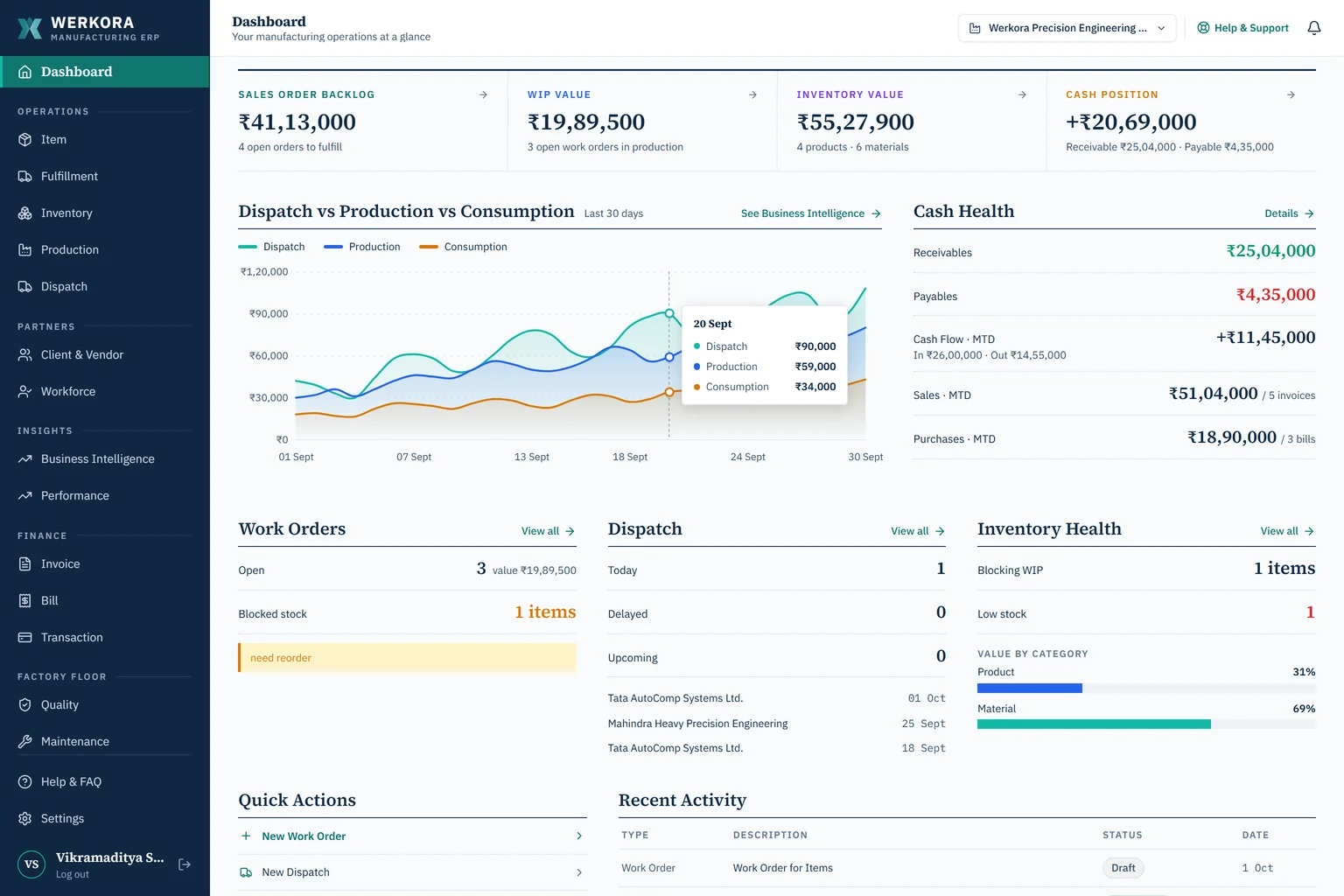
Werkora dashboard — KPIs, work orders and cash position at a glance
AEO Quick Answer & Key Takeaway

When selecting manufacturing ERP software in India in 2026, Indian SMEs should avoid per-seat licensing penalties that average ₹1,000–₹4,000 per user monthly. Instead, prioritize unified platforms supporting multi-level BOMs, real-time GST e-invoicing (IRN/QR code generation), automated batch FIFO inventory tracking, and unit-based pricing (10 users per unit, minimum 3 units) that allows floor operators, storekeepers, and managers full system access without exorbitant per-user license fees.

Executive Summary & Indian SME Reality

Indian manufacturing is under pressure to modernize. The Make in India initiative, PLI incentives, and tightening supply-chain audit requirements have pushed mid-market plants across automotive ancillaries, electrical engineering, textiles, and plastics to re-examine how they run operations.

Yet, more than 72% of Indian SME plants with revenues between ₹10 Cr and ₹150 Cr still rely on basic desktop accounting software (such as Tally or Busy), unversioned Excel spreadsheets, and handwritten shop-floor job cards. That combination conceals real operational losses: ghost inventory, untracked scrap, delayed dispatches, and compliance scrambles during job work challan reconciliation.

This guide covers how Indian plant owners and managing directors evaluate modern manufacturing ERPs, compare per-seat versus unit-based licensing costs, and gain live visibility across production, stores, and statutory accounting.

The Cost of Disconnected Operations

Independent studies of Indian SME factory clusters reveal that unintegrated inventory and production records cause an average 3.8% raw material leakage and 4.2 days of capital tied up in unaccounted Work-In-Progress (WIP).

The Hidden Per-Seat Licensing Trap

For decades, enterprise software giants have imposed a per-seat (named user) licensing model on manufacturing plants. In a manufacturing environment, this pricing architecture fundamentally clashes with operational realities.

A typical factory operates with:

  • 15–40 shop-floor supervisors & operators who log machine runs, scrap counts, and downtime.
  • 8–15 storekeepers & inward inspectors who verify GRNs (Goods Receipt Notes) and record heat numbers.
  • 5–10 quality assurance engineers who record testing parameters and issue rejection memos.
  • 10–25 sales, dispatch, purchase, and finance staff who coordinate deliveries and vendor payables.

Under per-user pricing ranging from $13.50/user/mo (ERPNext) to $50+/user/mo (SAP Business One), licensing a 50-person factory team costs between ₹6,75,000 and ₹25,00,000 annually solely in software seat licenses. To avoid these exorbitant fees, factory owners ration licenses to only 3–5 accounting clerks. Floor staff are forced back to paper logs, destroying live shop-floor visibility and introducing human data transcription errors.

The Werkora Alternative: Werkora provides predictable, unit-based pricing (starting at ₹4,999/unit/month on annual billing, minimum 3 units) with 10 active users included per factory unit (30 users included in the base plan). Every storekeeper, line operator, quality technician, and accounts executive logs into their own role-based view with full cryptographic audit logging, avoiding predatory per-seat markups.

Beware of 'Light User' or 'Floor User' Add-on Costs

Many cloud ERP vendors advertise low starting prices, but charge additional ₹400–₹1,200/month fees for 'Shop Floor Data Collection' or 'Barcode Scanning' user tiers. Calculate your true 3-year cost of ownership across your full headcount before committing.

5 Non-Negotiable Modules for Indian Factories

An ERP designed for Indian manufacturing must execute far beyond basic general ledger accounting. When evaluating software, verify native support for these five core capabilities:

1. Bill of Materials (BOM) & Process Routing

Real-world engineering products require precise formulation. A fabricated assembly needs raw sheet metal, surface finishing, hardware kits, and defined machine operations. Your ERP must support structured Bills of Materials (BOM) linked to sequential operation routings, standard times, and engineered scrap allowances.

2. GST-Compliant Tax Invoicing & Delivery Challans

The system must automatically calculate CGST, SGST, and IGST based on item HSN codes, support transporter details and e-way bill tracking, and print clear statutory delivery challans and tax invoices within seconds of dispatch verification.

3. Batch-Level FIFO Material Consumption

Raw materials purchased at varying steel coil, resin, or chemical spot prices must be depleted using strict batch-level First-In, First-Out (FIFO) logic. This ensures accurate cost of goods manufactured (COGM) figures rather than distorted theoretical averages.

4. Subcontractor & Job Work Material Tracking

Most Indian SMEs subcontract critical operations (heat treatment, plating, machining) to external job workers. The ERP must issue GST delivery challans, track pending material balances at vendor sites, and account for agreed conversion scrap upon return.

5. Role-Based Shop Floor Work Orders & Operation Travelers

Generate digital or printable work order travelers with clear operation step sequences. As parts transition from cutting to bending to welding, supervisors log stage completion on digital shop-floor terminals, instantly updating live plant WIP status.
2026 Vendor Comparison: Werkora vs ERPNext vs Marg vs SAP B1

Here is an objective comparison of the top enterprise solutions serving Indian SME manufacturers in 2026:

CriteriaWerkoraERPNext (Cloud)Marg ERPSAP Business One
Pricing ModelUnit-Based (₹4,999/unit/mo · Min 3 Units · 10 Users/Unit)Per-User ($13.50/user/mo)Per-Machine + AMCPer-User ($50–$120/user/mo)
50-User Cost / Year₹2,99,940 (5 Units · 50 Users)₹6,75,000+₹90,000 (Multi-PC + Addons)₹25,00,000+
Shop Floor Work OrdersBuilt-in Operation TravelersBuilt-in (requires user seats)Basic / Third-partyAdvanced (high config cost)
BOM & Scrap TrackingStandard BOM & Scrap RatiosNative BOMLimited Single-LevelNative Multi-Level
GST Invoicing & ChallansBuilt-in Tax Invoices & ChallansVia App / IntegrationNative ModuleVia Integration Partner
Implementation Timeline3–7 Business Days6–12 Weeks2–4 Weeks3–9 Months
Cloud Architecture & IsolationManaged Cloud / Dedicated Cloud VPCOpen Source (GPL)Closed / ProprietaryClosed / Proprietary

10-Point Vendor Evaluation Scorecard

Use this evaluation matrix when conducting vendor demonstrations with shortlisted ERP providers:

  1. Does the system maintain structured BOMs with routing steps and scrap allowances?
  2. Does scrap generation automatically adjust inventory accounts and log production variance?
  3. Can storekeepers receive materials with heat numbers, mill test certificates, and QC inspection checklists?
  4. Does the software generate GST-compliant invoices and delivery challans directly from dispatch orders?
  5. How are job work send/receive challans reconciled for material accountability?
  6. Can operators log machine downtime and scrap reasons directly from the shop floor?
  7. What is the incremental cost if your factory expands from 20 to 80 employees over the next 18 months?
  8. Does the software maintain an immutable, cryptographic audit chain of every inventory and financial entry?
  9. Does the vendor offer dedicated cloud isolation options to prevent noisy neighbors and meet security compliance?
  10. Does the vendor provide rapid onboarding and local support tailored to Indian manufacturing operations?

Total Cost of Ownership (TCO) & ROI Calculations

Let us review an actual case study of a precision auto-component manufacturer in Pune with 5 operational factory units (Raw Material Store, 2 CNC Machine Lines, Stamping Plant, Dispatch/Assembly) and 50 active staff (10 users per unit):

Under Legacy Cloud Per-User Software (50 Users):

  • 50 Users × $13.50/month = $675/month (₹56,362/month)
  • Annual Software Cost = ₹6,76,350/year
  • 3-Year Cumulative Subscription = ₹20,29,050

Under Werkora Unit-Based Model (5 Units · 50 Users):

  • 5 Units × ₹4,999/month = ₹24,995/month (₹2,99,940/year on annual plan) with 10 users per unit
  • Annual Software Cost = ₹2,99,940/year
  • 3-Year Cumulative Subscription = ₹8,99,820

Net 3-Year Capital Savings: ₹11,29,230 (₹11.3 Lakhs) vs ERPNext and ₹66.1 Lakhs vs SAP B1 - capital that was redirected into acquiring a new CNC tooling center.

Run Your Factory's Numbers in Real Time

Use our interactive ERP TCO Calculator below to input your exact factory user count and compare multi-year cash flow projections against all major platforms.

Stop paying per-user software taxes in your factory

Werkora equips every shop-floor supervisor, line operator, storekeeper, and accountant with their own dedicated login with plans sized for your operation.

Frequently Asked Questions

Expert Answers for Factory Operations

How much does a manufacturing ERP implementation cost in India for SMEs?

Traditional tier-1 and tier-2 ERP implementations in India typically cost between ₹15 Lakhs and ₹45 Lakhs upfront, plus ₹800 to ₹4,500 per user per month in ongoing subscription fees. In contrast, modern platforms like Werkora offer unit-based pricing starting at ₹4,999/unit/month (billed annually, saving 30%, minimum 3 units with 30 user seats included), predictable scaling, and deployment times measured in days rather than quarters.

Why do Indian factories need integrated GST e-invoicing instead of standalone accounting tools?

Mandatory e-invoicing requires real-time Invoice Reference Number (IRN) and signed QR code generation through the NIC portal at the point of dispatch. Standalone accounting software forces double data entry between shipping manifests and accounting ledgers, causing dispatch delays, vehicle detentions, and reconciliation errors in GSTR-1 and GSTR-3B.

What is the difference between Discrete and Batch Manufacturing ERP?

Discrete manufacturing ERP focuses on assembly trees, multi-level Bills of Materials (BOM), serial numbers, and machine routing for countable units (auto components, machinery, electronics). Batch manufacturing ERP manages chemical formulations, pot life, density conversions, expiration dates, and FEFO (First Expired, First Out) inventory for fluid or blended products (chemicals, food, pharmaceuticals).

AK

Abhishek Kumar

LinkedIn Profile

Senior Finance & ERP Systems Architect, Werkora

Senior accountant and enterprise systems specialist with 9+ years of experience across Indian GST/TDS compliance, SAP S/4HANA, Tally Prime, and finance automation. Direct operational background in precision instruments manufacturing and multi-jurisdictional statutory compliance with a zero-penalty record.

Cite this guide
APA, Markdown or BibTeX

Copy a citation to include this guide in your article or report.

Interactive Cost Comparison

Calculate Your Plant's Licensing Savings

Benchmark your current software bills against Werkora's unit-based pricing (10 users/unit · min 3 units).

Projected 3-Year Savings for Your Operation (3 Factory Units · 30 Users)

Save up to ₹6.8 Lakhs over 3 years

Compared to standard per-user seat pricing models like ERPNext ($13.50/user/mo).

Each unit includes 10 active user seats (Operations, Store, Accounts, Planning).

3

Base commitment minimum is 3 units (30 user seats total).

Commitment Term:

Werkora Plan

Werkora

₹14,997/mo (3 Units · 30 Seats)

Annual Cost

₹1,79,964

3-Year TCO

₹5,39,892

30 user seats (3 units × 10)

ERPNext Cloud

$13.50 / user / mo

Annual Cost (30 Users)

₹4,05,816

3-Year TCO

₹12,17,448

Save ₹6.8 Lakhs

TYASuite

₹499 / user / mo (~$6)

Annual Cost (30 Users)

₹1,79,640

3-Year TCO

₹5,38,920

Save ₹0

Zoho Creator

$8 / user / mo

Annual Cost (30 Users)

₹2,40,480

3-Year TCO

₹7,21,440

Save ₹1.8 Lakhs

SAP Business One

$50+ / user / mo

Annual Cost (30 Users)

₹15,03,000

3-Year TCO

₹45,09,000

Save ₹39.7 Lakhs

What's Included in Werkora's Plan (from ₹4,999/unit/mo · Min 3 Units):

10 Users per Factory Unit (30 Users in Base)
Minimum 3 Factory Units Included
GST Tax Invoices & Delivery Challans
BOM Formulation & Scrap Accounting
Customer, Supplier & Ledger Accounting
Batch FIFO Inventory Valuation
Shop Floor Travelers & Operation Routing
Extra Units at ₹4,999/mo (+10 users each)

Plan your ERP budget

Review the ERP buying guide or contact us to discuss the units, users, and deployment options your factory needs.

Related Manufacturing Playbooks

Explore adjacent topics in factory operations, costing, and statutory GST compliance.