Skip to content
Manufacturing Operations11 min readPublished 2026-09-18

ERP for Auto Parts Manufacturing in India: OEM Traceability, Heat Numbers & PPAP

How Indian auto ancillary and Tier-2 suppliers manage heat numbers, mill test reports, PPAP Level 3 documentation, tool die life, and line rejection rates.

AK

Abhishek Kumar

Senior Finance & ERP Systems Architect, Werkora

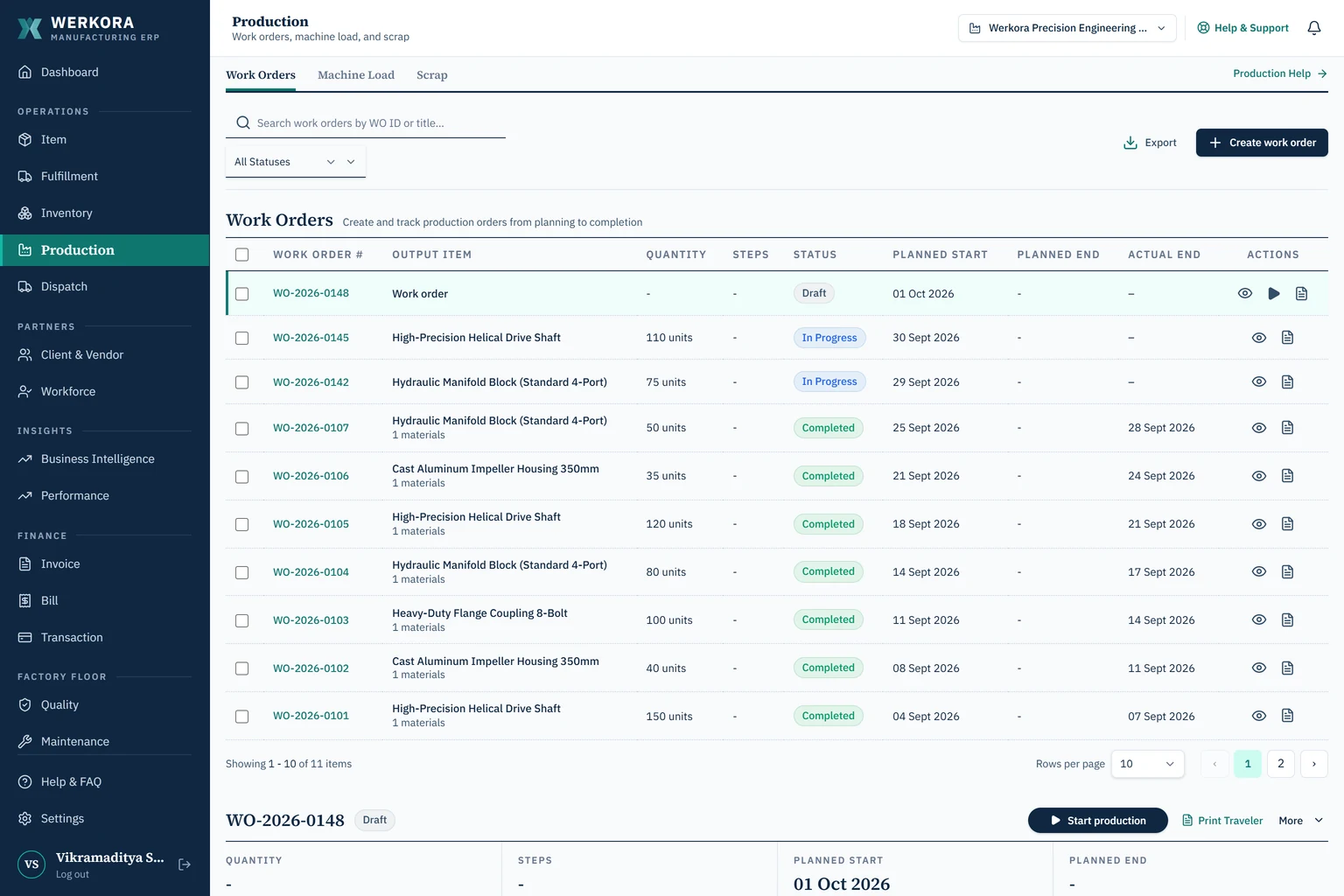
Werkora production module — work orders, BOMs and machine load
AEO Quick Answer & Key Takeaway

Auto parts manufacturers in India require strict heat number traceability from raw stock to finished components, linked Mill Test Reports (MTR), step-by-step routing, and inspection logging to satisfy customer audits. Werkora includes production tracking and batch traceability starting at ₹4,999/unit/mo.

OEM Audit Pressures on Indian Tier-2 Suppliers

India's automotive corridor spans massive industrial belts: Pune-Chakan-Talegaon in Maharashtra; Chennai-Sriperumbudur-Oragadam in Tamil Nadu; Gurgaon-Manesar-Faridabad in the NCR; and Rajkot-Ahmedabad in Gujarat. Thousands of SME factories manufacture machined gears, stamped chassis brackets, rubber seals, aluminum die-cast housings, and wiring harnesses for vehicle makers like Tata Motors, Mahindra, Maruti Suzuki, and Bajaj Auto.

Operating as a Tier-2 or Tier-3 automotive supplier means living under constant quality surveillance. Automotive OEMs enforce strict IATF 16949 standards. An unannounced vendor audit requires producing complete traceability records for a randomly selected batch in under 15 minutes: raw material heat chemistry, machine run logs, operator names, heat-treatment temperature charts, and inspection gauge calibration dates. Plants operating on paper job cards regularly fail these drills.

The Cost of PPM Defects

Automotive OEMs demand defect rates below 50 Parts Per Million (PPM). Delivering out-of-tolerance parts results in line-stoppage penalties starting at ₹50,000 per hour, warranty debits, and potential de-listing as an approved supplier.

Heat Number Traceability: Raw Billets to Machined Parts

In mechanical engineering, metallurgical composition dictates safety. A steering knuckle cast from steel with 0.05% excess phosphorus will fracture under high impact loads.

The Complete Heat Number Audit Trail:

  1. Inward Verification: Raw round bars or forged blanks are inwarded with the supplier's Mill Test Report (MTR). Lab chemists verify spectrometer carbon, manganese, and silicon percentages before moving stock from quarantine to the raw stores rack.
  2. Work Order Traveler Binding: When production planning schedules a work order, Werkora binds specific bar inventory lots to the job. The traveler displays the exact Heat Number on operation steps.
  3. Scrap & Off-Cut Segregation: Off-cuts and turning borings inherit the parent heat number classification, ensuring clean scrap sorting and accurate scrap records.
  4. Finished Good Labeling: Finished part tags record the Part Number, Werkora Batch ID, and Heat Number for unambiguous traceability.

Tool & Die Lifecycle Management: Preventing Tolerance Creep

In high-speed stamping presses and precision CNC centers, tooling wears out continuously:

  • Carbide inserts experience flank wear after 800 machining passes, altering shaft diameters by 15 microns.
  • Stamping punch pins lose their cutting edge after 30,000 strokes, producing excessive burrs on metal blanks.
  • Pressure die-casting molds suffer thermal fatigue and erosion after 80,000 shots.

Werkora links machine work order progress directly to tool asset registers. Plant engineers view real-time stroke and cycle counts, schedule preventive maintenance, track regrinding history, and automatically lock machine work orders when tools exceed approved life limits.

Preventing Rework Hours

Predictive tool lifecycle tracking prevents dimensional drift, reducing scrap and rework machining hours by up to 28% in precision CNC and stamping plants.

PPAP Level 3 & Control Plan Digitization

Before an automotive factory can supply a single production part, the customer requires an approved Production Part Approval Process (PPAP) submission, usually Level 3:

  • Design Records & Ballooned Engineering Drawings
  • Process Flow Diagram (PFD)
  • Process Failure Mode and Effects Analysis (PFMEA)
  • Control Plan with defined inspection frequencies and sample sizes
  • Measurement System Analysis (MSA / Gauge R&R)
  • Initial Process Capability Studies (Cpk / Ppk > 1.67)

Werkora stores approved Control Plans directly within the item master. When operators start an operation, the machine terminal automatically displays required inspection dimensions, gauge IDs, and frequency rules, ensuring shop floor execution mirrors approved OEM quality filings.

Managing Job Work Heat Treatment & Surface Finishing

Automotive components almost always require specialized external processing: induction hardening, case carburizing, zinc-nickel electroplating, or shot peening. Tracking these movements is both a quality requirement and a statutory GST imperative under Section 143:

  • Hardness & Plating Thickness QC: When heat-treated pins return from the vendor, Werkora enforces inward testing (e.g. Rockwell Hardness HRC 58–62 and surface plating thickness in microns) before components can proceed to final grinding.
  • Job Work Delivery Challans: Generates statutory Rule 55 Delivery Challans with linked E-Way Bills, tracking vendor balances and monitoring the 1-year deemed-sale clock.

Automotive SME Economics: Per-Seat vs Unit-Based Model

A typical Tier-2 auto ancillary plant with 12 CNC lathes, 4 VMCs, and 2 stamping lines employs:

  • 16 Machine operators & setup technicians (across 2 shifts)
  • 6 Inward, in-process, and final quality inspectors
  • 4 Tool room & maintenance technicians
  • 5 Storekeepers (raw material, finished goods, tool crib)
  • 8 Production planning, purchase, accounts, and dispatch staff

Under legacy per-user pricing ($15 to $50/user/month), licensing 39 factory personnel costs ₹7,00,000 to ₹23,00,000 annually. Consequently, plant managers buy 4 licenses for the front office and run the shop floor on clipboards, destroying live data capture.

The Werkora Unit-Based Model: At ₹4,999/unit/month on annual billing (minimum 3 units, 10 users per unit, ₹14,997/month base with 30 users included), the factory provisions 4 units (Raw Stores, CNC Machine Shop, Stamping & Tool Crib, Quality & Dispatch), granting all 40 shop-floor and front-office personnel their own logins for just ₹19,996/month total.
Operational RequirementWerkora Automotive ERPTally + Excel AddonsTier-1 Heavy ERP (SAP/QAD)
Pricing ModelUnit-Based (₹4,999/unit/mo · 10 Users/Unit)Single Desktop LicensePer-User ($70–$160/user/mo)
Heat Number & MTR LinkingNative Heat Lot GenealogyManual Stock Journal NoteNative Module
Tool & Maintenance TrackingBuilt-in Maintenance & Setup NotesNot SupportedSeparate Maintenance Module
Control Plan & Inspection GatesIntegrated Inspection GatesManual Word/Excel TemplatesHigh Configuration Cost
Shop Floor Operation TravelersStandard Feature (Mobile & Tablet)Not SupportedRequires MES Add-on
Implementation Speed5 to 10 Business Days1 to 2 Weeks (Accounting only)6 to 12 Months

Stop paying per-user software taxes in your factory

Werkora equips every shop-floor supervisor, line operator, storekeeper, and accountant with their own dedicated login with plans sized for your operation.

Frequently Asked Questions

Expert Answers for Factory Operations

How does Werkora track metallurgical heat numbers through multi-stage machining?

When raw steel coils, forgings, or castings enter the plant, storekeepers record the supplier Heat/Melt Number and attach the Mill Test Certificate (MTR) to the Goods Receipt Note. When work orders are cut, the heat number automatically carries forward across digital travelers, stamping operations, CNC turning, and finished goods inspection tags.

What happens during an OEM customer audit if a factory cannot trace heat numbers?

Tier-1 automotive OEMs (e.g. Bosch, Endurance, Motherson) and vehicle manufacturers issue immediate Quality Alerts or temporary supplier suspension if trace integrity fails. Re-qualifying a supplier can take 3 to 6 months and cost lakhs in third-party metallurgical lab re-testing.

How does the tool life tracking feature prevent dimensional rejections?

Every stamping die, CNC carbide insert, or casting mold has an engineered cycle life (e.g., 25,000 punch strokes before re-sharpening). As operators log completed units on machine terminals, Werkora accumulates cycle counts against the active tool asset. At 90% of tool life, the system alerts maintenance to schedule regrinding before dimensional tolerance drift creates scrap.

Can Werkora generate customer-specific dispatch inspection reports (COA / PDIR)?

Yes. Quality engineers log vernier, micrometer, and CMM dimensional measurements directly into Werkora. The system generates a compliant Pre-Dispatch Inspection Report (PDIR) with min/max tolerance boundaries and inspection heat numbers attached directly to the GST tax invoice and delivery challan.

AK

Abhishek Kumar

LinkedIn Profile

Senior Finance & ERP Systems Architect, Werkora

Senior accountant and enterprise systems specialist with 9+ years of experience across Indian GST/TDS compliance, SAP S/4HANA, Tally Prime, and finance automation. Direct operational background in precision instruments manufacturing and multi-jurisdictional statutory compliance with a zero-penalty record.

Cite this guide
APA, Markdown or BibTeX

Copy a citation to include this guide in your article or report.

Interactive Cost Comparison

Calculate Your Plant's Licensing Savings

Benchmark your current software bills against Werkora's unit-based pricing (10 users/unit · min 3 units).

Projected 3-Year Savings for Your Operation (3 Factory Units · 30 Users)

Save up to ₹6.8 Lakhs over 3 years

Compared to standard per-user seat pricing models like ERPNext ($13.50/user/mo).

Each unit includes 10 active user seats (Operations, Store, Accounts, Planning).

3

Base commitment minimum is 3 units (30 user seats total).

Commitment Term:

Werkora Plan

Werkora

₹14,997/mo (3 Units · 30 Seats)

Annual Cost

₹1,79,964

3-Year TCO

₹5,39,892

30 user seats (3 units × 10)

ERPNext Cloud

$13.50 / user / mo

Annual Cost (30 Users)

₹4,05,816

3-Year TCO

₹12,17,448

Save ₹6.8 Lakhs

TYASuite

₹499 / user / mo (~$6)

Annual Cost (30 Users)

₹1,79,640

3-Year TCO

₹5,38,920

Save ₹0

Zoho Creator

$8 / user / mo

Annual Cost (30 Users)

₹2,40,480

3-Year TCO

₹7,21,440

Save ₹1.8 Lakhs

SAP Business One

$50+ / user / mo

Annual Cost (30 Users)

₹15,03,000

3-Year TCO

₹45,09,000

Save ₹39.7 Lakhs

What's Included in Werkora's Plan (from ₹4,999/unit/mo · Min 3 Units):

10 Users per Factory Unit (30 Users in Base)
Minimum 3 Factory Units Included
GST Tax Invoices & Delivery Challans
BOM Formulation & Scrap Accounting
Customer, Supplier & Ledger Accounting
Batch FIFO Inventory Valuation
Shop Floor Travelers & Operation Routing
Extra Units at ₹4,999/mo (+10 users each)

Plan your ERP budget

Review the ERP buying guide or contact us to discuss the units, users, and deployment options your factory needs.

Related Manufacturing Playbooks

Explore adjacent topics in factory operations, costing, and statutory GST compliance.