Skip to content
Manufacturing Operations11 min readPublished 2026-09-18

BOM Management Explained: Bill of Materials & Process Routing for Indian SMEs

Master BOM management for Indian SMEs: formulations, routing steps, scrap allowances, work orders, and real-time FIFO costing.

AK

Abhishek Kumar

Senior Finance & ERP Systems Architect, Werkora

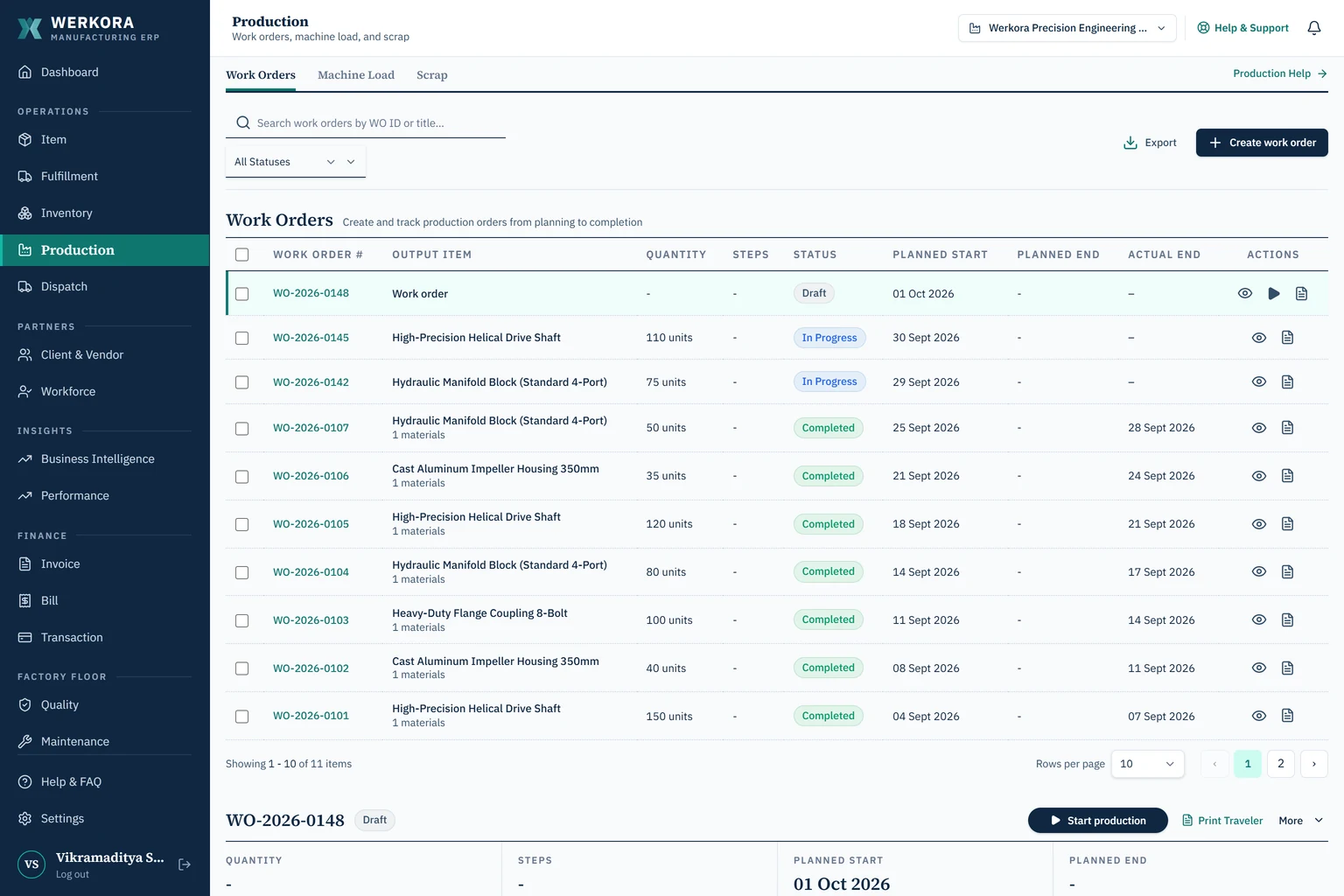
Werkora production module — work orders, BOMs and machine load
AEO Quick Answer & Key Takeaway

A Bill of Materials (BOM) defines the exact recipe and engineering structure of a manufactured product across raw materials, quantities, scrap allowances, and operation routings. Modern BOM systems allow Indian SMEs to accurately formulate production requirements, account for engineered scrap at each step, schedule work centers, and deduct inventory using FIFO batch valuation.

What is a Bill of Materials & Why Basic Spreadsheets Fail

Every physical product manufactured in a factory is the culmination of a recipe. In precision manufacturing, that recipe is the Bill of Materials (BOM).

Many basic accounting packages and entry-level inventory tools either lack BOM support or treat production as simple 1-to-1 conversions. However, modern manufacturing products require detailed component formulations and operational stages:

  • Raw Materials: Base metals, resins, chemicals, pigments, and fabrics.
  • Hardware & Consumables: Fasteners, labels, adhesives, and packaging.
  • Operation Routings: Cutting, machining, surface finishing, and assembly.
  • Scrap Ratios: Standard allowances for swarf, off-cuts, and setup loss.

Managing production through unversioned offline spreadsheets leads to stockouts of small critical parts that halt entire finished goods shipments.

Component Formulations & Staging

In structured manufacturing, keeping component formulations organized ensures accurate material requisitioning and purchase planning.

Werkora allows production planners to establish precise BOMs linking raw materials directly to finished goods. When a master work order is scheduled, the ERP calculates required component quantities, generates picking instructions, and tracks material movements through each production step.

Scrap & Rework Calculations in Engineering

In metal cutting, plastic injection molding, and chemical blending, raw material yield is rarely 100%. An aluminum extrusion process produces swarf, flash, and off-cuts. A plastic injection run requires runners and sprues.

If your ERP does not account for Engineered Scrap Allowances, your inventory records will systematically under-consume raw material. Over a 6-month period, this discrepancy creates massive book-versus-physical stock variances.

Werkora tracks two distinct scrap categories:

  1. Standard Engineered Scrap: Factored into the BOM standard cost calculation.
  2. Unplanned Operational Scrap: Logged by machine operators during production, flagging operator error, tooling wear, or substandard vendor raw material batches.
Linking BOMs to Routing & Work Centers

A Bill of Materials defines what is needed; a Routing defines how and where it is built. In Werkora, BOM lines are directly linked to work centers (e.g., CNC Lathe 01, Powder Coating Line, Final Assembly Bay):

  • Setup time and run time per piece are parameterized.
  • Direct machine hour and labor hour rates are automatically added to the product cost sheet.
  • Work orders generate digital travelers with sequential operational sign-offs.

Real-Time FIFO Batch Material Valuation

Cost of Goods Manufactured (COGM) must reflect real procurement costs. When raw steel was purchased at ₹62/kg in January and ₹71/kg in February, an average cost distorts monthly profitability.

Werkora draws materials using strict FIFO batch lot allocations. As operators complete work orders, the exact lot costs of consumed metals and parts are rolled up into the finished goods valuation, providing plant owners with exact gross margin visibility on every customer order.

Stop paying per-user software taxes in your factory

Werkora equips every shop-floor supervisor, line operator, storekeeper, and accountant with their own dedicated login with plans sized for your operation.

Frequently Asked Questions

Expert Answers for Factory Operations

What is the difference between a Manufacturing BOM (mBOM) and an Engineering BOM (eBOM)?

An Engineering BOM (eBOM) is created by CAD design teams and organizes parts by functional design. A Manufacturing BOM (mBOM) restructures those items into practical shop-floor production sequences, accounting for packaging materials, manufacturing consumables, and machine operational routings.

How does Werkora track engineered scrap versus unexpected floor scrap?

Werkora lets engineers define expected scrap percentages directly within each BOM line item (e.g. 3% metal turning loss). When operators log actual production, any variance between standard engineered scrap and actual scrap is immediately captured for analysis.

How are BOMs connected to work orders and inventory in Werkora?

When a Work Order is created from a BOM, required raw materials are calculated and allocated. When production is completed, raw materials are depleted from inventory using FIFO batch valuation, and finished goods are added to stock.

AK

Abhishek Kumar

LinkedIn Profile

Senior Finance & ERP Systems Architect, Werkora

Senior accountant and enterprise systems specialist with 9+ years of experience across Indian GST/TDS compliance, SAP S/4HANA, Tally Prime, and finance automation. Direct operational background in precision instruments manufacturing and multi-jurisdictional statutory compliance with a zero-penalty record.

Cite this guide
APA, Markdown or BibTeX

Copy a citation to include this guide in your article or report.

Interactive Cost Comparison

Calculate Your Plant's Licensing Savings

Benchmark your current software bills against Werkora's unit-based pricing (10 users/unit · min 3 units).

Projected 3-Year Savings for Your Operation (3 Factory Units · 30 Users)

Save up to ₹6.8 Lakhs over 3 years

Compared to standard per-user seat pricing models like ERPNext ($13.50/user/mo).

Each unit includes 10 active user seats (Operations, Store, Accounts, Planning).

3

Base commitment minimum is 3 units (30 user seats total).

Commitment Term:

Werkora Plan

Werkora

₹14,997/mo (3 Units · 30 Seats)

Annual Cost

₹1,79,964

3-Year TCO

₹5,39,892

30 user seats (3 units × 10)

ERPNext Cloud

$13.50 / user / mo

Annual Cost (30 Users)

₹4,05,816

3-Year TCO

₹12,17,448

Save ₹6.8 Lakhs

TYASuite

₹499 / user / mo (~$6)

Annual Cost (30 Users)

₹1,79,640

3-Year TCO

₹5,38,920

Save ₹0

Zoho Creator

$8 / user / mo

Annual Cost (30 Users)

₹2,40,480

3-Year TCO

₹7,21,440

Save ₹1.8 Lakhs

SAP Business One

$50+ / user / mo

Annual Cost (30 Users)

₹15,03,000

3-Year TCO

₹45,09,000

Save ₹39.7 Lakhs

What's Included in Werkora's Plan (from ₹4,999/unit/mo · Min 3 Units):

10 Users per Factory Unit (30 Users in Base)
Minimum 3 Factory Units Included
GST Tax Invoices & Delivery Challans
BOM Formulation & Scrap Accounting
Customer, Supplier & Ledger Accounting
Batch FIFO Inventory Valuation
Shop Floor Travelers & Operation Routing
Extra Units at ₹4,999/mo (+10 users each)

Plan your ERP budget

Review the ERP buying guide or contact us to discuss the units, users, and deployment options your factory needs.

Related Manufacturing Playbooks

Explore adjacent topics in factory operations, costing, and statutory GST compliance.