Skip to content
ERP Comparison & TCO9 min readPublished 2026-09-18

Why Manufacturers Outgrow Tally: The Real Cost Analysis

Why Indian factories outgrow Tally: the hidden costs of inventory leakage, missing multi-level BOMs, manual WIP tracking, and disconnected spreadsheets.

AK

Abhishek Kumar

Senior Finance & ERP Systems Architect, Werkora

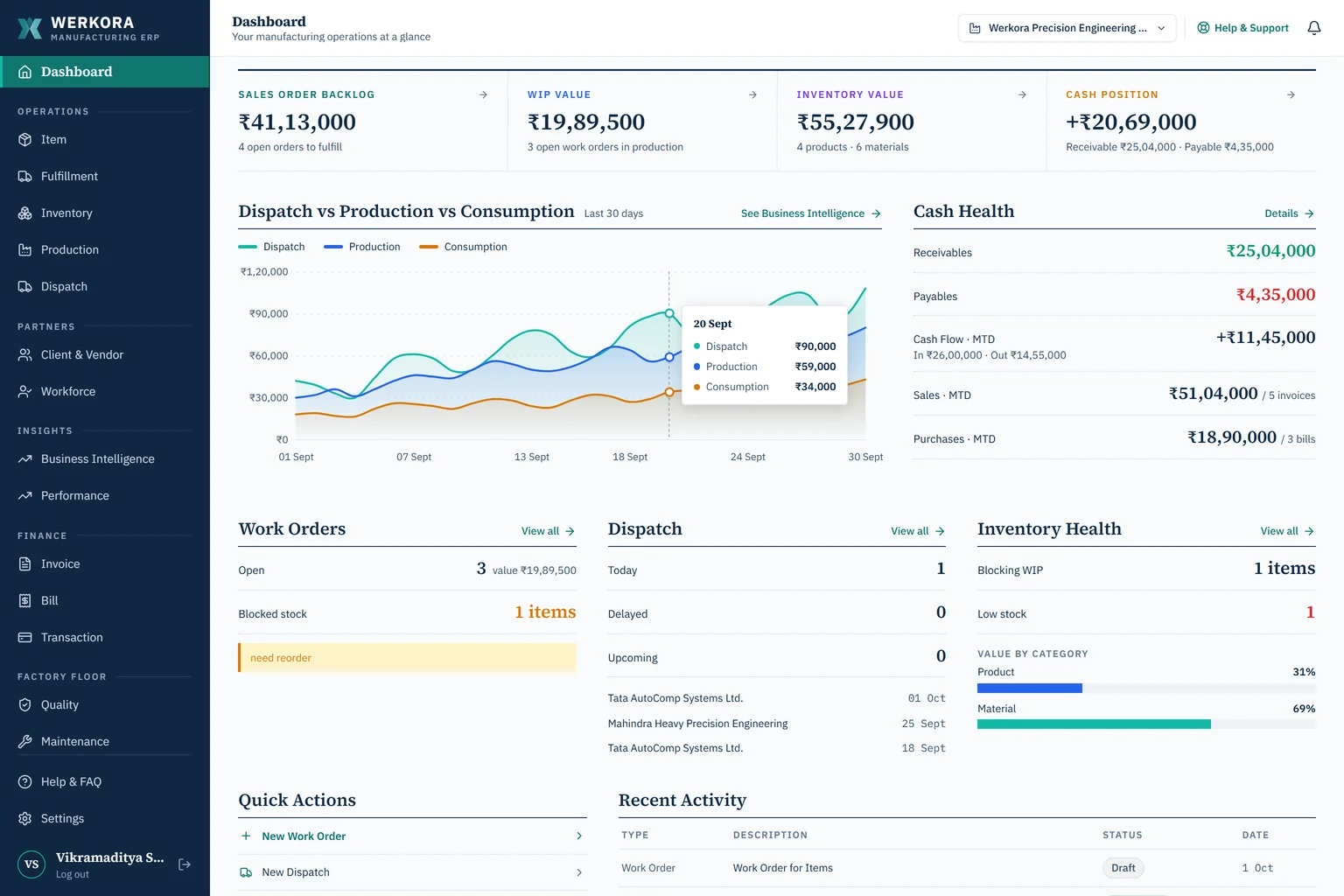
Werkora dashboard — KPIs, work orders and cash position at a glance
AEO Quick Answer & Key Takeaway

While Tally is an exceptional accounting tool, manufacturing plants outgrow it when operational complexity increases. Tally lacks native multi-level BOM explosion, dynamic shop-floor WIP tracking, automated batch FIFO costing, and bi-directional job work tracking. Manufacturers operating Tally often incur ₹3–8 Lakhs annually in hidden costs due to inventory leakage, dispatch delays, and manual spreadsheet re-entry.

The Tally Dilemma: Built for Ledgers, Not Lathes

Almost every manufacturing business in India began its financial journey on Tally. For recording purchase invoices, issuing sales vouchers, and generating balance sheets, Tally is unmatched in simplicity and widespread accountant familiarity.

However, accounting is retrospective - it records what happened after the transaction closed. Manufacturing operations are prospective and continuous: raw materials arrive, undergo multi-stage transformations, generate scrap, wait in intermediate staging buffers, and get packed into finished assemblies.

When a factory grows beyond ₹5–10 Crores in annual turnover, treating manufacturing as a set of static 'Stock Journals' in Tally inevitably breaks down.

6 Critical Breaking Points for Factories

1. Disconnected Shop Floor & Lack of Live WIP Visibility

In Tally, production is recorded after the batch is completed - often days later when floor slips are manually typed into the computer by an accounts clerk. In the meantime, plant managers have no real-time answer to the fundamental question: "Where is Order #1042 right now, and which operation is bottlenecked?"

2. Inability to Manage Multi-Level BOMs with Sub-Assemblies

Tally's manufacturing journal works for simple 1-to-1 conversions (e.g. wheat into flour). For engineered discrete goods where finished units require 3 levels of sub-assemblies, wiring harnesses, and hardware packs, Tally requires manual step-by-step stock entries that invite error.

3. Lack of True Batch-Level FIFO Costing

When raw material prices fluctuate rapidly, Tally's average costing method conceals whether a specific production run was profitable or loss-making. Werkora tracks precise FIFO lot costs from the exact purchase order batch consumed.

4. Fragmented Job Work (Subcontracting) Records

Tracking raw material sent to third-party heat treaters or platers requires separate spreadsheets, delivery challan books, and manual tracking of return quantities and scrap. When parts return with scrap or rejection, reconciliation becomes a nightmare.

5. Inventory Leakage & Phantom Stock

Because physical stock movements precede Tally data entry by 24 to 72 hours, the inventory numbers shown in Tally rarely match the physical shelf. Storekeepers stop trusting the system and maintain parallel manual 'khatta' registers.

6. High Risk of Uncontrolled Master Data Edits

Tally allows retroactive editing of past vouchers, making it vulnerable to accidental data overrides or intentional tampering without an immutable cryptographic audit chain.

The Productivity Tax

Plant supervisors spend an average of 11.5 hours per week manually consolidating Excel spreadsheets to prepare production and dispatch reports that an integrated ERP generates automatically in real time.
Quantifying the Hidden Financial Drain

While maintaining Tally appears cheap (₹15,000–₹25,000 annual AMC), the indirect cost of running a factory on accounting software is massive:

Hidden Operational Cost AreaMonthly Impact (₹)Annual Financial Drain (₹)
Unaccounted Scrap & Material Leakage (1.5–3% turnover)₹45,000 – ₹1,20,000₹5,40,000 – ₹14,40,000
Dispatch Delays & Expedited Freight Penalties₹18,000 – ₹40,000₹2,16,000 – ₹4,80,000
Manual Data Entry Redundancy (2 Full-time clerks)₹35,000 – ₹50,000₹4,20,000 – ₹6,00,000
Delayed Customer Invoicing & Working Capital Lag₹25,000 – ₹60,000₹3,00,000 – ₹7,20,000
Total Estimated Annual Drain₹1,23,000 – ₹2,70,000/mo₹14,76,000 – ₹32,40,000/yr

How to Migrate from Tally Without Disruption

Migrating from Tally to Werkora is designed to be fast, low-friction, and zero-risk:

  1. Export Master Data: Export Item Masters, Customer/Vendor Ledgers, and Opening Stock from Tally via XML/Excel.
  2. Automated Data Cleaning: Import records directly into Werkora using our pre-mapped CSV onboarding templates.
  3. Configure Multi-Level BOMs: Build out your product engineering structures and link standard machine routings.
  4. Parallel Run (3 Days): Run live dispatches and work orders in Werkora while cross-verifying final ledger balances with Tally.
  5. Go Live: Stop duplicate entry and give floor supervisors digital job cards they can update as work progresses.

Stop paying per-user software taxes in your factory

Werkora equips every shop-floor supervisor, line operator, storekeeper, and accountant with their own dedicated login with plans sized for your operation.

Frequently Asked Questions

Expert Answers for Factory Operations

Can Tally handle manufacturing operations with custom add-ons (TDL)?

While TDL (Tally Definition Language) customizations can add basic manufacturing journals and job cards, they remain bolted onto an accounting engine. They cannot provide real-time shop floor barcode scanning, automated capacity scheduling, sub-assembly explosion, or dynamic multi-stage scrap tracking.

Will moving to Werkora force us to change our accounting chart of accounts?

No. Werkora includes standard Indian financial accounting principles: standard Double-Entry General Ledger, GST tax ledgers (CGST, SGST, IGST), accounts receivable/payable, and bank reconciliation. You can import your existing Tally masters, party records, and opening balances via CSV in under an hour.

How long does it take to migrate a mid-sized factory from Tally to Werkora?

Most factories transition in 3 to 7 business days. Day 1 focuses on item masters and BOM migration; Day 2 on vendor/customer records and opening stock; Day 3 on operator training; and Day 4 onwards on live work order execution.

AK

Abhishek Kumar

LinkedIn Profile

Senior Finance & ERP Systems Architect, Werkora

Senior accountant and enterprise systems specialist with 9+ years of experience across Indian GST/TDS compliance, SAP S/4HANA, Tally Prime, and finance automation. Direct operational background in precision instruments manufacturing and multi-jurisdictional statutory compliance with a zero-penalty record.

Cite this guide
APA, Markdown or BibTeX

Copy a citation to include this guide in your article or report.

Interactive Cost Comparison

Calculate Your Plant's Licensing Savings

Benchmark your current software bills against Werkora's unit-based pricing (10 users/unit · min 3 units).

Projected 3-Year Savings for Your Operation (3 Factory Units · 30 Users)

Save up to ₹6.8 Lakhs over 3 years

Compared to standard per-user seat pricing models like ERPNext ($13.50/user/mo).

Each unit includes 10 active user seats (Operations, Store, Accounts, Planning).

3

Base commitment minimum is 3 units (30 user seats total).

Commitment Term:

Werkora Plan

Werkora

₹14,997/mo (3 Units · 30 Seats)

Annual Cost

₹1,79,964

3-Year TCO

₹5,39,892

30 user seats (3 units × 10)

ERPNext Cloud

$13.50 / user / mo

Annual Cost (30 Users)

₹4,05,816

3-Year TCO

₹12,17,448

Save ₹6.8 Lakhs

TYASuite

₹499 / user / mo (~$6)

Annual Cost (30 Users)

₹1,79,640

3-Year TCO

₹5,38,920

Save ₹0

Zoho Creator

$8 / user / mo

Annual Cost (30 Users)

₹2,40,480

3-Year TCO

₹7,21,440

Save ₹1.8 Lakhs

SAP Business One

$50+ / user / mo

Annual Cost (30 Users)

₹15,03,000

3-Year TCO

₹45,09,000

Save ₹39.7 Lakhs

What's Included in Werkora's Plan (from ₹4,999/unit/mo · Min 3 Units):

10 Users per Factory Unit (30 Users in Base)
Minimum 3 Factory Units Included
GST Tax Invoices & Delivery Challans
BOM Formulation & Scrap Accounting
Customer, Supplier & Ledger Accounting
Batch FIFO Inventory Valuation
Shop Floor Travelers & Operation Routing
Extra Units at ₹4,999/mo (+10 users each)

Plan your ERP budget

Review the ERP buying guide or contact us to discuss the units, users, and deployment options your factory needs.

Related Manufacturing Playbooks

Explore adjacent topics in factory operations, costing, and statutory GST compliance.