Chemical Manufacturing ERP: Formula Security, Batch Potency & Hazardous Goods Compliance
A guide for chemical, polymer, paint, and agrochemical manufacturers: dynamic potency, formula masking, GHS/SDS sheets, and PCB compliance.
Abhishek Kumar
An operational guide for Indian pharma MSMEs: Revised Schedule M, electronic Batch Manufacturing Records (e-BMR), API potency scaling, and CDSCO audit readiness.
Abhishek Kumar
Senior Finance & ERP Systems Architect, Werkora

Manufacturing execution in pharmaceutical and health sciences demands rigorous quality control, batch traceability, and audit documentation aligned with GMP guidelines. Werkora enables formulation plants to manage structured BOM formulations, step-by-step batch routing, quarantine-to-release inventory gates, and complete transactional audit trails with predictable unit-based pricing.
The regulatory landscape for India's pharmaceutical manufacturing sector has permanently changed. Following quality alerts and contaminated cough syrup incidents in overseas markets, the Ministry of Health and Family Welfare notified the Revised Schedule M (Good Manufacturing Practices) rules in January 2024.
For more than 8,500 small and medium pharmaceutical manufacturing units across Baddi, Ahmedabad, Hyderabad, Ankleshwar, and Sikkim, Revised Schedule M is no longer optional. It mandates:
State and Central drug inspectors have initiated joint inspections across pharmaceutical MSME hubs. Units lacking documented computerized systems and traceable batch records risk manufacturing license suspension.
Traditional paper records are prone to illegible handwriting, missed sign-offs, and post-shift transcription errors.
Digital batch records replace loose paper with guided operational workflows on shop-floor terminals:
Drug regulatory agencies evaluate electronic software against the ALCOA+ data integrity principles:
Werkora provides an immutable, append-only system audit trail capturing user ID, timestamp, old value, and new value across inventory movements, work orders, and financial vouchers.
| Schedule M Requirement | Traditional Paper BMR | Werkora Manufacturing ERP |
|---|---|---|
| Dispensing Verification | Manual paper ledger tick mark | Lot-verified material issue & traveler logging |
| Formulation & Yield | Hand calculations prone to decimal error | Standardized BOM formulation with yield tracking |
| Audit Trail Logging | Corrections made with whitener or cross-out | Immutable timestamped digital log with user tracking |
| Quarantine Gatekeeping | Physical color tags on drums (risk of slip) | Software system hold on unreleased lot numbers |
| Certificate of Analysis | Transcribed Word document | Direct digital lab entry with inspection records |
| Batch Traceability | Manual ledger search taking days | Fast lot tracking across GRN, WIP, and dispatch |
In chemical and pharmaceutical manufacturing, Active Pharmaceutical Ingredients (APIs) rarely arrive at exactly 100.0% theoretical potency on an 'as-is' basis. Variations in moisture content (Loss on Drying - LOD) and chemical assay require batch charge compensation.
For example, to produce 1,00,000 tablets of Metformin Hydrochloride 500 mg:
Standard Active Requirement = 1,00,000 tablets × 0.500 kg = 50.00 kg pure API
If the issued raw material lot has a certificate assay of 97.5% and a water content of 1.2%:
Active Potency Factor = 97.5% × (1 - 0.012) = 96.33% effective potency
Adjusted Quantity to Dispense = 50.00 kg / 0.9633 = 51.905 kg
To keep the total tablet weight constant at the specified 650 mg target, the extra 1.905 kg of API must be offset by reducing filler excipients (such as Microcrystalline Cellulose or Dicalcium Phosphate). Werkora performs this auto-scaling calculation automatically upon raw material allocation, preventing under-dosing or tablet weight variations.
Configuring primary and balancing filler excipients in your formulation BOM prevents manual calculation mistakes during dispensary stage handovers.
Strict segregation between Quarantined, Under Test, Approved, and Rejected material is a foundational GMP tenet. Werkora enforces digital quarantine gates across three manufacturing phases:
n = 1 + √N.Under Schedule M, drug manufacturers must conduct stability studies (accelerated at 40°C/75% RH and real-time at 30°C/75% RH) for commercial batches. Werkora schedules automated alerts for 3-month, 6-month, 9-month, and annual testing pull dates, preventing missed stability testing intervals.
In addition, plants must prove their ability to execute a full mock product recall within 2 to 4 hours. Because Werkora maintains an integrated genealogy from API supplier heat lot through granulation, blister packing, and customer wholesale dispatch invoices, generating a complete distribution list for any affected batch takes less than 60 seconds.
Pharma manufacturing facilities require high system participation across multiple functional teams: dispensary operators, granulation technicians, QC analysts, QA documentation officers, storekeepers, and maintenance engineers. In a 75-person facility, licensing software at ₹1,500 to ₹4,000 per user per month results in prohibitive costs of ₹13,00,000 to ₹36,00,000 annually.
The Werkora Unit Model: At ₹4,999/unit/month (minimum 3 units, 10 users per unit, ₹14,997/month base with 30 users included), a formulation plant can deploy 5 units (Store & Dispensary, Granulation & Compression, Packaging & Serialization, Quality Control/QA, and Regulatory/Finance) covering 50 employees for only ₹24,995/month total.
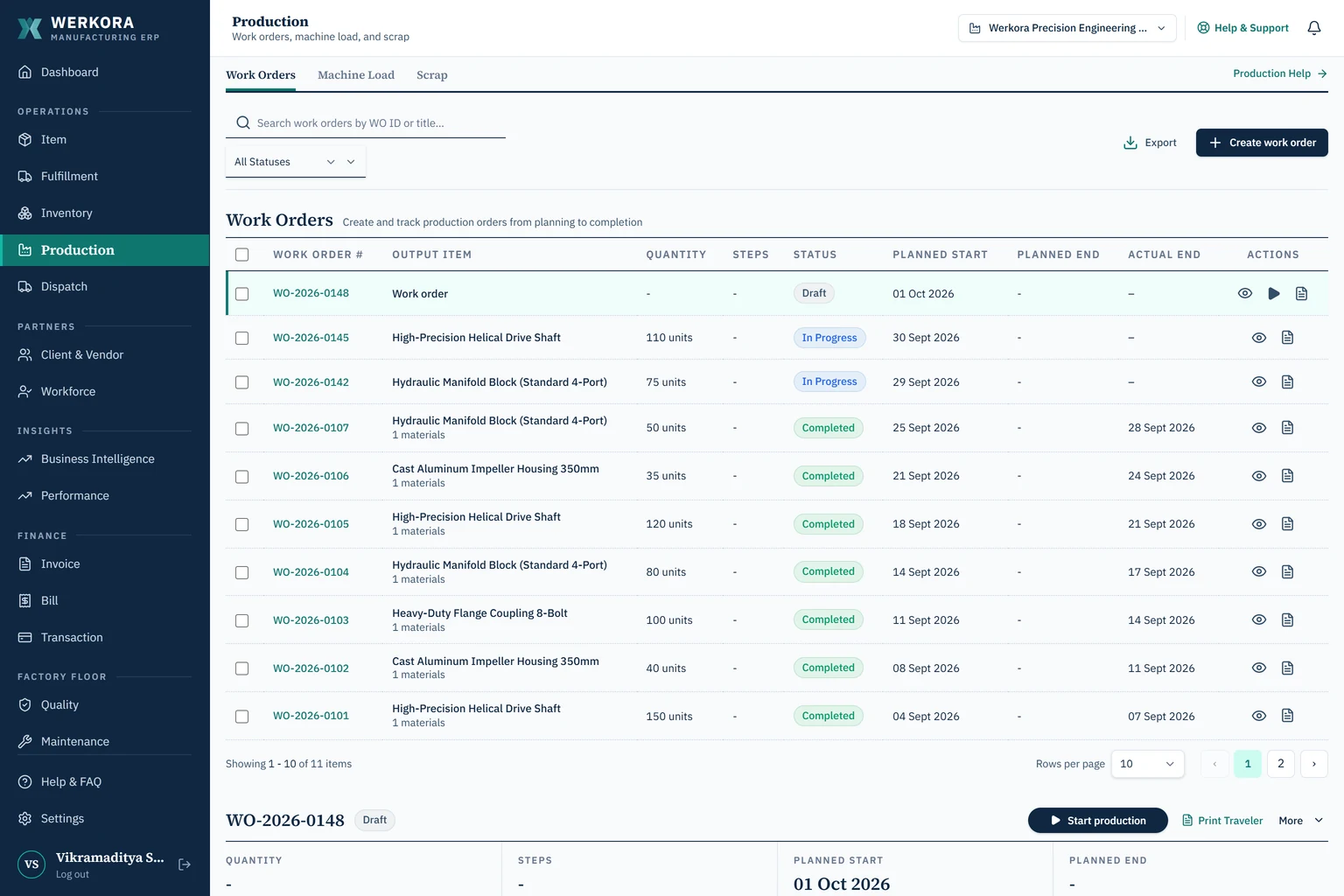
Werkora equips every shop-floor supervisor, line operator, storekeeper, and accountant with their own dedicated login with plans sized for your operation.
Under the Ministry of Health and Family Welfare notification, small and medium enterprises with turnover below ₹250 crore were given 12 months to upgrade manufacturing practices to Revised Schedule M, which aligns Indian GMP with international WHO and PIC/S standards.
Werkora enables formulation teams to define standard recipe quantities, operation steps, and expected yield or scrap allowances for each production batch, accurately calculating raw material requirements and costing.
Yes. Werkora provides granular role-based permissions, allowing organizations to require supervisor and QA verification before releasing work orders or approving finished goods inventory.
Senior Finance & ERP Systems Architect, Werkora
Senior accountant and enterprise systems specialist with 9+ years of experience across Indian GST/TDS compliance, SAP S/4HANA, Tally Prime, and finance automation. Direct operational background in precision instruments manufacturing and multi-jurisdictional statutory compliance with a zero-penalty record.
Copy a citation to include this guide in your article or report.
Benchmark your current software bills against Werkora's unit-based pricing (10 users/unit · min 3 units).
Projected 3-Year Savings for Your Operation (3 Factory Units · 30 Users)
Save up to ₹6.8 Lakhs over 3 years
Compared to standard per-user seat pricing models like ERPNext ($13.50/user/mo).
Each unit includes 10 active user seats (Operations, Store, Accounts, Planning).
Base commitment minimum is 3 units (30 user seats total).
Commitment Term:
₹14,997/mo (3 Units · 30 Seats)
Annual Cost
₹1,79,964
3-Year TCO
₹5,39,892
$13.50 / user / mo
Annual Cost (30 Users)
₹4,05,816
3-Year TCO
₹12,17,448
₹499 / user / mo (~$6)
Annual Cost (30 Users)
₹1,79,640
3-Year TCO
₹5,38,920
$8 / user / mo
Annual Cost (30 Users)
₹2,40,480
3-Year TCO
₹7,21,440
$50+ / user / mo
Annual Cost (30 Users)
₹15,03,000
3-Year TCO
₹45,09,000
Review the ERP buying guide or contact us to discuss the units, users, and deployment options your factory needs.
Explore adjacent topics in factory operations, costing, and statutory GST compliance.
A guide for chemical, polymer, paint, and agrochemical manufacturers: dynamic potency, formula masking, GHS/SDS sheets, and PCB compliance.
Abhishek Kumar
The complete guide to ERP for Indian food and beverage plants: FEFO inventory, FSSAI Schedule IV compliance, recipe scaling, and 2-hour batch recall.
Abhishek Kumar
Master BOM management for Indian SMEs: formulations, routing steps, scrap allowances, work orders, and real-time FIFO costing.
Abhishek Kumar
A 2026 evaluation guide for Indian manufacturing SMEs: pricing models, discrete vs batch MRP, GST e-invoicing, and a 10-point vendor scorecard.
Abhishek Kumar