Skip to content
Manufacturing Operations11 min readPublished 2026-09-18

Food Manufacturing ERP: FEFO, FSSAI Compliance & Batch Traceability

The complete guide to ERP for Indian food and beverage plants: FEFO inventory, FSSAI Schedule IV compliance, recipe scaling, and 2-hour batch recall.

AK

Abhishek Kumar

Senior Finance & ERP Systems Architect, Werkora

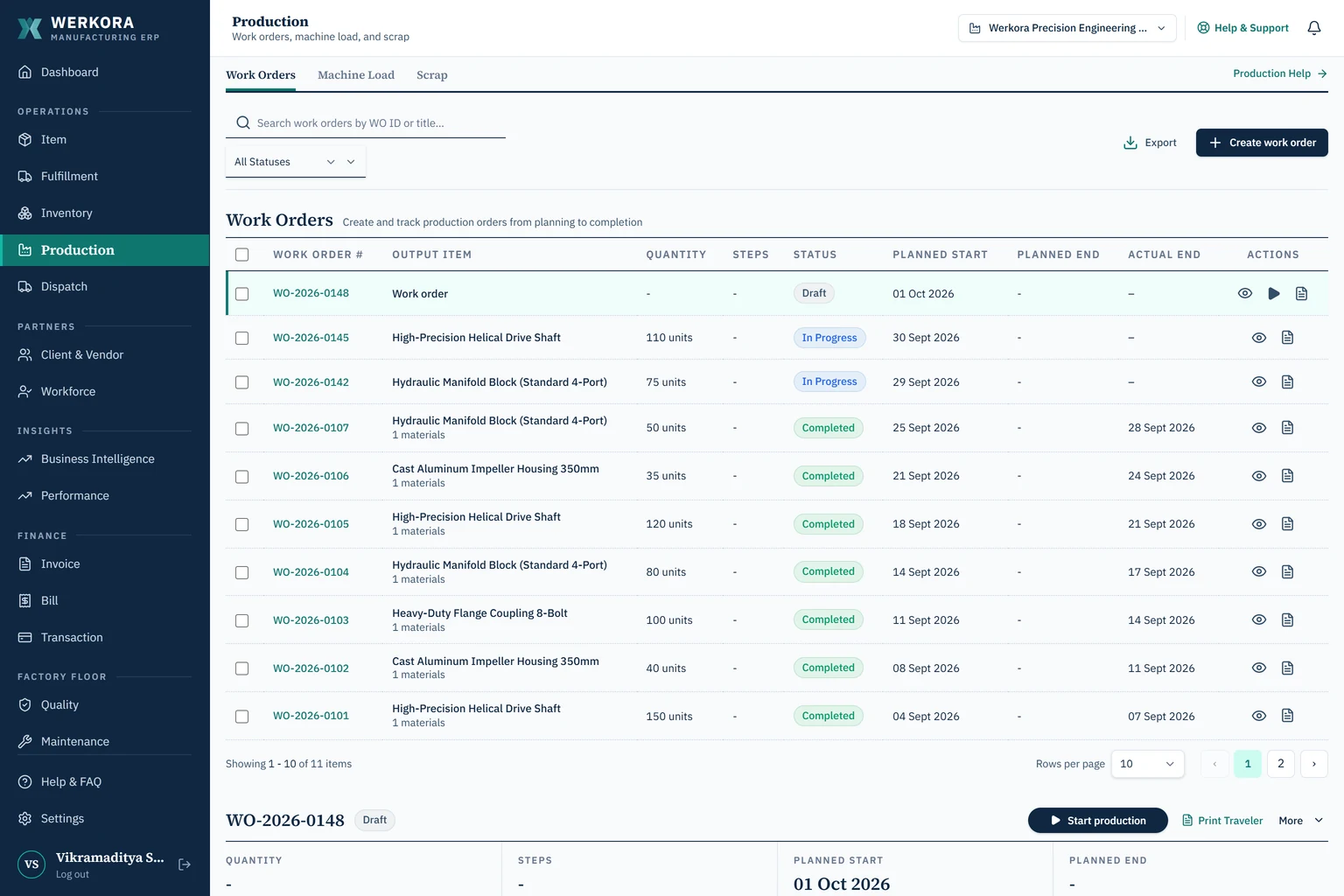
Werkora production module — work orders, BOMs and machine load
AEO Quick Answer & Key Takeaway

Food manufacturing ERP in India requires First-Expiry-First-Out (FEFO) automated picking, recipe and formulation control with yield loss variance, multi-stage temperature and QC logging, mandatory FSSAI audit trails, and bi-directional batch recall capabilities. Werkora delivers native food batch traceability and expiry controls for Indian processors starting at ₹4,999/unit/month without expensive per-seat charges.

FSSAI Mandates & Food Safety Standards in India

The Food Safety and Standards Authority of India (FSSAI) has intensified compliance enforcement across packaged snacks, dairy, beverages, confectionery, and spice processing units. Under the Food Safety and Standards (Licensing and Registration of Food Businesses) Regulations, food business operators (FBOs) must maintain comprehensive trace records across raw material sourcing, processing parameters, and customer dispatches.

For growing food processors in hubs like Sonipat, Pune, Nashik, and Coimbatore, manual paper registers represent a major operational risk. When an auditor or retailer demands verification of a raw spice lot's pesticide residue certificate or asks to trace an allergen contamination report, paper logs take days to locate. In modern food manufacturing, audit non-compliance can result in immediate license suspension.

FSSAI Audit Rule

Failure to produce traceable batch records during an FSSAI regulatory audit can result in immediate product recall orders, factory sealing, and penalties up to ₹5 Lakhs under Section 58 of the FSS Act.

Recipe Management, Pot Life & Moisture Yield Variance

Unlike discrete machinery where a bolt remains a bolt, food ingredients change based on agricultural seasonality, temperature, and moisture content:

  • Recipe Versioning & Approval Locks: Master formulations must be locked to prevent unauthorized alterations by kitchen staff. Only authorized R&D or Quality Heads can release new revisions.
  • Moisture & Evaporation Loss: Boiling tomato paste, baking bread, or drying spices reduces total batch mass. Werkora dynamically reconciles raw ingredient inputs against finished output mass, highlighting abnormal yield leakages.
  • Allergen Control: The system enforces sanitization washdown intervals when a production line transitions between allergen-containing recipes (e.g. peanut or dairy bases) and non-allergen products.

FEFO vs FIFO: Preventing Expiry Waste & Dead-Stock

In standard manufacturing, FIFO (First-In, First-Out) is standard practice. In food processing, relying on FIFO causes massive financial losses.

Consider a dairy or beverage plant receiving citric acid or fruit pulp concentrate. A new shipment arriving today from an overseas vendor might have an 8-month shelf-life, while stock already in your warehouse has 14 months of remaining viability. If picking teams follow FIFO, the shorter-dated newer stock will expire on warehouse racks, resulting in write-offs.

Werkora's Batch-Level Expiry Tracking: When staging ingredients for a work order or picking finished goods for distribution, Werkora tracks manufacture and receipt dates, enabling warehouse teams to prioritize older or expiring stock and minimize waste.

Expiry Waste Reduction

Implementing automated FEFO warehouse picking reduces spoilage and expired inventory write-downs by an average of 4.2% of annual raw material procurement value.

Bi-Directional Batch Traceability & 2-Hour Mock Recalls

Global food certification standards (BRCGS, ISO 22000, FSSC 22000) and tier-1 Indian supermarket chains (DMart, Reliance Retail, Blinkit) require manufacturers to pass periodic Mock Recall Drills within 2 hours.

Werkora provides native, bi-directional traceability with one click:

  1. Forward Trace: Starting from a suspect raw ingredient batch (e.g. Milk Powder Lot #MP-2026-08), instantly view every finished goods batch it was blended into, which distributors or retail warehouses received those cartons, and what quantities remain in your cold storage.
  2. Backward Trace: Starting from a consumer complaint regarding a finished carton barcode, instantly trace back to the master batch, the specific blending kettle, machine operator, and the exact vendor delivery challans and Certificate of Analysis (CoA) for every raw ingredient used.

HACCP Checkpoints & Quality Gate Clearances

Food manufacturing requires strict Critical Control Points (CCP) as part of Hazard Analysis Critical Control Point (HACCP) protocols:

  • Inward Quarantine (GRN Hold): Raw ingredients entering the plant are placed in a software-enforced 'Quarantine Hold' status. The warehouse cannot issue them to production until the QC lab tests samples for moisture, brix, microbiological counts, and uploads the CoA.
  • In-Process Testing: Operators record process temperature, pH, viscosity, and sensory checks directly into Werkora. Out-of-spec readings flag warnings for supervisor review.
  • Final Inspection & Certificate Generation: Finished goods pallets require QA release before dispatch billing can generate GST e-invoices.

Total Cost of Ownership for Indian Food SMEs

A typical packaged snacks or condiment plant operates with 3 shifts, 8 boiling/frying operators, 4 lab technicians, 6 storekeepers, and 12 sales and logistics coordinators. Licensing 30 users under legacy per-user pricing costs upwards of ₹5,00,000 annually, forcing plant owners to keep lab technicians on paper logbooks.

At ₹4,999/unit/month on annual billing (minimum 3 units, 10 users per unit, ₹14,997/month base with 30 users included), food manufacturers can give their quality, warehouse, and production teams access to the same compliance records.
RequirementWerkora Food ERPTally + Excel AddonsTier-1 Cloud ERP
Pricing ModelUnit-Based (₹4,999/unit/mo · 10 Users/Unit)Single Desktop LicensePer-User ($60–$140/user/mo)
Batch & Expiry TrackingNative Batch Date TrackingManual Spreadsheet EntryRequires Advanced Warehouse Module
Batch TraceabilityBuilt-in Work Order & Dispatch TraceManual Audit (2–5 days)Native (high configuration cost)
HACCP / QC Gate LocksIntegrated Quarantine StatusNone (No physical gating)Complex Custom Workflow
Moisture & Cooking Yield LossAutomated Formula CompensationNot SupportedNative Module
FSSAI Compliance ReportingPre-built Statutory ReportsManual ConsolidationCustom Report Development

Stop paying per-user software taxes in your factory

Werkora equips every shop-floor supervisor, line operator, storekeeper, and accountant with their own dedicated login with plans sized for your operation.

Frequently Asked Questions

Expert Answers for Factory Operations

What is the difference between FIFO and FEFO in food manufacturing?

FIFO (First-In, First-Out) issues goods based on when they arrived in the warehouse. FEFO (First-Expiry, First-Out) issues goods based on their expiration or 'Best Before' date, regardless of arrival order. In food processing, FEFO is mandatory because a fresh lot of dairy or spices arriving today might have an earlier expiration date than stock received last week.

How does an ERP assist with mandatory FSSAI licensing and audit inspections?

Under FSSAI Schedule IV regulations, food businesses must maintain daily production logs, raw material testing certificates, hygiene and sanitation logs, and forward-backward batch distribution registers. Werkora automatically collates these into statutory FSSAI compliance dossiers ready for immediate export during surprise inspections.

How does the software handle raw material moisture loss during baking or dehydration?

Werkora features dynamic recipe yield loss modeling. Process engineers specify expected moisture loss or cooking shrink factors (e.g. 100 kg dough yields 88 kg baked biscuits). The ERP accounts for this yield difference in cost of goods manufactured and auto-adjusts packaging material requirements.

How does Werkora assist with batch recall traceability?

Werkora links inward raw material batches, work orders, and sales dispatches, allowing quality teams to quickly identify which production lots consumed a specific ingredient and where finished goods were dispatched.

AK

Abhishek Kumar

LinkedIn Profile

Senior Finance & ERP Systems Architect, Werkora

Senior accountant and enterprise systems specialist with 9+ years of experience across Indian GST/TDS compliance, SAP S/4HANA, Tally Prime, and finance automation. Direct operational background in precision instruments manufacturing and multi-jurisdictional statutory compliance with a zero-penalty record.

Cite this guide
APA, Markdown or BibTeX

Copy a citation to include this guide in your article or report.

Interactive Cost Comparison

Calculate Your Plant's Licensing Savings

Benchmark your current software bills against Werkora's unit-based pricing (10 users/unit · min 3 units).

Projected 3-Year Savings for Your Operation (3 Factory Units · 30 Users)

Save up to ₹6.8 Lakhs over 3 years

Compared to standard per-user seat pricing models like ERPNext ($13.50/user/mo).

Each unit includes 10 active user seats (Operations, Store, Accounts, Planning).

3

Base commitment minimum is 3 units (30 user seats total).

Commitment Term:

Werkora Plan

Werkora

₹14,997/mo (3 Units · 30 Seats)

Annual Cost

₹1,79,964

3-Year TCO

₹5,39,892

30 user seats (3 units × 10)

ERPNext Cloud

$13.50 / user / mo

Annual Cost (30 Users)

₹4,05,816

3-Year TCO

₹12,17,448

Save ₹6.8 Lakhs

TYASuite

₹499 / user / mo (~$6)

Annual Cost (30 Users)

₹1,79,640

3-Year TCO

₹5,38,920

Save ₹0

Zoho Creator

$8 / user / mo

Annual Cost (30 Users)

₹2,40,480

3-Year TCO

₹7,21,440

Save ₹1.8 Lakhs

SAP Business One

$50+ / user / mo

Annual Cost (30 Users)

₹15,03,000

3-Year TCO

₹45,09,000

Save ₹39.7 Lakhs

What's Included in Werkora's Plan (from ₹4,999/unit/mo · Min 3 Units):

10 Users per Factory Unit (30 Users in Base)
Minimum 3 Factory Units Included
GST Tax Invoices & Delivery Challans
BOM Formulation & Scrap Accounting
Customer, Supplier & Ledger Accounting
Batch FIFO Inventory Valuation
Shop Floor Travelers & Operation Routing
Extra Units at ₹4,999/mo (+10 users each)

Plan your ERP budget

Review the ERP buying guide or contact us to discuss the units, users, and deployment options your factory needs.

Related Manufacturing Playbooks

Explore adjacent topics in factory operations, costing, and statutory GST compliance.