Skip to content
GST & Compliance12 min readPublished 2026-09-18

Multi-Plant Manufacturing ERP for Indian Enterprises: Inter-Branch Stock Transfers & GST Compliance

Manage multiple factories under single or distinct GSTINs: inter-branch stock transfers, delivery challans vs tax invoices, and cross-unit MRP.

AK

Abhishek Kumar

Senior Finance & ERP Systems Architect, Werkora

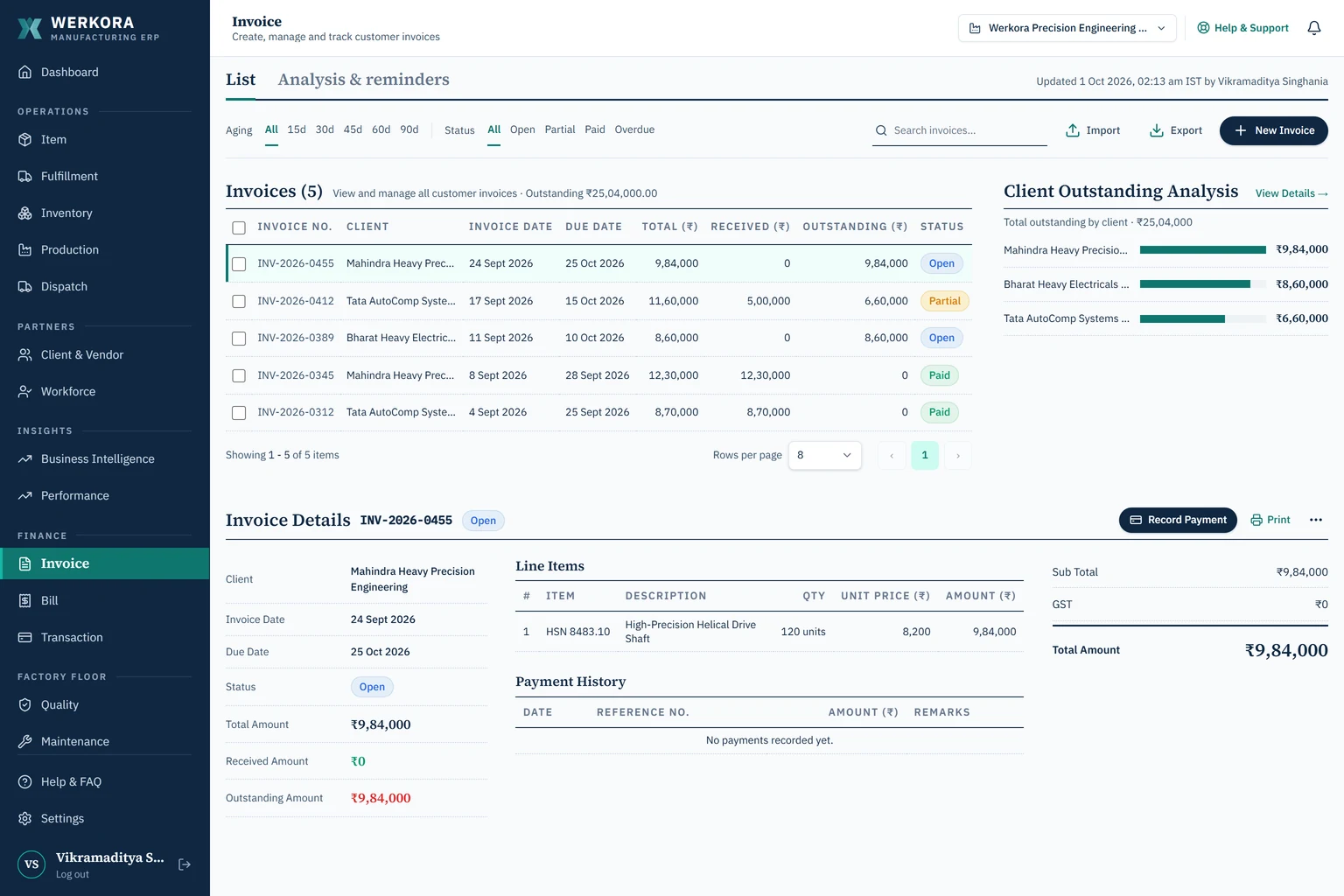
Werkora invoice module — GST e-invoicing and IRN status
AEO Quick Answer & Key Takeaway

A multi-plant manufacturing ERP coordinates operations across multiple factory locations and warehouses. When sister plants share the same state GSTIN, inventory transfers move under Rule 55 Delivery Challans with e-way bills. When plants operate across different state borders, transfers constitute a supply under GST Section 25(4) requiring a Tax Invoice and IGST payment under Rule 28 valuation. Werkora unifies multi-plant MRP and GST compliance across all locations.

Single GSTIN vs Distinct GSTIN Multi-Plant Architecture

As Indian manufacturing businesses expand from a single shed into multiple specialized facilities-such as a foundry in Kolhapur feeding a precision CNC machining unit in Pune, or an injection molding plant in Greater Noida feeding an assembly line in Haridwar-managing inventory and statutory compliance becomes complex.

Indian GST law recognizes two distinct structural models for multi-location manufacturing:

  1. Intrastate Multi-Unit (Single GSTIN): Multiple plants or warehouses located within the same state registered under a single 15-digit GST number as additional places of business (APOB). Goods movements between these units are internal transfers without tax levy.
  2. Interstate Multi-Unit (Distinct Persons): Factories operating in different states. Under Section 25(4) of the CGST Act, separate state registrations belonging to the same PAN are legally classified as 'Distinct Persons'. Every stock transfer across state borders is legally deemed a taxable supply under Schedule I, even without monetary payment.
GST Trap on Interstate Transfers

Treating interstate transfers to your own branch as an internal delivery challan without issuing a tax invoice and charging IGST violates Section 7 and invites penalties equal to 100% of the unpaid tax.

Rule 55 Delivery Challan vs Section 7 Tax Invoice

Selecting the correct dispatch document depends strictly on the GSTIN relationship between the dispatching and receiving factory units:

Transfer ScenarioStatutory DocumentGST ApplicableE-Way Bill Type
Same State, Same GSTIN (e.g. Pune Plant to Chakan Warehouse)Rule 55 Delivery ChallanNil (Internal transfer)Inward / Outward: 'Others' / 'Transfer'
Different States (e.g. Pune Plant to Haridwar Unit)Section 31 Tax InvoiceIGST charged at standard HSN rateOutward Supply: 'Supply'
Same State, Separate GSTIN (Special Economic Zone - SEZ)Tax Invoice / Bill of ExportZero-rated with LUT or IGST paymentOutward: 'Export to SEZ'
Material Sent for Subcontract Job WorkRule 55 Job Work ChallanNil (Subject to Section 143 return)Outward: 'Job Work'

GST Rule 28 Valuation for Distinct Persons

When issuing a Tax Invoice for an interstate stock transfer between distinct persons, determining the invoice valuation is governed by Rule 28 of the CGST Rules:

  • Open Market Value: The value of goods of like kind and quality sold to third-party customers.
  • Cost Plus 10% (Rule 30): 110% of the cost of manufacturing if open market value cannot be determined.
  • Second Proviso to Rule 28 (Full ITC Rule): Where the recipient branch is entitled to claim 100% Input Tax Credit on the inward supply, the value declared in the invoice is deemed to be the open market value of the goods.

This second proviso gives multi-plant manufacturers legal flexibility to invoice goods at standard inventory valuation cost, provided the receiving plant claims the corresponding IGST credit in its GSTR-3B.

Generating Automated E-Way Bills for Inter-Unit Stock Movement

Any inter-plant transfer where consignment value exceeds ₹50,000 (or ₹1,00,000 in specific states such as Maharashtra and Tamil Nadu for intrastate movement) requires an electronic way bill prior to vehicle movement:

  1. Part-A Generation: Populated automatically from the transfer document (HSN code, consignment value, dispatch unit GSTIN, recipient unit GSTIN).
  2. Part-B Vehicle Assignment: Linked to the company's dedicated transport vehicle number or third-party logistics (3PL) transporter ID.
  3. Validity Window: Valid for 1 day per 200 km traveled. For a 1,400 km transfer between Chennai and Gurgaon, the e-way bill carries a 7-day validity window.

Werkora captures e-way bill particulars and generates verified dispatch challans the moment the loading manifest is confirmed, eliminating transport documentation discrepancies.
Multi-Plant Material Requirements Planning (Cross-Plant MRP)

In disconnected systems, Plant B issues a raw material purchase order to an external vendor, unaware that Plant A has 8,000 kg of excess steel coils sitting in its dead-stock warehouse 40 kilometers away.

Werkora's cross-plant MRP evaluates inventory availability across all organizational units simultaneously:

  • Internal Transfer Requisitions: If a sister plant holds surplus stock above its safety threshold, the system suggests an internal transfer rather than an external purchase order.
  • Inter-Plant Transit Tracking: Stock in transit between units is tracked in a dedicated 'In-Transit Store' account, preventing inventory disappearance during multi-day highway haulage.
  • Goods Receipt Note (GRN) Acknowledgment: When the truck arrives at the receiving plant, the gate team performs a verification against the original dispatch manifest. Discrepancies (transit damage or weight loss) are logged immediately.
Working Capital Optimization

Centralizing cross-plant stock visibility eliminates duplicate raw material purchases and reduces overall corporate safety stock by 18% to 26%.

Unit-Wise Costing and Consolidated Financial Statements

Multi-plant managing directors require dual perspectives: unit-level profitability to hold individual plant managers accountable, and consolidated corporate financial statements for bankers and board reviews:

  • Unit P&L Isolation: Each plant operates as a cost center with isolated revenues, direct materials, power expenses, labor payroll, and overhead absorption.
  • Inter-Company Profit Elimination: When semi-finished components are transferred at cost-plus margins between sister plants, Werkora automatically eliminates unrealized inter-unit profits from consolidated balance sheets at period close.
  • Centralized Vendor Negotiations: Aggregates purchase volumes across all units, allowing procurement teams to negotiate tier-1 volume discounts with major steel, polymer, and chemical mills.

Deploying Multi-Unit Operations in Werkora

Werkora's architecture was engineered specifically for multi-unit manufacturing organizations:

  1. Unit-Based Scaling: Instead of charging per-user fees that penalize multi-site operations, Werkora charges ₹4,999/unit/month (minimum 3 units, 10 users per unit, ₹14,997/month base with 30 users included). Adding a new satellite plant or dispatch warehouse requires just one additional unit subscription.
  2. Granular Role-Based Permissions: Store managers and operators only access their assigned unit's inventory and work orders, while managing directors and CFOs switch between units with a single click.
  3. Unified Tax Visibility: Accurately isolates state-wise sales registers, delivery challans, and input tax ledgers across all operating units.

Stop paying per-user software taxes in your factory

Werkora equips every shop-floor supervisor, line operator, storekeeper, and accountant with their own dedicated login with plans sized for your operation.

Frequently Asked Questions

Expert Answers for Factory Operations

Is IGST payable when transferring stock between company-owned factories in different states?

Yes. Under Section 25(4) of the CGST Act, establishments of the same legal entity registered in different states are treated as 'Distinct Persons'. Even though there is no monetary sale consideration, Schedule I treats interstate stock transfers as a taxable supply requiring a formal Tax Invoice and IGST payment.

Can an enterprise use Rule 55 delivery challans for intrastate plant transfers?

Yes. If Plant A (foundry) and Plant B (machine shop) are located within the same state and registered under the exact same GSTIN, movements between them do not trigger GST tax invoices. The goods travel under a statutory Rule 55 Delivery Challan accompanied by an e-way bill with transaction type 'Others' or 'Line Item Transfer'.

How does Werkora handle cross-plant inventory visibility?

Werkora gives centralized production planners real-time visibility into raw materials, WIP, and finished goods across all factory units, while restricting local machine operators to their own plant unit. Planners can initiate an internal replenishment order that generates transit documents automatically.

AK

Abhishek Kumar

LinkedIn Profile

Senior Finance & ERP Systems Architect, Werkora

Senior accountant and enterprise systems specialist with 9+ years of experience across Indian GST/TDS compliance, SAP S/4HANA, Tally Prime, and finance automation. Direct operational background in precision instruments manufacturing and multi-jurisdictional statutory compliance with a zero-penalty record.

Cite this guide
APA, Markdown or BibTeX

Copy a citation to include this guide in your article or report.

Interactive Cost Comparison

Calculate Your Plant's Licensing Savings

Benchmark your current software bills against Werkora's unit-based pricing (10 users/unit · min 3 units).

Projected 3-Year Savings for Your Operation (3 Factory Units · 30 Users)

Save up to ₹6.8 Lakhs over 3 years

Compared to standard per-user seat pricing models like ERPNext ($13.50/user/mo).

Each unit includes 10 active user seats (Operations, Store, Accounts, Planning).

3

Base commitment minimum is 3 units (30 user seats total).

Commitment Term:

Werkora Plan

Werkora

₹14,997/mo (3 Units · 30 Seats)

Annual Cost

₹1,79,964

3-Year TCO

₹5,39,892

30 user seats (3 units × 10)

ERPNext Cloud

$13.50 / user / mo

Annual Cost (30 Users)

₹4,05,816

3-Year TCO

₹12,17,448

Save ₹6.8 Lakhs

TYASuite

₹499 / user / mo (~$6)

Annual Cost (30 Users)

₹1,79,640

3-Year TCO

₹5,38,920

Save ₹0

Zoho Creator

$8 / user / mo

Annual Cost (30 Users)

₹2,40,480

3-Year TCO

₹7,21,440

Save ₹1.8 Lakhs

SAP Business One

$50+ / user / mo

Annual Cost (30 Users)

₹15,03,000

3-Year TCO

₹45,09,000

Save ₹39.7 Lakhs

What's Included in Werkora's Plan (from ₹4,999/unit/mo · Min 3 Units):

10 Users per Factory Unit (30 Users in Base)
Minimum 3 Factory Units Included
GST Tax Invoices & Delivery Challans
BOM Formulation & Scrap Accounting
Customer, Supplier & Ledger Accounting
Batch FIFO Inventory Valuation
Shop Floor Travelers & Operation Routing
Extra Units at ₹4,999/mo (+10 users each)

Plan your ERP budget

Review the ERP buying guide or contact us to discuss the units, users, and deployment options your factory needs.

Related Manufacturing Playbooks

Explore adjacent topics in factory operations, costing, and statutory GST compliance.