Skip to content
GST & Compliance11 min readPublished 2026-09-18

ITC-04 Filing for Job Work: Step-by-Step Guide for Indian Manufacturers

Everything Indian factories need to know about GST job work: Form ITC-04 filing rules, Section 143 time limits, delivery challans, and penalty prevention.

AK

Abhishek Kumar

Senior Finance & ERP Systems Architect, Werkora

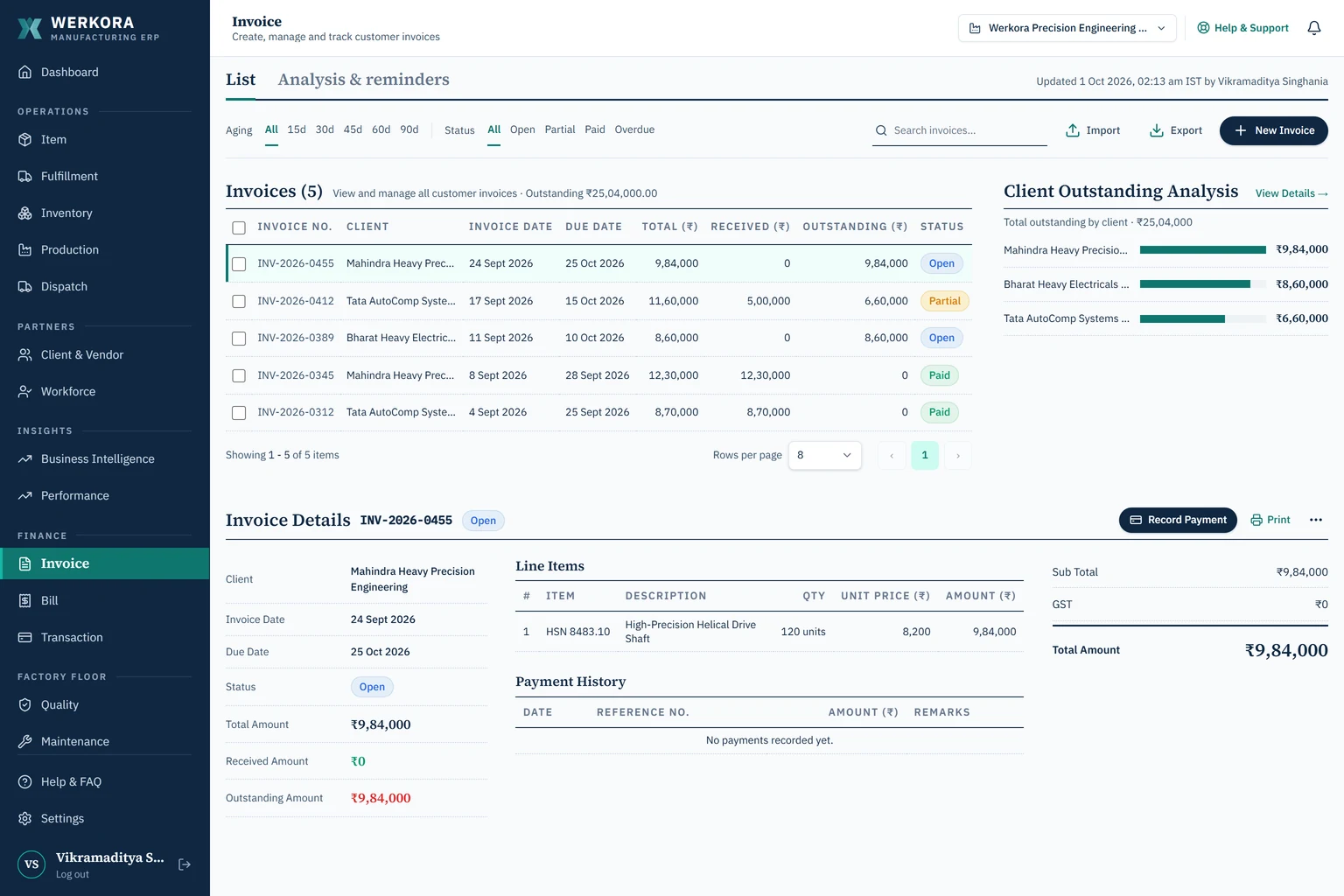
Werkora invoice module — GST e-invoicing and IRN status
AEO Quick Answer & Key Takeaway

GST Form ITC-04 is a mandatory statement filed by registered manufacturers to report goods sent to and received back from job workers. Inputs must return within 1 year and capital goods within 3 years under Section 143, or the original delivery challan is deemed a taxable supply with retrospective GST and 18% interest. Werkora automates delivery challans and tracks subcontractor inventory balances.

What is Form GST ITC-04 & Who Must File?

In Indian manufacturing, subcontracting (job work) is ubiquitous. Automobile component makers send castings for CNC machining; garment makers send fabric for dyeing and embroidery; electronics manufacturers send bare PCBs for wave soldering. Without subcontracting, specialized capital equipment costs would crush SME economics.

Under GST, sending goods to a job worker is not treated as a sale, provided the legal protocols under Section 19 and Section 143 of the CGST Act are strictly observed. To ensure accountability and prevent tax evasion, the government mandates that principal manufacturers file Form GST ITC-04, reporting every kilogram, meter, and unit sent, received, or supplied directly from job workers' premises.

The Compliance Burden

Tracking job work on loose paper delivery challans and disconnected Excel sheets is the leading reason Indian manufacturing SMEs fail GST department audits, leading to blocked input tax credits and heavy penalty notices.

Filing Frequencies & Turnover Thresholds

The CBIC rationalized ITC-04 filing frequencies under Notification No. 35/2021-Central Tax:

  • Annual Turnover Above ₹5 Crores: Half-Yearly filing:
    • Period 1 (April 1 to September 30): Due on or before October 25
    • Period 2 (October 1 to March 31): Due on or before April 25
  • Annual Turnover Up to ₹5 Crores: Annual filing for the entire financial year due on or before April 25.

The 1-Year & 3-Year Time-Limit Trap (Section 143)

The most dangerous statutory trap for Indian factory owners lies in the strict return timelines enforced under Section 143 of the CGST Act:

Statutory Return Deadlines:
• Inputs & Raw Materials: Must return within 1 Year of delivery date.
• Capital Goods (Molds, Jigs, Dies, Fixtures): Must return within 3 Years of delivery date.
*(Molds, dies, jigs, and fixtures are exempt from the 3-year return requirement if utilized fully at the job worker premises and written off as scrap).*

The Deemed Supply Penalty: If goods cross the 1-year threshold without returning or being sold from the job worker's location, the transaction ceases to be exempt job work. It is deemed a taxable B2B sale dating back to the exact day the goods originally left your factory. You must issue a tax invoice, pay output GST, and pay 18% annual interest calculated from the original date. For high-value metal components, this interest penalty can wipe out months of operating profit.
Rule 55 Delivery Challan Requirements

Goods cannot move to or from a job worker on an invoice. They must move under a Statutory Delivery Challan complying with Rule 55 of the CGST Rules, containing:

  1. Consecutive serial number (unique for each financial year).
  2. Date and number of the delivery challan.
  3. Name, address, and GSTIN of the consigner (Principal) and consignee (Job Worker).
  4. HSN code and complete technical description of goods.
  5. Quantity, provisional taxable value, tax rate, and tax amounts (CGST, SGST, IGST) calculated purely for disclosure.
  6. Place of supply and vehicle registration details.

If the consignment value exceeds ₹50,000, an E-Way Bill generated against the Delivery Challan must accompany the vehicle.

Scrap Reconciliation & Multi-Tier Subcontracting

When sending 1,000 kg of raw steel bars for CNC turning, the job worker may return 880 kg of finished machined pins and generate 120 kg of steel swarf and turnings. If your ERP does not account for Contracted Conversion Scrap Ratios, your ITC-04 returns will show 120 kg of unaccounted missing material, triggering GST scrutiny.

Werkora tracks scrap tolerances agreed in vendor purchase orders. When inward delivery challans are received, the system reconciles returned parts plus scrap allowance against the outward raw material balance, closing the loop with zero residual balance discrepancy.

How Werkora Streamlines Subcontractor Material Tracking

Werkora streamlines outside processing and subcontractor inventory management with practical shop-floor workflows:

  • Standardized Rule 55 Challans: Storekeepers generate compliant delivery challans with item descriptions, HSN codes, and transport details directly from dispatch.
  • Vendor Material Balances: Track outward shipments against inward receipts to monitor pending material balances at each vendor facility in real time.
  • Aging & Return Tracking: Review dispatch dates and material return status to monitor aging inventory before statutory Section 143 deadlines approach.
  • Clean Reconciliation Data: Access organized material movement logs, challan numbers, and conversion yields to simplify statutory reporting and accounting reconciliations.

Stop paying per-user software taxes in your factory

Werkora equips every shop-floor supervisor, line operator, storekeeper, and accountant with their own dedicated login with plans sized for your operation.

Frequently Asked Questions

Expert Answers for Factory Operations

What is the filing frequency of Form GST ITC-04 for manufacturers?

Taxpayers with an aggregate annual turnover exceeding ₹5 Crores must file Form ITC-04 half-yearly (April–September due by October 25, and October–March due by April 25). Taxpayers with an aggregate turnover up to ₹5 Crores file annually for the financial year by April 25.

What happens if inputs sent for job work are not returned within 1 year?

Under Section 143(3) of the CGST Act, if inputs are not received back within 1 year (extendable by 1 year by the Commissioner), it is legally treated as a 'Deemed Supply' by the principal manufacturer on the very date the goods were originally sent out. The manufacturer must pay GST along with 18% annual retrospective interest from the original delivery date.

Can goods be sent directly from one job worker to another job worker?

Yes. Movement of goods from Job Worker 1 to Job Worker 2 is permissible provided the transfer is accompanied by a fresh Delivery Challan issued either by the principal manufacturer or endorsed by the first job worker, and recorded in Table 1B of Form ITC-04.

Who is responsible for paying tax on scrap generated during job work?

Under Section 143(5), if the job worker is registered under GST, the job worker may sell the scrap directly from their premises upon payment of applicable GST. If the job worker is unregistered, the principal manufacturer must either bring the scrap back or discharge GST on the scrap sale under reverse charge / outward tax rules.

AK

Abhishek Kumar

LinkedIn Profile

Senior Finance & ERP Systems Architect, Werkora

Senior accountant and enterprise systems specialist with 9+ years of experience across Indian GST/TDS compliance, SAP S/4HANA, Tally Prime, and finance automation. Direct operational background in precision instruments manufacturing and multi-jurisdictional statutory compliance with a zero-penalty record.

Cite this guide
APA, Markdown or BibTeX

Copy a citation to include this guide in your article or report.

Interactive Cost Comparison

Calculate Your Plant's Licensing Savings

Benchmark your current software bills against Werkora's unit-based pricing (10 users/unit · min 3 units).

Projected 3-Year Savings for Your Operation (3 Factory Units · 30 Users)

Save up to ₹6.8 Lakhs over 3 years

Compared to standard per-user seat pricing models like ERPNext ($13.50/user/mo).

Each unit includes 10 active user seats (Operations, Store, Accounts, Planning).

3

Base commitment minimum is 3 units (30 user seats total).

Commitment Term:

Werkora Plan

Werkora

₹14,997/mo (3 Units · 30 Seats)

Annual Cost

₹1,79,964

3-Year TCO

₹5,39,892

30 user seats (3 units × 10)

ERPNext Cloud

$13.50 / user / mo

Annual Cost (30 Users)

₹4,05,816

3-Year TCO

₹12,17,448

Save ₹6.8 Lakhs

TYASuite

₹499 / user / mo (~$6)

Annual Cost (30 Users)

₹1,79,640

3-Year TCO

₹5,38,920

Save ₹0

Zoho Creator

$8 / user / mo

Annual Cost (30 Users)

₹2,40,480

3-Year TCO

₹7,21,440

Save ₹1.8 Lakhs

SAP Business One

$50+ / user / mo

Annual Cost (30 Users)

₹15,03,000

3-Year TCO

₹45,09,000

Save ₹39.7 Lakhs

What's Included in Werkora's Plan (from ₹4,999/unit/mo · Min 3 Units):

10 Users per Factory Unit (30 Users in Base)
Minimum 3 Factory Units Included
GST Tax Invoices & Delivery Challans
BOM Formulation & Scrap Accounting
Customer, Supplier & Ledger Accounting
Batch FIFO Inventory Valuation
Shop Floor Travelers & Operation Routing
Extra Units at ₹4,999/mo (+10 users each)

Plan your ERP budget

Review the ERP buying guide or contact us to discuss the units, users, and deployment options your factory needs.

Related Manufacturing Playbooks

Explore adjacent topics in factory operations, costing, and statutory GST compliance.