Skip to content
GST & Compliance10 min readPublished 2026-09-18

GST Invoicing & Dispatch Compliance for Manufacturing Companies: Complete Guide

The complete statutory guide to GST invoicing and dispatch compliance for Indian factories: tax rules, e-way bills, delivery challans, and audit readiness.

AK

Abhishek Kumar

Senior Finance & ERP Systems Architect, Werkora

Werkora invoice module — GST e-invoicing and IRN status
AEO Quick Answer & Key Takeaway

Under Indian GST law, all B2B manufacturing supplies require strict statutory tax compliance, including valid HSN codes, CGST/SGST/IGST calculation, transporter documentation, and delivery challans for subcontracting. A compliant manufacturing ERP generates structured tax invoices, records e-way bill details, prints delivery challans for outside job work, and maintains complete audit trails from raw material GRN to customer delivery.

The Statutory Framework & Mandatory Thresholds

The Central Board of Indirect Taxes and Customs (CBIC) has steadily lowered the e-invoicing threshold to bring all mid-market and SME manufacturers under mandatory electronic compliance. Today, any enterprise whose aggregate annual turnover exceeds ₹5 Crores in any preceding financial year must generate an electronic invoice for all B2B supplies, exports, and credit/debit notes.

For factory owners, non-compliance is not merely an accounting inconvenience - it halts trucks at highway checkposts, attracts 200% tax penalties, and damages supplier relationships when buyers cannot claim Input Tax Credit (ITC).
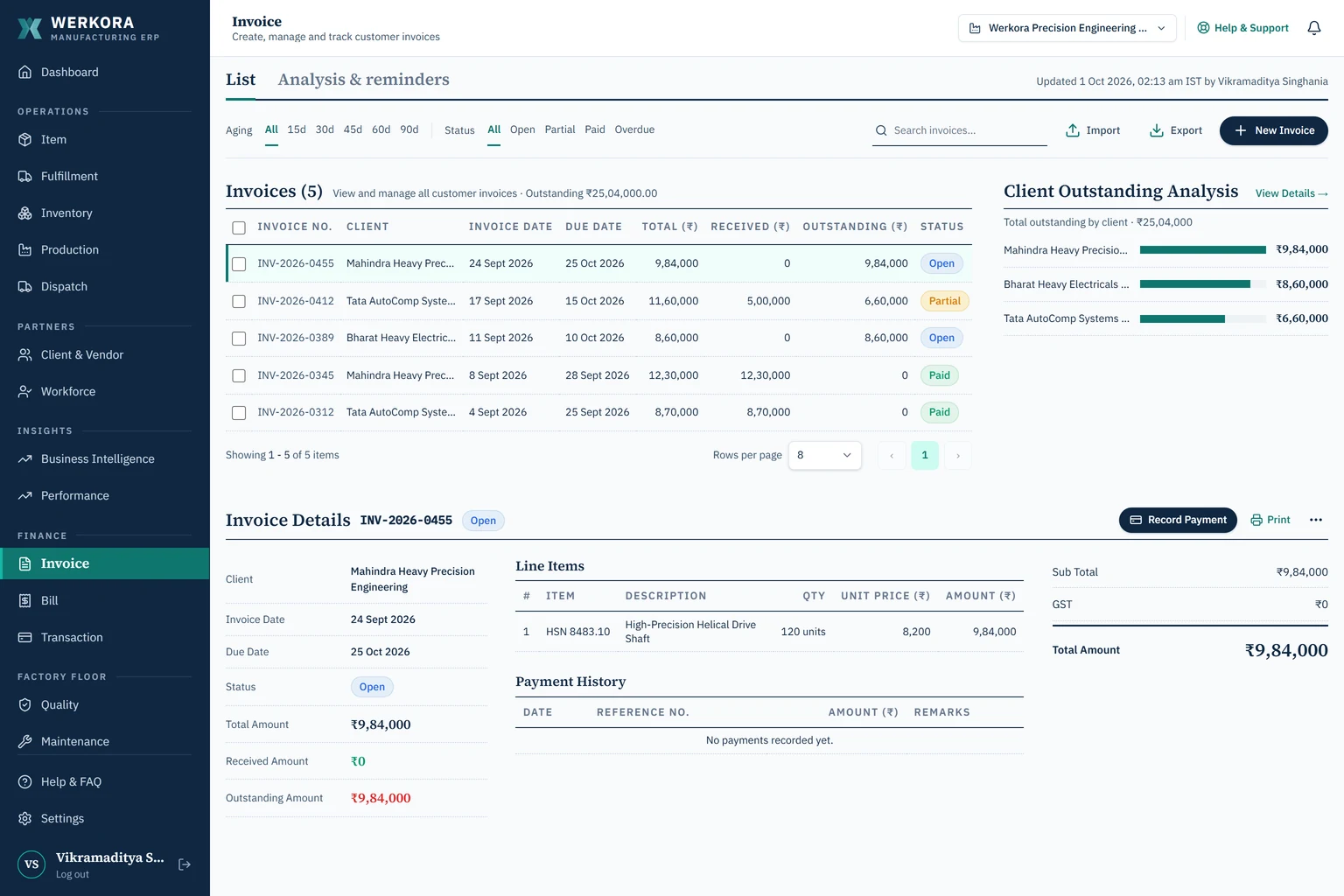
The Dispatch & GST Invoicing Workflow for Factories

In a manual workflow, the dispatch department weighs the vehicle, prepares a packing list on paper, hands it to accounts, waits for accounts to calculate tax rates and verify HSN codes, and brings paper copies back to the security gate. This process causes unnecessary delays at the factory gate.

The Werkora Dispatch Engine:

  1. Dispatch Verification: Storekeepers verify finished goods against the Sales Order.
  2. Automated Tax Calculation: The ERP automatically applies HSN-specific tax rates (CGST + SGST for intrastate, IGST for interstate dispatches).
  3. Transport Documentation: Record transporter name, vehicle registration number, and e-way bill reference directly on the dispatch record.
  4. Integrated Printout: Generate clean, professional GST tax invoices and delivery challans formatted with statutory details ready for driver handoff and portal reconciliation.
Eliminate Gate Congestion

Integrated dispatch verification and automated tax invoicing significantly reduce factory gate truck turnaround times.

E-Way Bill Compliance & Transport Documentation

Moving consignments over ₹50,000 requires valid transport documentation and e-way bills under Rule 138 of the CGST Rules. Werkora captures vehicle numbers, transporter IDs, and invoice particulars directly within the dispatch module.

This allows dispatch teams to keep shipping records, delivery challans, and e-way bill references synchronized without discrepancy between the physical truck and accounts.

Job Work Delivery Challans & Subcontractor Tracking

Job work is an essential component of Indian manufacturing. Semi-finished parts undergo CNC machining at one vendor and electroplating at another before returning for final assembly. Under Section 143 of the CGST Act, raw materials sent for job work must return within 1 year (3 years for capital goods), or they are legally treated as a deemed taxable supply.

Werkora's Subcontractor & Challan Management:

  • Generates standard Delivery Challans with item descriptions, HSN codes, quantities, and agreed scrap allowances.
  • Maintains clear material ledgers of pending balances at each job worker facility.
  • Tracks dispatch dates to help production and accounts teams monitor aging material before statutory deadlines.
  • Provides inward receipt matching to record converted goods and scrap returns accurately.

Audit Defensibility & GSTR-2B Matching

GST audits demand end-to-end trace integrity. When tax officers audit an invoice, they cross-examine:

  • The purchase order and inward Goods Receipt Note (GRN).
  • The QC inspection memo approving the material.
  • The specific work order where the material was converted.
  • The outward sales invoice and dispatch weighbridge slip.

Werkora links all five transactional records into an immutable audit chain, ensuring your enterprise is 100% audit-ready at all times.

Stop paying per-user software taxes in your factory

Werkora equips every shop-floor supervisor, line operator, storekeeper, and accountant with their own dedicated login with plans sized for your operation.

Frequently Asked Questions

Expert Answers for Factory Operations

Can an invoice be amended or cancelled after dispatch?

Under GST regulations, once an invoice is dispatched with an active transport document, cancellation or quantity adjustments must be executed via statutory Credit Notes or Debit Notes in compliance with GST Rule 54.

What happens if goods are transported without a valid GST tax invoice or delivery challan?

Under GST Rule 48, any goods moving between business premises must be accompanied by a valid tax invoice, bill of supply, or delivery challan. Moving goods without valid documentation exposes consignments to detention under Section 129 of the CGST Act.

How does Werkora handle delivery challans for outside job workers?

Werkora generates statutory GST Delivery Challans when raw materials or semi-finished goods leave for outside processing. When items return, the system records inward receipts against outward shipments, tracks scrap or conversion yield, and maintains an accurate vendor material ledger.

AK

Abhishek Kumar

LinkedIn Profile

Senior Finance & ERP Systems Architect, Werkora

Senior accountant and enterprise systems specialist with 9+ years of experience across Indian GST/TDS compliance, SAP S/4HANA, Tally Prime, and finance automation. Direct operational background in precision instruments manufacturing and multi-jurisdictional statutory compliance with a zero-penalty record.

Cite this guide
APA, Markdown or BibTeX

Copy a citation to include this guide in your article or report.

Interactive Cost Comparison

Calculate Your Plant's Licensing Savings

Benchmark your current software bills against Werkora's unit-based pricing (10 users/unit · min 3 units).

Projected 3-Year Savings for Your Operation (3 Factory Units · 30 Users)

Save up to ₹6.8 Lakhs over 3 years

Compared to standard per-user seat pricing models like ERPNext ($13.50/user/mo).

Each unit includes 10 active user seats (Operations, Store, Accounts, Planning).

3

Base commitment minimum is 3 units (30 user seats total).

Commitment Term:

Werkora Plan

Werkora

₹14,997/mo (3 Units · 30 Seats)

Annual Cost

₹1,79,964

3-Year TCO

₹5,39,892

30 user seats (3 units × 10)

ERPNext Cloud

$13.50 / user / mo

Annual Cost (30 Users)

₹4,05,816

3-Year TCO

₹12,17,448

Save ₹6.8 Lakhs

TYASuite

₹499 / user / mo (~$6)

Annual Cost (30 Users)

₹1,79,640

3-Year TCO

₹5,38,920

Save ₹0

Zoho Creator

$8 / user / mo

Annual Cost (30 Users)

₹2,40,480

3-Year TCO

₹7,21,440

Save ₹1.8 Lakhs

SAP Business One

$50+ / user / mo

Annual Cost (30 Users)

₹15,03,000

3-Year TCO

₹45,09,000

Save ₹39.7 Lakhs

What's Included in Werkora's Plan (from ₹4,999/unit/mo · Min 3 Units):

10 Users per Factory Unit (30 Users in Base)
Minimum 3 Factory Units Included
GST Tax Invoices & Delivery Challans
BOM Formulation & Scrap Accounting
Customer, Supplier & Ledger Accounting
Batch FIFO Inventory Valuation
Shop Floor Travelers & Operation Routing
Extra Units at ₹4,999/mo (+10 users each)

Plan your ERP budget

Review the ERP buying guide or contact us to discuss the units, users, and deployment options your factory needs.

Related Manufacturing Playbooks

Explore adjacent topics in factory operations, costing, and statutory GST compliance.