Skip to content
GST & Compliance10 min readPublished 2026-09-18

E-Way Bill Rules for Manufacturing Companies: Validity, Part-B & Multi-Vehicle Automation

A compliance guide for factory dispatch managers: ₹50,000 threshold, distance-based validity, Part-A vs Part-B updates, and ERP automation.

AK

Abhishek Kumar

Senior Finance & ERP Systems Architect, Werkora

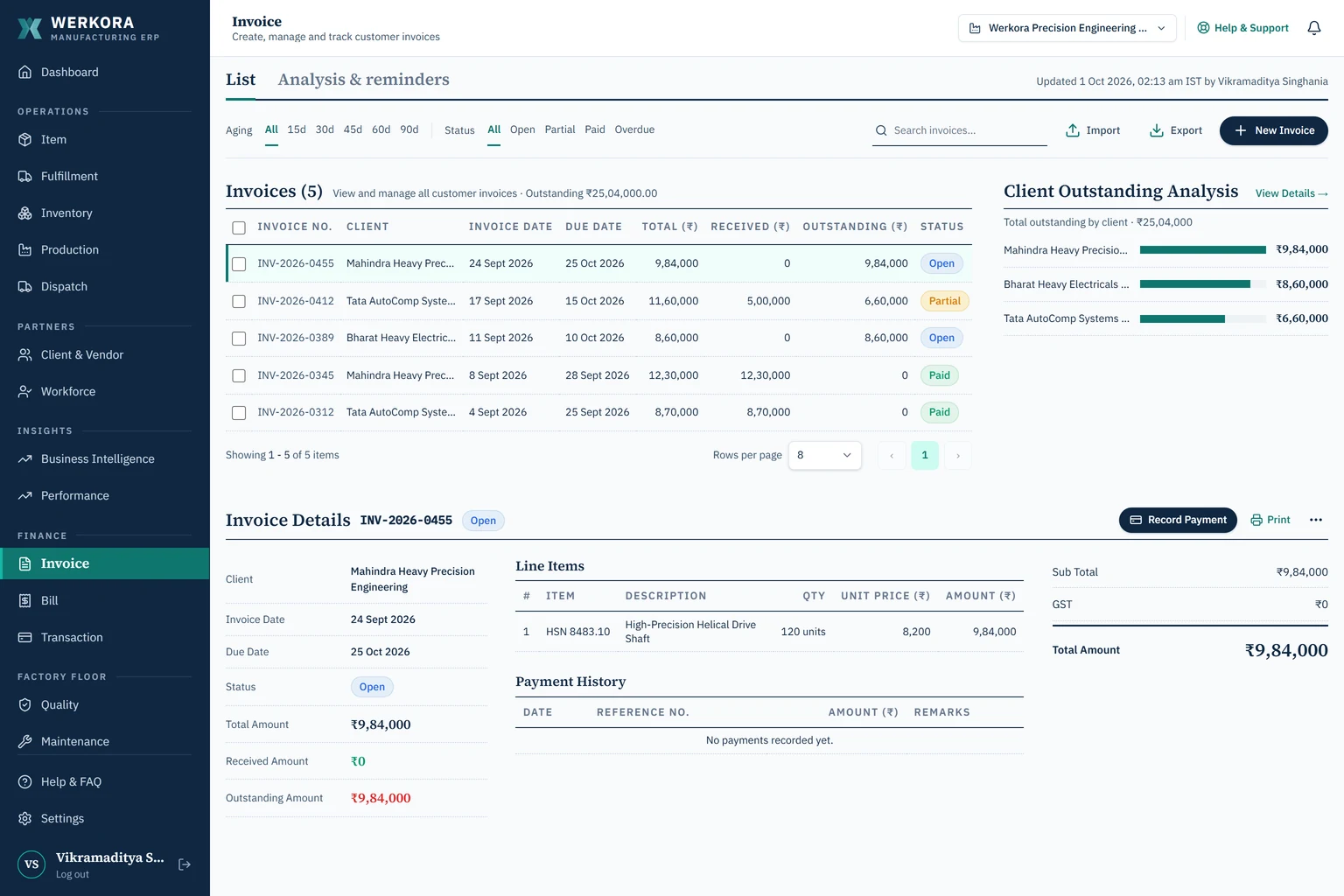
Werkora invoice module — GST e-invoicing and IRN status
AEO Quick Answer & Key Takeaway

Manufacturing companies in India must generate an e-Way Bill for any goods movement exceeding ₹50,000 (or state-specific intra-state thresholds). Validity is 1 day per 200 km for normal cargo and 20 km for Over Dimensional Cargo (ODC). Werkora generates GST tax invoices, delivery challans, and captures e-way bill details directly on dispatch records.

E-Way Bill Mandates for Manufacturing Plants

For any manufacturing enterprise in India, the dispatch gate is the pulse of commercial operations. Finished goods, subcontracted job work, scrap consignments, capital machinery transfers, and branch stock movements all cross the factory gate daily.

Under Rule 138 of the CGST Rules, an electronic Way Bill (e-Way Bill) is mandatory for any movement of goods where the consignment value (including taxes) exceeds ₹50,000. Certain states have set higher intra-state thresholds (e.g. ₹1,00,000 in Maharashtra and Bihar for intra-state goods), but for inter-state manufacturing consignments, the strict ₹50,000 threshold applies nationwide.
Distance & Validity Calculations: The 200 km Rule

Validity is computed based on distance between the dispatch origin and the final delivery address:

  • Normal Cargo: 1 Day for every 200 km (or part thereof). A 650 km haul from Pune to Rajkot receives 4 days of validity.
  • Over Dimensional Cargo (ODC) / Multimodal with Vessel: 1 Day for every 20 km (or part thereof).

Validity begins at the exact moment Part-B (vehicle registration number) is generated, and expires at midnight on the last calculated day. Dispatch managers must plan departures carefully to avoid mid-highway expiry.

The 8-Hour Extension Window

Never let an e-Way Bill expire while a vehicle is on the road. Werkora records dispatch timestamps and transport details, helping dispatch teams monitor active consignments and take timely action before validity windows lapse.

Part-A vs Part-B & Transporter Handoffs

An e-Way Bill consists of two distinct components:

  1. Part-A: Financial and item details: GSTIN of supplier and recipient, place of delivery, invoice/challan number and date, value of goods, HSN codes, and reason for transportation.
  2. Part-B: Transport details: Vehicle registration number (for road transit) or Railway Receipt / Airway Bill / Bill of Lading number.

Crucial Rule: An e-Way Bill is not legally valid for goods movement until Part-B is filled. Carrying a printout with only Part-A completed is treated as transporting goods without an e-Way Bill under Section 129.

Managing Vehicle Breakdowns, Multi-Vehicle & Transshipment

In freight logistics, vehicles frequently break down or goods are consolidated at a transporter's hub (transshipment):

  • Vehicle Change: When cargo is shifted to a replacement truck due to an engine breakdown, Part-B must be updated with the new vehicle registration number before the replacement vehicle commences transit.
  • Multi-Vehicle Movement: When a massive consignment is dispatched from the factory across multiple trucks, Werkora allows dispatch teams to record separate transport manifests and vehicle numbers for each vehicle.

Preventing Checkpost Detention (Section 129 Penalties)

State GST flying squads and mobile patrol units inspect freight at highway toll gates and state borders. If discrepancies are found (expired validity, mismatched vehicle number, missing QR code, wrong HSN):

  • The vehicle and cargo are seized under Form GST MOV-06.
  • Release requires payment of 200% penalty on the applicable tax (Section 129(1)(a)).
  • If penalty is not paid within 14 days, confiscation proceedings commence under Section 130.

Werkora Integrated E-Way Bill & Dispatch Records

Werkora streamlines factory dispatches by integrating shipping verification with GST invoicing:

  1. Storekeepers verify finished goods items and quantities against the Sales Order.
  2. Confirming dispatch automatically calculates applicable CGST, SGST, or IGST based on item HSN codes.
  3. Recording vehicle numbers, transporter names, and e-way bill references produces unified, printable tax invoices and delivery challans ready for the driver.

Stop paying per-user software taxes in your factory

Werkora equips every shop-floor supervisor, line operator, storekeeper, and accountant with their own dedicated login with plans sized for your operation.

Frequently Asked Questions

Expert Answers for Factory Operations

How is e-Way Bill validity calculated for normal versus Over Dimensional Cargo (ODC)?

For regular cargo, validity is 1 day for every 200 km (or part thereof). For Over Dimensional Cargo (ODC) or multimodal shipments involving vessel transport, validity is 1 day for every 20 km (or part thereof). Validity expires at midnight on the final day.

Can an e-Way Bill validity be extended if a truck breaks down?

Yes. The e-Way Bill validity can be extended either by the generator or the transporter within 8 hours before or 8 hours after the expiration time, provided the reason for delay (e.g. mechanical breakdown, accident, natural calamity) and updated vehicle details are documented.

What is the penalty if goods move with an expired or missing e-Way Bill?

Under Section 129 of the CGST Act, transporting goods without a valid e-Way Bill results in vehicle detention and a mandatory penalty of 200% of the applicable tax on taxable goods, or 2% of the value of goods (up to ₹25,000) for exempted goods.

Is an e-Way Bill required for moving goods to a job worker located within 10 km?

If the consignment value exceeds ₹50,000, an e-Way Bill is required even for short movements. However, if goods move within the same State/UT from the consignor's place of business to the transporter's premises (up to 50 km) for further transit, only Part-A is required, and Part-B vehicle details can be updated by the transporter later.

AK

Abhishek Kumar

LinkedIn Profile

Senior Finance & ERP Systems Architect, Werkora

Senior accountant and enterprise systems specialist with 9+ years of experience across Indian GST/TDS compliance, SAP S/4HANA, Tally Prime, and finance automation. Direct operational background in precision instruments manufacturing and multi-jurisdictional statutory compliance with a zero-penalty record.

Cite this guide
APA, Markdown or BibTeX

Copy a citation to include this guide in your article or report.

Interactive Cost Comparison

Calculate Your Plant's Licensing Savings

Benchmark your current software bills against Werkora's unit-based pricing (10 users/unit · min 3 units).

Projected 3-Year Savings for Your Operation (3 Factory Units · 30 Users)

Save up to ₹6.8 Lakhs over 3 years

Compared to standard per-user seat pricing models like ERPNext ($13.50/user/mo).

Each unit includes 10 active user seats (Operations, Store, Accounts, Planning).

3

Base commitment minimum is 3 units (30 user seats total).

Commitment Term:

Werkora Plan

Werkora

₹14,997/mo (3 Units · 30 Seats)

Annual Cost

₹1,79,964

3-Year TCO

₹5,39,892

30 user seats (3 units × 10)

ERPNext Cloud

$13.50 / user / mo

Annual Cost (30 Users)

₹4,05,816

3-Year TCO

₹12,17,448

Save ₹6.8 Lakhs

TYASuite

₹499 / user / mo (~$6)

Annual Cost (30 Users)

₹1,79,640

3-Year TCO

₹5,38,920

Save ₹0

Zoho Creator

$8 / user / mo

Annual Cost (30 Users)

₹2,40,480

3-Year TCO

₹7,21,440

Save ₹1.8 Lakhs

SAP Business One

$50+ / user / mo

Annual Cost (30 Users)

₹15,03,000

3-Year TCO

₹45,09,000

Save ₹39.7 Lakhs

What's Included in Werkora's Plan (from ₹4,999/unit/mo · Min 3 Units):

10 Users per Factory Unit (30 Users in Base)
Minimum 3 Factory Units Included
GST Tax Invoices & Delivery Challans
BOM Formulation & Scrap Accounting
Customer, Supplier & Ledger Accounting
Batch FIFO Inventory Valuation
Shop Floor Travelers & Operation Routing
Extra Units at ₹4,999/mo (+10 users each)

Plan your ERP budget

Review the ERP buying guide or contact us to discuss the units, users, and deployment options your factory needs.

Related Manufacturing Playbooks

Explore adjacent topics in factory operations, costing, and statutory GST compliance.