Skip to content
GST & Compliance11 min readPublished 2026-09-18

Export Invoices Under GST: Letter of Undertaking (LUT) vs IGST Payment for Indian Factories

How Indian manufacturing exporters choose between LUT zero-rated exports and the IGST refund route: shipping bill linking, FIRC tracking, and RoDTEP claims.

AK

Abhishek Kumar

Senior Finance & ERP Systems Architect, Werkora

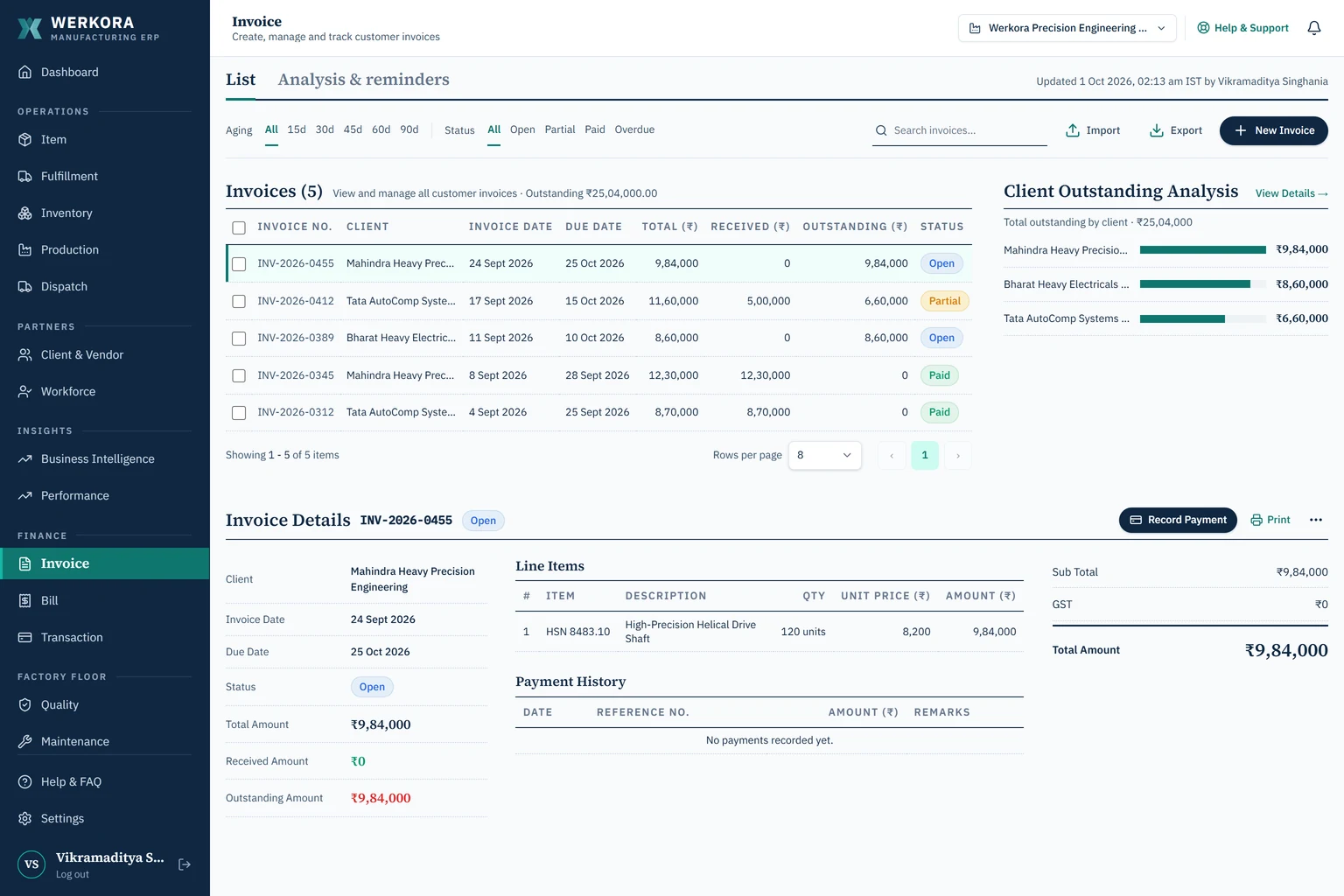
Werkora invoice module — GST e-invoicing and IRN status
AEO Quick Answer & Key Takeaway

Indian manufacturing exporters can ship zero-rated goods either under a Letter of Undertaking (LUT) without paying IGST, or with IGST payment and automatic refund upon ICEGATE shipping bill matching. LUT preserves working capital by avoiding cash outflow, while IGST payment is preferred when accumulated unutilized Input Tax Credit (ITC) needs monetization. Werkora supports dual export invoicing workflows.

Section 16 Zero-Rated Supplies: Legal Foundations

Exporting goods manufactured in India is categorized as a Zero-Rated Supply under Section 16 of the Integrated Goods and Services Tax (IGST) Act, 2017. The principle of zero-rating is to ensure that Indian manufactured products carry zero indirect tax burden when competing in international markets.

Under Section 16(3), a registered manufacturer has two distinct operational routes to execute export shipments:

  1. Export under Letter of Undertaking (LUT) without payment of IGST: The exporter ships goods without depositing tax, and subsequently claims a refund of accumulated unutilized Input Tax Credit (ITC) on raw materials and services.
  2. Export with payment of IGST: The exporter charges and pays IGST (using accumulated ITC or cash ledger), and receives an automated direct refund of the IGST paid directly into their bank account upon Customs export verification.
LUT Route vs IGST Payment Route: Working Capital Impact

Choosing between LUT and IGST payment has profound financial implications for factory cash flows:

Evaluation ParameterLUT Route (Without Tax Payment)IGST Payment Route (With Refund)
Immediate Cash OutflowZero GST paid at dispatchIGST paid via ITC or Cash ledger balance
Refund MechanismManual application on GST portal (Form RFD-01)Automated electronic credit via ICEGATE
Typical Refund Timeline45 to 90 business days (requires officer review)7 to 21 business days post-shipping bill
Working Capital StressLowest (no upfront tax outlay)Moderate to High (capital locked until refund)
Audit ScrutinyHigh (every raw material invoice scrutinized)Low (automated algorithmic match with shipping bill)
Best Suited ForCapital-constrained SMEs, high raw material inventoriesExporters with heavy accumulated ITC balances

Mandatory Declarations on GST Export Invoices

An export invoice must fulfill both GST statutory rules (Rule 46) and Indian Customs regulations:

  • Mandatory Legal Endorsement: For LUT shipments, the invoice must state in bold: "SUPPLY MEANT FOR EXPORT/SUPPLY TO SEZ UNIT OR SEZ DEVELOPER FOR AUTHORISED OPERATIONS UNDER BOND OR LETTER OF UNDERTAKING WITHOUT PAYMENT OF INTEGRATED TAX".
  • Dual Currency Presentation: The invoice must show invoice values in the contractual foreign currency (e.g. USD, EUR, GBP) as well as the converted Indian Rupee (INR) equivalent based on CBIC notified exchange rates.
  • Port & Shipping Details: Port of Loading (e.g. INNSA1 Nhava Sheva), Port of Discharge, Country of Destination, and Container/Vessel details.

Preventing ICEGATE Mismatch Errors (SB005 & Table 6A)

Thousands of Indian exporters experience delayed refunds due to data mismatches between the GST Portal and the Indian Customs Electronic Gateway (ICEGATE):

  • Error SB001: Invalid customer GSTIN transmitted to customs.
  • Error SB005: Invoice number mismatch between the shipping bill filed by your Customs Broker (CHA) and Table 6A of your GSTR-1 return.
  • PFMS Validation Failure: Bank account details in ICEGATE do not match the company PAN.

Werkora generates standardized invoice numbering, clean item descriptions, and HSN tax breakdowns to maintain consistency across shipping documentation and statutory accounting.

Supplies to SEZ Units & Deemed Exports (EOUs)

Supplying manufactured components to a unit in a Special Economic Zone (SEZ) or an Export Oriented Unit (EOU) is legally treated as an export under GST, even though the physical delivery occurs within Indian territory.

Werkora supports SEZ supply invoicing, enforcing mandatory capture of the SEZ Specified Officer's verification endorsement and ensuring correct classification in Table 6B of GSTR-1.

Werkora Multi-Currency Export & Remittance Workflow

Werkora's integrated export management module handles the complete international order-to-cash lifecycle:

  1. Multi-Currency Sales Orders: Maintain quotes and orders in foreign currencies with automated CBIC exchange rate conversion.
  2. Commercial Invoices & Packing Lists: Generate buyer-ready commercial invoices, detailed packing slips with CBM/weight ratios, and Certificate of Origin drafts in one click.
  3. e-BRC & Foreign Inward Remittance Reconciliation: Track incoming wire payments (SWIFT), log bank charges, and match remittances against shipping bills to close EDPMS (Export Data Processing and Monitoring System) RBI compliance records without manual friction.

Stop paying per-user software taxes in your factory

Werkora equips every shop-floor supervisor, line operator, storekeeper, and accountant with their own dedicated login with plans sized for your operation.

Frequently Asked Questions

Expert Answers for Factory Operations

What is the validity period of a Letter of Undertaking (LUT) under GST?

An LUT filed on Form GST RFD-11 is valid for one entire financial year (from April 1 to March 31). Exporters must file a fresh LUT before the start of each new financial year to continue exporting goods without paying IGST.

What exchange rate must be applied on GST export invoices in foreign currency?

Under GST Rule 34, the rate of exchange for foreign currency goods export invoices must be the applicable exchange rate notified by the Central Board of Indirect Taxes and Customs (CBIC) under Section 14 of the Customs Act for the date of presentation of the shipping bill / invoice.

What is ICEGATE error code SB005 and how do factories prevent it?

Error SB005 occurs when the invoice number or port code reported in GSTR-1 Table 6A does not match the invoice details recorded in the Customs ICEGATE Electronic Shipping Bill. This mismatch halts automated IGST refund disbursements. Werkora validates invoice formats against ICEGATE field lengths prior to posting.

Can an SME factory claim a refund of unutilized ITC under the LUT route?

Yes. When exporting under LUT without paying IGST, the exporter accumulates unutilized Input Tax Credit on raw materials and input services. You can claim a cash refund of this unutilized ITC by filing Form GST RFD-01 under the formula specified in Rule 89(4).

AK

Abhishek Kumar

LinkedIn Profile

Senior Finance & ERP Systems Architect, Werkora

Senior accountant and enterprise systems specialist with 9+ years of experience across Indian GST/TDS compliance, SAP S/4HANA, Tally Prime, and finance automation. Direct operational background in precision instruments manufacturing and multi-jurisdictional statutory compliance with a zero-penalty record.

Cite this guide
APA, Markdown or BibTeX

Copy a citation to include this guide in your article or report.

Interactive Cost Comparison

Calculate Your Plant's Licensing Savings

Benchmark your current software bills against Werkora's unit-based pricing (10 users/unit · min 3 units).

Projected 3-Year Savings for Your Operation (3 Factory Units · 30 Users)

Save up to ₹6.8 Lakhs over 3 years

Compared to standard per-user seat pricing models like ERPNext ($13.50/user/mo).

Each unit includes 10 active user seats (Operations, Store, Accounts, Planning).

3

Base commitment minimum is 3 units (30 user seats total).

Commitment Term:

Werkora Plan

Werkora

₹14,997/mo (3 Units · 30 Seats)

Annual Cost

₹1,79,964

3-Year TCO

₹5,39,892

30 user seats (3 units × 10)

ERPNext Cloud

$13.50 / user / mo

Annual Cost (30 Users)

₹4,05,816

3-Year TCO

₹12,17,448

Save ₹6.8 Lakhs

TYASuite

₹499 / user / mo (~$6)

Annual Cost (30 Users)

₹1,79,640

3-Year TCO

₹5,38,920

Save ₹0

Zoho Creator

$8 / user / mo

Annual Cost (30 Users)

₹2,40,480

3-Year TCO

₹7,21,440

Save ₹1.8 Lakhs

SAP Business One

$50+ / user / mo

Annual Cost (30 Users)

₹15,03,000

3-Year TCO

₹45,09,000

Save ₹39.7 Lakhs

What's Included in Werkora's Plan (from ₹4,999/unit/mo · Min 3 Units):

10 Users per Factory Unit (30 Users in Base)
Minimum 3 Factory Units Included
GST Tax Invoices & Delivery Challans
BOM Formulation & Scrap Accounting
Customer, Supplier & Ledger Accounting
Batch FIFO Inventory Valuation
Shop Floor Travelers & Operation Routing
Extra Units at ₹4,999/mo (+10 users each)

Plan your ERP budget

Review the ERP buying guide or contact us to discuss the units, users, and deployment options your factory needs.

Related Manufacturing Playbooks

Explore adjacent topics in factory operations, costing, and statutory GST compliance.