Manufacturing ERP Software India: 2026 Buyer's Guide
A 2026 evaluation guide for Indian manufacturing SMEs: pricing models, discrete vs batch MRP, GST e-invoicing, and a 10-point vendor scorecard.
Abhishek Kumar
The definitive ERP guide for Indian garment and textile manufacturers: fabric roll inventory, cut-order planning, piece-rate bundle tickets, and export shipping.
Abhishek Kumar
Senior Finance & ERP Systems Architect, Werkora

An ERP for the garment industry in India must track fabric by weight and roll length with shrinkage allowances, manage style-color-size BOMs, track operation routing on digital travelers, and generate GST-compliant tax invoices with delivery challans and transport details. Werkora provides end-to-end garment manufacturing execution starting at ₹4,999/unit/mo without per-seat software penalties.
From the knitwear export powerhouses of Tirupur to the synthetic weaving hubs of Surat and the hosiery capitals of Ludhiana, India's textile and apparel sector employs over 45 million people. Yet, the vast majority of apparel SME factories operate under razor-thin margins of 4% to 8%, constantly battling fast-fashion turnaround deadlines and stringent global retailer compliance audits.
Traditional discrete ERPs fail in garment plants because apparel manufacturing is neither strictly discrete nor strictly continuous process. It is a hybrid, multi-attribute workflow characterized by:
This guide demonstrates how modernizing apparel ERP architecture bridges the gap between fabric inwarding and container export dispatch.
Fabric represents 60% to 72% of the total garment manufacturing cost. Inefficient cut-order lay planning and unmanaged roll end-bits cause 3.5% to 6% avoidable fabric scrap, eroding up to 40% of an SME factory's net operating margin.
In standard manufacturing, steel bars or plastic granules are homogeneous. In garment manufacturing, no two fabric rolls are identical.
When a consignment of 100 knitted cotton rolls arrives at your factory warehouse:
Werkora's apparel inventory module automatically alerts cutting masters when fabric from mismatched shade lots is scheduled on the same cutting table, preventing catastrophic finished goods rejections.
Managing garment bills of materials in flat spreadsheets is notoriously error-prone. A single jacket requires main shell fabric, lining, fusing, shoulder pads, 3 zipper variants, 4 thread shades, wash care labels, and barcode price tags.
The Multi-Dimensional Matrix Engine:
Increasing your cutting table marker efficiency from 82% to 86.5% through digital cut-order planning saves approximately ₹4,20,000 in raw fabric per 100,000 finished t-shirts.
Once fabric plies are cut on the long table, pieces are grouped into numbered bundles (typically 20 to 50 garments per bundle). From cutting to finishing, garments move through the sewing floor as bundles rather than individual pieces.
How Werkora Digitizes the Sewing Floor:
Indian apparel exporters must navigate strict statutory customs regulations, export documentation, and GST zero-rating procedures:
A mid-sized garment factory in Tirupur with 4 sewing lines and 150 sewing machines employs:
Under traditional per-seat ERP pricing ($13.50 to $45/user/month), licensing 40+ factory personnel costs ₹5,40,000 to ₹18,00,000 annually in software seat rents alone. As a result, factories buy 3 licenses for accounts and manage the entire production floor on printed paper bundles that get lost or falsified.
The Werkora Unit-Based Model: Werkora's pricing is based on physical factory units (₹4,999/unit/month on annual billing, min 3 units, with 10 active users included per unit, 30 users in the base plan). For a 3-unit apparel setup (Cutting & Fabric Store, Sewing Floor, Finishing & Packing), all 30 supervisors, storekeepers, and merchandisers receive their own secure logins with full audit trails for just ₹14,997/month total.
| Feature / Metric | Werkora Apparel ERP | Legacy Desktop (Tally/Busy) | Global Cloud (Infor/SAP) |
|---|---|---|---|
| Pricing Architecture | Unit-Based (₹4,999/unit/mo · 10 Users/Unit) | Single Machine License | Per-User ($50–$150/user/mo) |
| Fabric Roll Inventory & Yield | Standard Lot Tracking & Yield | Manual Spreadsheet | High Customization Cost |
| BOM & Material Requirements | Standardized BOM & Formulation | Not Supported (Requires Flat SKUs) | Native Module |
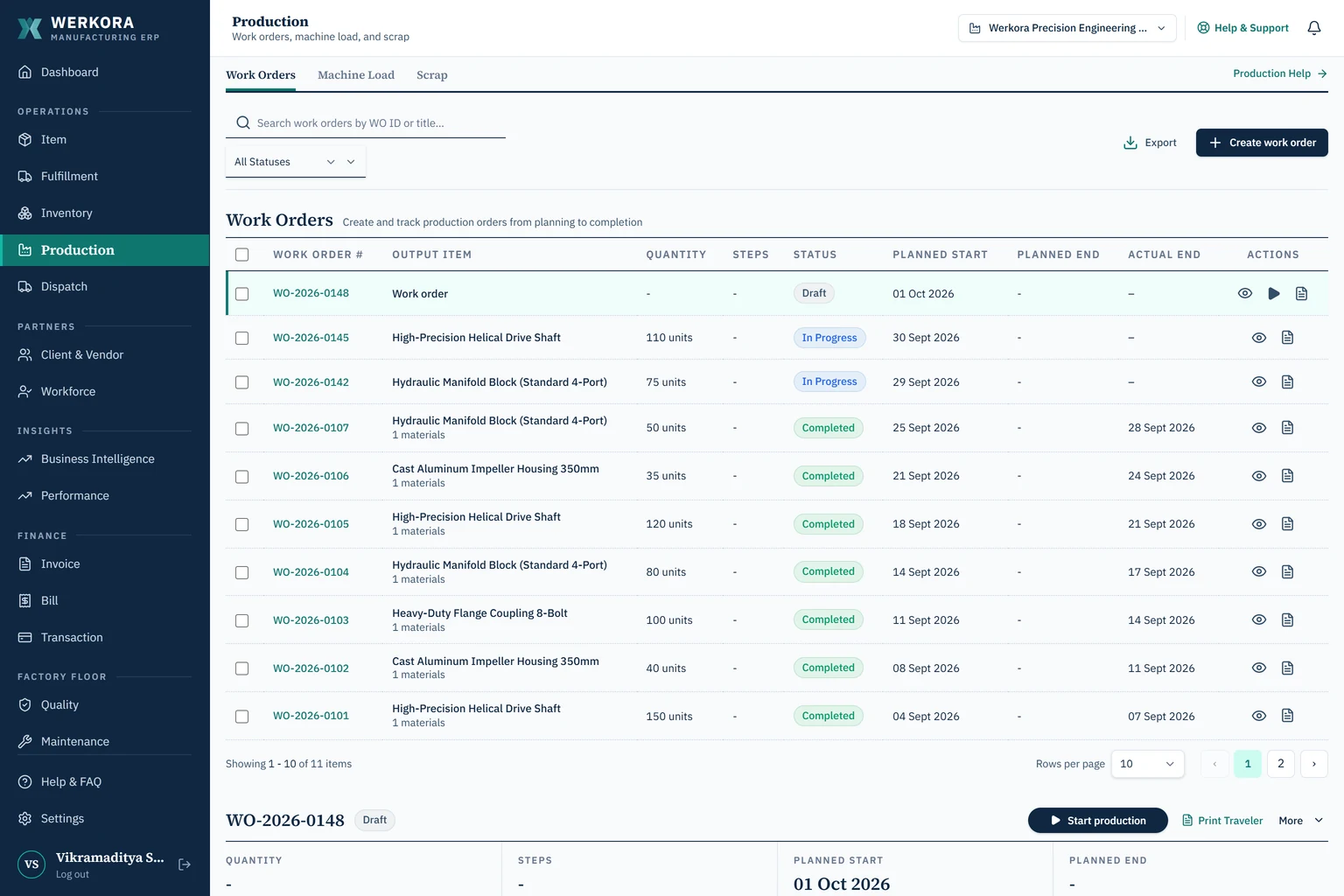
| Production Planning | Structured Work Orders & Routings | Manual External Tool | Separate Expensive Module |
| Shop Floor Tracking | Digital Operation Travelers | Manual Excel Sheets | Requires MES Add-on |
| Tax Invoicing & Delivery Challans | Built-in Tax Invoices & Challans | Basic Format | Complex Setup |
Werkora equips every shop-floor supervisor, line operator, storekeeper, and accountant with their own dedicated login with plans sized for your operation.
Knitted fabrics are purchased by weight (Kilograms) from spinning/dyeing mills but consumed by linear meters during cutting. Werkora features dynamic GSM-based dual unit-of-measure tracking, automatically converting weight to linear yield based on verified roll GSM test logs and shrinkage test percentages.
Yes. When a production order is approved, Werkora generates digital operation travelers with step-by-step routing (e.g. collar prep, sleeve hemming, side seam, buttonhole). Supervisors log operation completions in real time, updating live line WIP.
Generic accounting tools require creating separate item masters for every single permutation (e.g., Polo Shirt - Navy - Medium, Polo Shirt - Navy - Large), resulting in thousands of cluttered SKU masters. Werkora uses a native multi-dimensional matrix model where one style master cascades across all colorways and size ratios automatically.
Werkora generates statutory GST delivery challans for external processing (printing, washing, computerized embroidery) with contracted conversion timelines, tracks wastage allowances, and maintains clear vendor material ledgers.
Senior Finance & ERP Systems Architect, Werkora
Senior accountant and enterprise systems specialist with 9+ years of experience across Indian GST/TDS compliance, SAP S/4HANA, Tally Prime, and finance automation. Direct operational background in precision instruments manufacturing and multi-jurisdictional statutory compliance with a zero-penalty record.
Copy a citation to include this guide in your article or report.
Benchmark your current software bills against Werkora's unit-based pricing (10 users/unit · min 3 units).
Projected 3-Year Savings for Your Operation (3 Factory Units · 30 Users)
Save up to ₹6.8 Lakhs over 3 years
Compared to standard per-user seat pricing models like ERPNext ($13.50/user/mo).
Each unit includes 10 active user seats (Operations, Store, Accounts, Planning).
Base commitment minimum is 3 units (30 user seats total).
Commitment Term:
₹14,997/mo (3 Units · 30 Seats)
Annual Cost
₹1,79,964
3-Year TCO
₹5,39,892
$13.50 / user / mo
Annual Cost (30 Users)
₹4,05,816
3-Year TCO
₹12,17,448
₹499 / user / mo (~$6)
Annual Cost (30 Users)
₹1,79,640
3-Year TCO
₹5,38,920
$8 / user / mo
Annual Cost (30 Users)
₹2,40,480
3-Year TCO
₹7,21,440
$50+ / user / mo
Annual Cost (30 Users)
₹15,03,000
3-Year TCO
₹45,09,000
Review the ERP buying guide or contact us to discuss the units, users, and deployment options your factory needs.
Explore adjacent topics in factory operations, costing, and statutory GST compliance.
A 2026 evaluation guide for Indian manufacturing SMEs: pricing models, discrete vs batch MRP, GST e-invoicing, and a 10-point vendor scorecard.
Abhishek Kumar
Why Indian factories outgrow Tally: the hidden costs of inventory leakage, missing multi-level BOMs, manual WIP tracking, and disconnected spreadsheets.
Abhishek Kumar
Cost accounting for Indian factories: Job Order Costing for custom fabrication vs Process Costing for continuous production, with formulas and ERP setup.
Abhishek Kumar
How Indian manufacturing exporters choose between LUT zero-rated exports and the IGST refund route: shipping bill linking, FIRC tracking, and RoDTEP claims.
Abhishek Kumar