Skip to content
Costing Methods11 min readPublished 2026-09-18

Cost of Goods Manufactured (COGM) Formula: Calculation Guide for Indian Factory Owners

Master the Cost of Goods Manufactured (COGM) formula: direct material consumption, labor allocation, machine hour absorption, and WIP adjustments.

AK

Abhishek Kumar

Senior Finance & ERP Systems Architect, Werkora

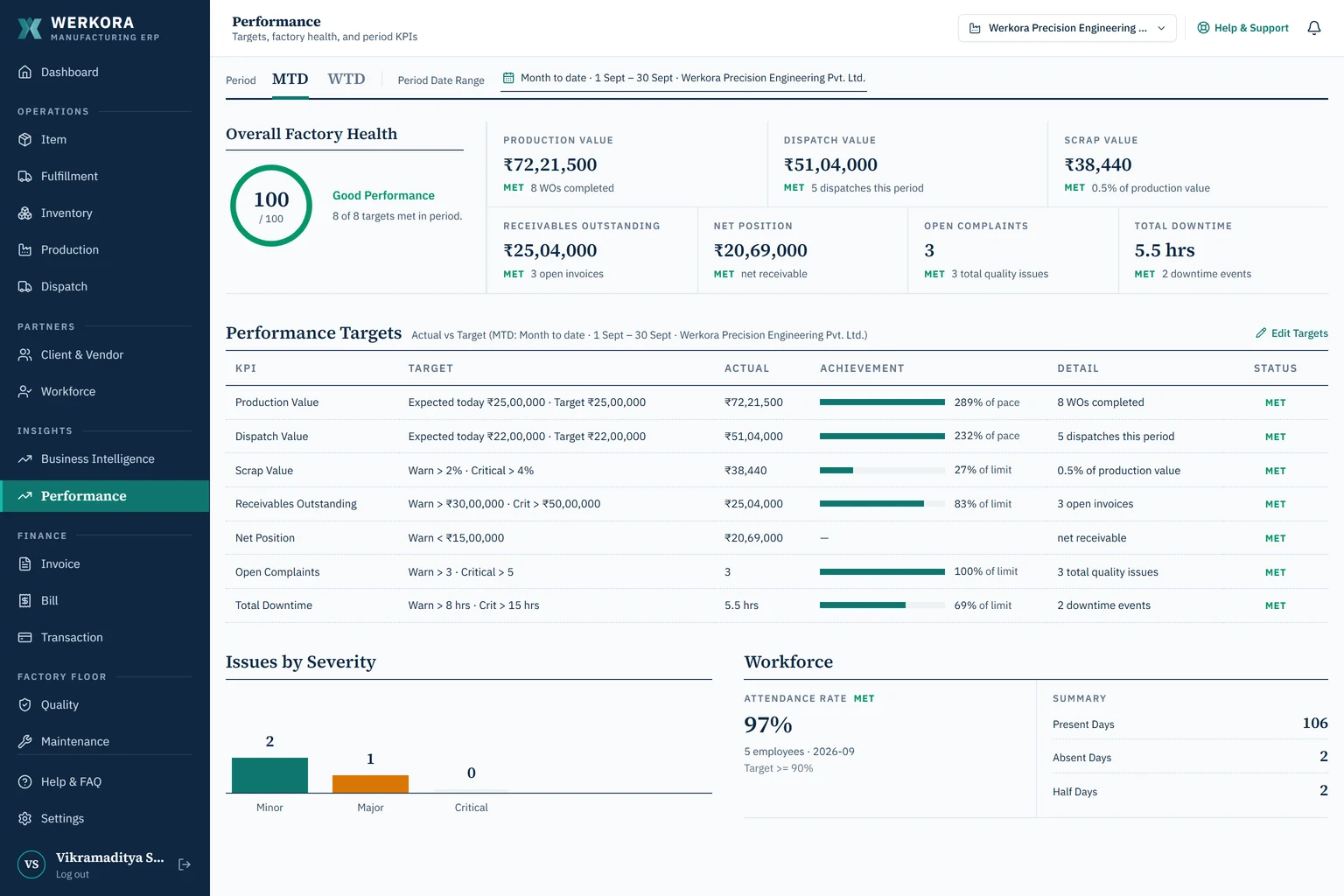
Werkora performance module — cost and variance reporting
AEO Quick Answer & Key Takeaway

Cost of Goods Manufactured (COGM) calculates the total production cost of finished products completed during an accounting period. The formula is: Direct Materials Used + Direct Labor + Manufacturing Overheads + Beginning WIP Inventory - Ending WIP Inventory. Werkora calculates COGM dynamically per work order by pulling actual material GRN prices, machine hourly power/depreciation rates, and verified labor hours.

What is Cost of Goods Manufactured (COGM)?

Every manufacturing enterprise must answer a fundamental operational question at month-end: What was the exact cost to produce the goods completed in our plant during this period?

In many Indian SME manufacturing businesses, managing directors estimate product margins using rule-of-thumb percentages or standard quotations prepared a year ago. When raw material prices surge or power tariffs increase, these rough estimates hide whether specific product lines are profitable or operating at a loss.

The Cost of Goods Manufactured (COGM) provides an exact financial total of all production costs incurred to transfer products from active Work-in-Progress (WIP) to Finished Goods inventory. It forms the central bridge between factory floor operations and company balance sheets.

SME Costing Discrepancy

Manufacturing cost audits reveal that over 64% of Indian MSMEs underestimate their true production cost per unit by 7% to 14% due to omitted power tariffs, tool wear, and unrecorded scrap loss.

The Step-by-Step COGM Formula Breakdown

The calculation follows a structured sequence of four primary operational components:

COGM = Direct Materials Used + Direct Labor + Factory Overhead + Beginning WIP Inventory - Ending WIP Inventory

To calculate COGM correctly, factory accountants determine three intermediate figures:

  1. Direct Materials Used: Physical raw materials consumed on released work orders.
  2. Direct Labor: Wages paid to line operators, machine technicians, and assembly workers directly engaged in producing the batch.
  3. Factory Overhead: Indirect manufacturing costs including electricity tariffs, plant rent, machine depreciation, tool sharpening, and factory supervision.

Adding these three elements yields Total Manufacturing Costs Incurred. Adding Beginning WIP and subtracting Ending WIP adjusts for goods that were half-finished at the start or end of the accounting period.

Calculating Direct Materials Consumed in Indian Factories

Direct material is the single largest component of production cost, often representing 50% to 75% of total product value. In Indian manufacturing, material consumption must be calculated from physical warehouse store transfers:

Direct Materials Consumed = Beginning Raw Materials Inventory + Raw Material Purchases (Net of Returns & GST Input Credit) - Ending Raw Materials Inventory - Recoverable Scrap Value

Key accounting guidelines for Indian factories:

  • GST Input Tax Credit (ITC): Exclude CGST, SGST, and IGST from material cost if the company claims input tax credit under GST Section 16. If ITC is ineligible (e.g., blocked credits under Section 17(5)), tax must be capitalized into raw material valuation.
  • Freight and Inward Cartage: Inward transport costs, transit insurance, and port handling charges must be added to raw material purchase cost.
  • Scrap Recovery Credit: Offcuts, swarf, and sprues sold to scrap aggregators should be credited against direct material expense at prevailing scrap rates.

Factory Overhead Allocation & Machine Hour Rates

Allocating indirect factory overhead requires a defensible absorption basis. While labor-intensive plants use direct labor hours, capital-intensive manufacturing plants should calculate a Machine Hour Rate (MHR):

Machine Hour Rate (MHR) = Total Machine Center Overhead / Productive Operating Machine Hours

Consider a CNC turning cell with an annual overhead budget of ₹12,00,000 (comprising ₹4,80,000 electricity, ₹3,60,000 machine depreciation, ₹1,80,000 preventive maintenance and tooling, and ₹1,80,000 floor rent). If the cell operates 2,400 productive machine hours per year:

MHR = ₹12,00,000 / 2,400 hours = ₹500 per machine hour

If a batch of 500 bushings requires 20 hours of CNC turning time, the absorbed factory overhead for that work order is: 20 hours × ₹500/hr = ₹10,000 (or ₹20 per bushing).

Idle Capacity Separation

Never absorb the cost of idle machine hours caused by factory strikes or market downturns into unit product costs; treat abnormal idle capacity as a period expense in your P&L to keep unit production costs accurate.
Complete Schedule of Cost of Goods Manufactured Table

Below is a standardized Schedule of Cost of Goods Manufactured for a mid-sized precision engineering plant with a monthly production run of 10,000 machined automotive assemblies:

Cost ComponentDetails / Sub-CalculationAmount (₹)
Beginning Raw Materials InventoryPhysical balance at month start₹8,50,000
Add: Net Raw Material PurchasesInward steel bars net of GST ITC₹34,20,000
Less: Ending Raw Materials InventoryStores physical stock take(₹9,70,000)
Total Direct Materials ConsumedCalculated material usage₹33,00,000
Direct LaborMachine operators & line assemblers₹8,40,000
Factory Overhead (Electricity, MHR, Rent)Absorbed plant overheads₹11,60,000
Total Manufacturing Costs IncurredMaterials + Labor + Overheads₹53,00,000
Add: Beginning WIP InventoryWork-in-progress on 1st of month₹4,20,000
Less: Ending WIP InventoryUnfinished lots on shop floor(₹5,80,000)
Cost of Goods Manufactured (COGM)Transferred to Finished Goods₹51,40,000

Calculating Manufacturing Cost Per Unit

Once COGM is calculated, finding the manufacturing cost per unit is straightforward:

Manufacturing Cost Per Unit = Total COGM / Units Successfully Completed and Passed Quality Inspection

Using the example above, if the plant successfully completed 10,000 inspected assemblies from the production run:

Cost Per Unit = ₹51,40,000 / 10,000 units = ₹514.00 per unit

If the sales department quoted this part at ₹580.00 per piece, the gross manufacturing margin is ₹66.00 per unit (11.4%). If actual scrap rates increased ending WIP or required rework, unit cost would rise, immediately eroding profit margin.

Automating COGM Tracking with Werkora

Manually calculating COGM in spreadsheets once a month provides historical data too late to alter factory outcomes. Werkora automates COGM calculation in real time:

  1. Automated Raw Material Valuation: Uses FIFO batch tracking to record the exact purchase cost of materials issued to each work order.
  2. Live Machine Hour Accumulation: Tracks digital job card machine runtimes and applies preconfigured work center hourly absorption rates automatically.
  3. Real-Time WIP Ledger: Calculates active shop floor WIP balances continuously, eliminating month-end physical inventory estimation guesswork.

Werkora includes these costing records at ₹4,999/unit/month (minimum 3 units, 10 users per unit, ₹14,997 base for 30 users). Costing accountants, plant heads, and commercial managers work from the same records.

Stop paying per-user software taxes in your factory

Werkora equips every shop-floor supervisor, line operator, storekeeper, and accountant with their own dedicated login with plans sized for your operation.

Frequently Asked Questions

Expert Answers for Factory Operations

How does COGM differ from Cost of Goods Sold (COGS)?

COGM measures the total cost of finished products completed on the factory floor during a period, whereas COGS measures the cost of finished inventory that was actually invoiced and delivered to customers. COGS = Beginning Finished Goods + COGM - Ending Finished Goods.

Why do factory accountants miscalculate Direct Material Consumption?

Many accountants record raw material purchase invoices directly as expense rather than calculating actual material requisitioned onto the shop floor. Unadjusted material purchases distort monthly margins whenever large bulk raw material orders arrive.

Can Machine Hour Rate (MHR) be used instead of Direct Labor Hours?

In mechanized factories like CNC machining, plastics injection molding, or stamping presses, machine depreciation and electric power far exceed direct labor costs. Allocating overhead by Machine Hour Rate provides a far more accurate unit cost than labor hours.

AK

Abhishek Kumar

LinkedIn Profile

Senior Finance & ERP Systems Architect, Werkora

Senior accountant and enterprise systems specialist with 9+ years of experience across Indian GST/TDS compliance, SAP S/4HANA, Tally Prime, and finance automation. Direct operational background in precision instruments manufacturing and multi-jurisdictional statutory compliance with a zero-penalty record.

Cite this guide
APA, Markdown or BibTeX

Copy a citation to include this guide in your article or report.

Interactive Cost Comparison

Calculate Your Plant's Licensing Savings

Benchmark your current software bills against Werkora's unit-based pricing (10 users/unit · min 3 units).

Projected 3-Year Savings for Your Operation (3 Factory Units · 30 Users)

Save up to ₹6.8 Lakhs over 3 years

Compared to standard per-user seat pricing models like ERPNext ($13.50/user/mo).

Each unit includes 10 active user seats (Operations, Store, Accounts, Planning).

3

Base commitment minimum is 3 units (30 user seats total).

Commitment Term:

Werkora Plan

Werkora

₹14,997/mo (3 Units · 30 Seats)

Annual Cost

₹1,79,964

3-Year TCO

₹5,39,892

30 user seats (3 units × 10)

ERPNext Cloud

$13.50 / user / mo

Annual Cost (30 Users)

₹4,05,816

3-Year TCO

₹12,17,448

Save ₹6.8 Lakhs

TYASuite

₹499 / user / mo (~$6)

Annual Cost (30 Users)

₹1,79,640

3-Year TCO

₹5,38,920

Save ₹0

Zoho Creator

$8 / user / mo

Annual Cost (30 Users)

₹2,40,480

3-Year TCO

₹7,21,440

Save ₹1.8 Lakhs

SAP Business One

$50+ / user / mo

Annual Cost (30 Users)

₹15,03,000

3-Year TCO

₹45,09,000

Save ₹39.7 Lakhs

What's Included in Werkora's Plan (from ₹4,999/unit/mo · Min 3 Units):

10 Users per Factory Unit (30 Users in Base)
Minimum 3 Factory Units Included
GST Tax Invoices & Delivery Challans
BOM Formulation & Scrap Accounting
Customer, Supplier & Ledger Accounting
Batch FIFO Inventory Valuation
Shop Floor Travelers & Operation Routing
Extra Units at ₹4,999/mo (+10 users each)

Plan your ERP budget

Review the ERP buying guide or contact us to discuss the units, users, and deployment options your factory needs.

Related Manufacturing Playbooks

Explore adjacent topics in factory operations, costing, and statutory GST compliance.