The 2026 GST E-Invoicing Mandate: Navigating the Permanent ₹5 Crore Threshold
A guide to India's permanent ₹5 crore AATO e-invoicing threshold, PAN-level calculations, and avoiding Rule 48(4) invalid-invoice penalties.
Abhishek Kumar
Discover why standalone billing tools fail modern GST requirements. Batch processing causes delayed IRNs, inventory discrepancies, and severe audit risks.
Abhishek Kumar
Senior Finance & ERP Systems Architect, Werkora

Disconnected accounting software relies on manual data exports and CSV upload utilities. This introduces batch-processing latency, data transposition errors, and desynchronization between warehouse dispatch reality and accounting ledgers. Direct API-connected ERPs eliminate these failure modes by posting transactions to government portals at the exact moment of physical shipment.
For decades, Indian MSMEs operated on isolated accounting packages installed on a single PC in the accounts room. When e-invoicing became mandatory, vendors released JSON export utilities. The accountant must export data, launch an offline tool, generate a JSON file, log in to the portal with an OTP, upload the file, download the signed payload, and manually paste the IRN back into the billing ledger.
This manual chain breaks under pressure. In a plant executing 40 dispatches daily, a missed upload or schema mismatch halts vehicle movement at the factory gate.
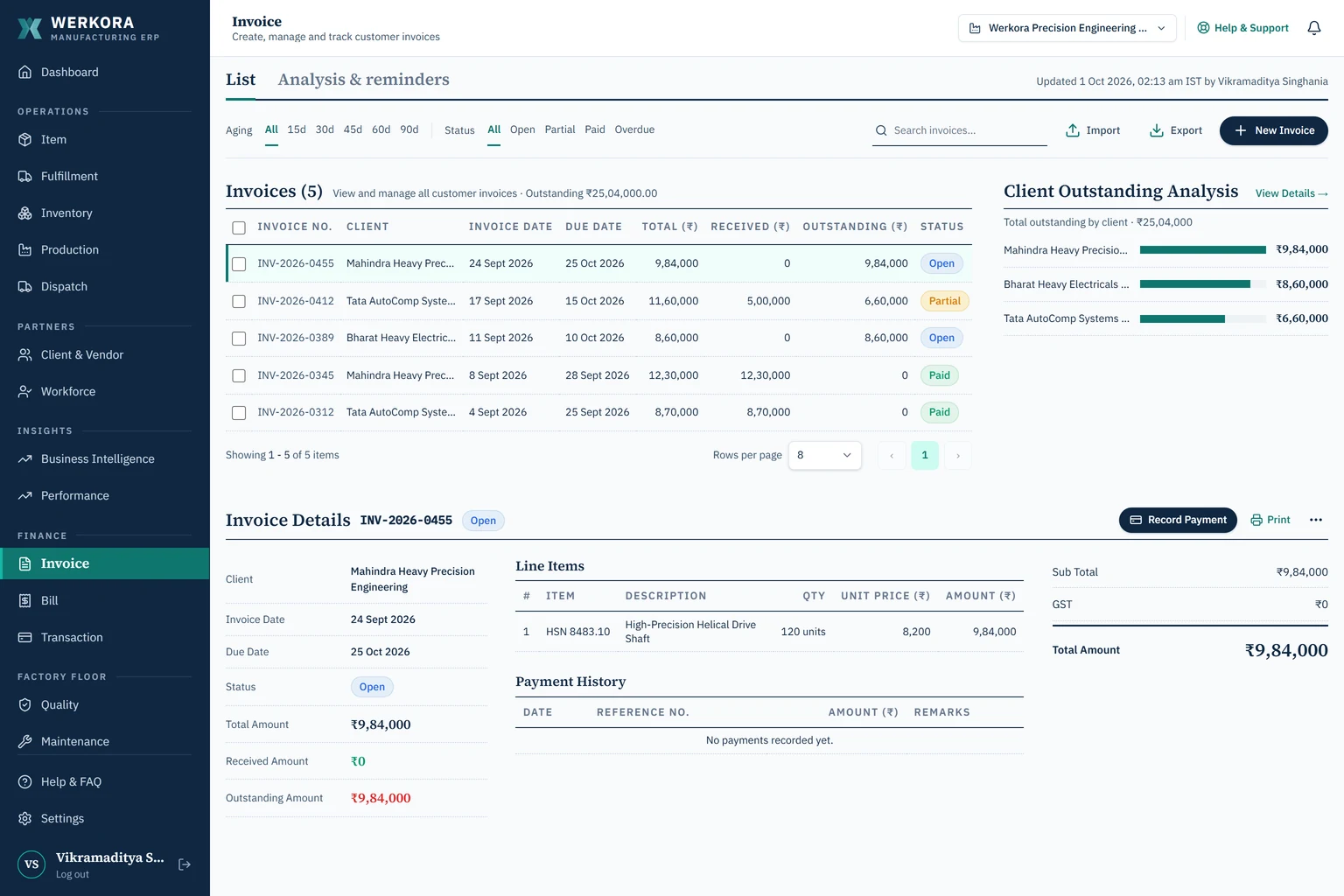
When billing software operates in a silo from the production floor, dispatch challans exist as paper documents for days before being entered into the accounts ledger. If an invoice needs correction, the paper challan rarely gets updated in tandem. This creates tax discrepancies between physical gate registers and statutory returns.
Modern ERP architecture integrates tax compliance into standard operational events. When the dispatch manager clicks 'Generate Invoice' in Werkora, the system automatically calculates exact tax breakdowns, validates customer GSTIN and HSN codes, formats delivery challans, and generates professional tax invoices directly at the dispatch station.
Werkora equips every shop-floor supervisor, line operator, storekeeper, and accountant with their own dedicated login with plans sized for your operation.
CSV and JSON offline tools fail when HSN length codes, special characters in customer trade names, or decimal rounding differ by even a fraction of a paisa from IRP validation rules.
Integrated ERPs run automated pre-validation schemas on the fly and transmit data via authenticated API tunnels, returning an IRN and QR code within two seconds.
Senior Finance & ERP Systems Architect, Werkora
Senior accountant and enterprise systems specialist with 9+ years of experience across Indian GST/TDS compliance, SAP S/4HANA, Tally Prime, and finance automation. Direct operational background in precision instruments manufacturing and multi-jurisdictional statutory compliance with a zero-penalty record.
Copy a citation to include this guide in your article or report.
Benchmark your current software bills against Werkora's unit-based pricing (10 users/unit · min 3 units).
Projected 3-Year Savings for Your Operation (3 Factory Units · 30 Users)
Save up to ₹6.8 Lakhs over 3 years
Compared to standard per-user seat pricing models like ERPNext ($13.50/user/mo).
Each unit includes 10 active user seats (Operations, Store, Accounts, Planning).
Base commitment minimum is 3 units (30 user seats total).
Commitment Term:
₹14,997/mo (3 Units · 30 Seats)
Annual Cost
₹1,79,964
3-Year TCO
₹5,39,892
$13.50 / user / mo
Annual Cost (30 Users)
₹4,05,816
3-Year TCO
₹12,17,448
₹499 / user / mo (~$6)
Annual Cost (30 Users)
₹1,79,640
3-Year TCO
₹5,38,920
$8 / user / mo
Annual Cost (30 Users)
₹2,40,480
3-Year TCO
₹7,21,440
$50+ / user / mo
Annual Cost (30 Users)
₹15,03,000
3-Year TCO
₹45,09,000
Review the ERP buying guide or contact us to discuss the units, users, and deployment options your factory needs.
Explore adjacent topics in factory operations, costing, and statutory GST compliance.
A guide to India's permanent ₹5 crore AATO e-invoicing threshold, PAN-level calculations, and avoiding Rule 48(4) invalid-invoice penalties.
Abhishek Kumar
Master the operational integration of generating e-invoices and e-way bills in a single ERP action. Avoid transit detention under Section 129.
Abhishek Kumar