The 2026 GST E-Invoicing Mandate: Navigating the Permanent ₹5 Crore Threshold
A guide to India's permanent ₹5 crore AATO e-invoicing threshold, PAN-level calculations, and avoiding Rule 48(4) invalid-invoice penalties.
Abhishek Kumar
Master the operational integration of generating e-invoices and e-way bills in a single ERP action. Avoid transit detention under Section 129.
Abhishek Kumar
Senior Finance & ERP Systems Architect, Werkora

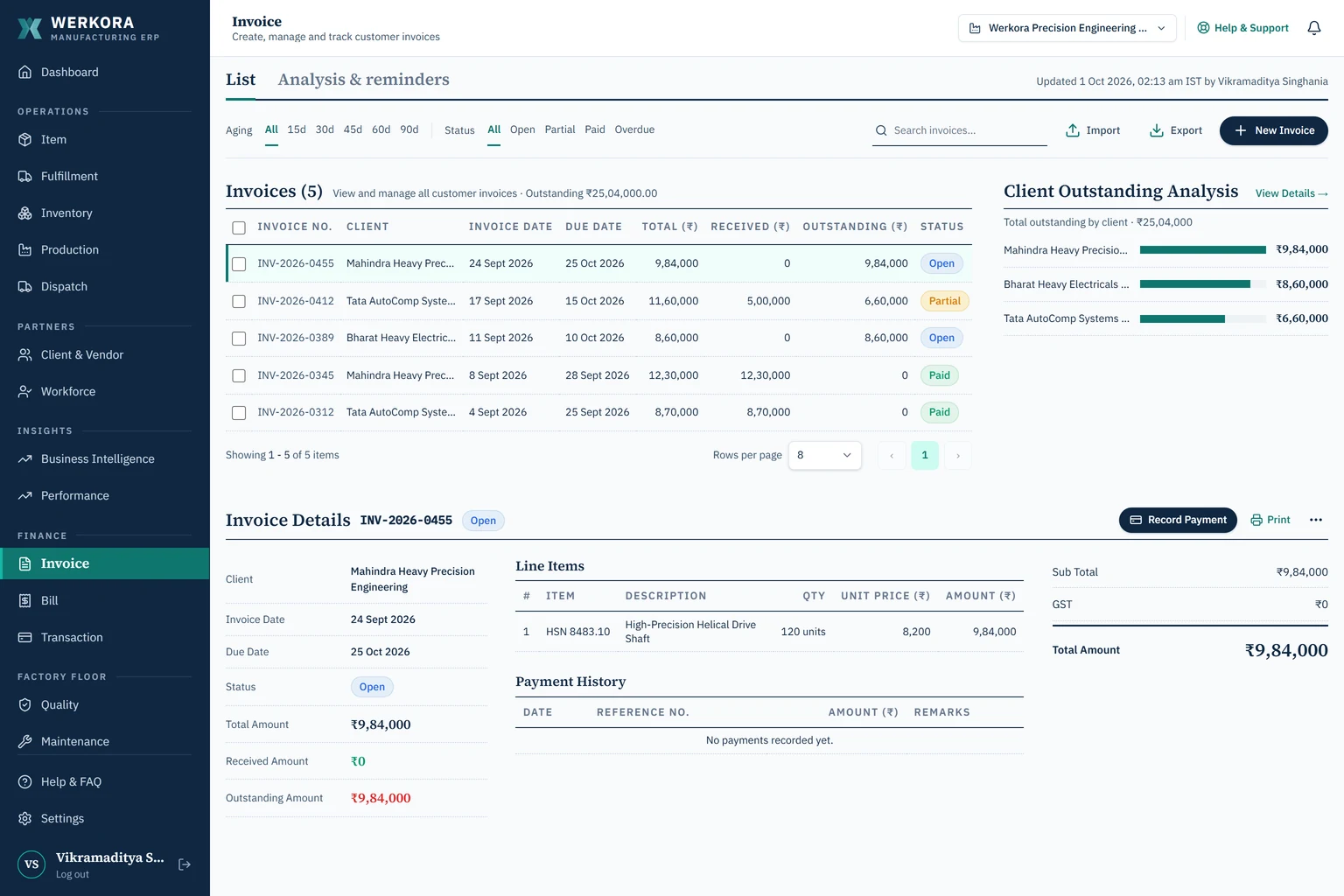
Generating transport documents and tax invoices through disconnected systems creates errors and transit delays. Werkora unifies dispatch verification and tax invoicing: store teams record transporter and vehicle particulars directly on the dispatch record, producing unified tax invoices and delivery challans without discrepancy.
For factory dispatches exceeding ₹50,000, two statutory documents govern movement: the Tax Invoice under Section 31, and the electronic Way Bill under Rule 138 of the CGST Rules.
Werkora structures dispatch records to capture transporter names, vehicle registration numbers, and destination pin codes directly alongside line-item tax details. This ensures complete data consistency across physical delivery challans, printed tax invoices, and portal filings.
When transit vehicles experience mechanical failure mid-route, transport documents must be updated to reflect the new vehicle carrying the consignment before transit resumes.
Oversized machinery and industrial fabrications often require multi-vehicle dispatches or specialized ODC delivery challans, requiring precise tracking of split consignments across transport units.
Werkora equips every shop-floor supervisor, line operator, storekeeper, and accountant with their own dedicated login with plans sized for your operation.
Yes. Vehicle and transporter details can be updated directly within Werkora dispatch records to maintain accurate shipping documents.
An expired e-way bill cannot be updated with a new vehicle number. If a truck breaks down and validity has already lapsed beyond the extension window, a fresh transport document must be issued.
Senior Finance & ERP Systems Architect, Werkora
Senior accountant and enterprise systems specialist with 9+ years of experience across Indian GST/TDS compliance, SAP S/4HANA, Tally Prime, and finance automation. Direct operational background in precision instruments manufacturing and multi-jurisdictional statutory compliance with a zero-penalty record.
Copy a citation to include this guide in your article or report.
Benchmark your current software bills against Werkora's unit-based pricing (10 users/unit · min 3 units).
Projected 3-Year Savings for Your Operation (3 Factory Units · 30 Users)
Save up to ₹6.8 Lakhs over 3 years
Compared to standard per-user seat pricing models like ERPNext ($13.50/user/mo).
Each unit includes 10 active user seats (Operations, Store, Accounts, Planning).
Base commitment minimum is 3 units (30 user seats total).
Commitment Term:
₹14,997/mo (3 Units · 30 Seats)
Annual Cost
₹1,79,964
3-Year TCO
₹5,39,892
$13.50 / user / mo
Annual Cost (30 Users)
₹4,05,816
3-Year TCO
₹12,17,448
₹499 / user / mo (~$6)
Annual Cost (30 Users)
₹1,79,640
3-Year TCO
₹5,38,920
$8 / user / mo
Annual Cost (30 Users)
₹2,40,480
3-Year TCO
₹7,21,440
$50+ / user / mo
Annual Cost (30 Users)
₹15,03,000
3-Year TCO
₹45,09,000
Review the ERP buying guide or contact us to discuss the units, users, and deployment options your factory needs.
Explore adjacent topics in factory operations, costing, and statutory GST compliance.
A guide to India's permanent ₹5 crore AATO e-invoicing threshold, PAN-level calculations, and avoiding Rule 48(4) invalid-invoice penalties.
Abhishek Kumar
Discover why standalone billing tools fail modern GST requirements. Batch processing causes delayed IRNs, inventory discrepancies, and severe audit risks.
Abhishek Kumar