Skip to content
GST & Compliance11 min readPublished 2026-09-18

The 2026 GST E-Invoicing Mandate: Navigating the Permanent ₹5 Crore Threshold

A guide to India's permanent ₹5 crore AATO e-invoicing threshold, PAN-level calculations, and avoiding Rule 48(4) invalid-invoice penalties.

AK

Abhishek Kumar

Senior Finance & ERP Systems Architect, Werkora

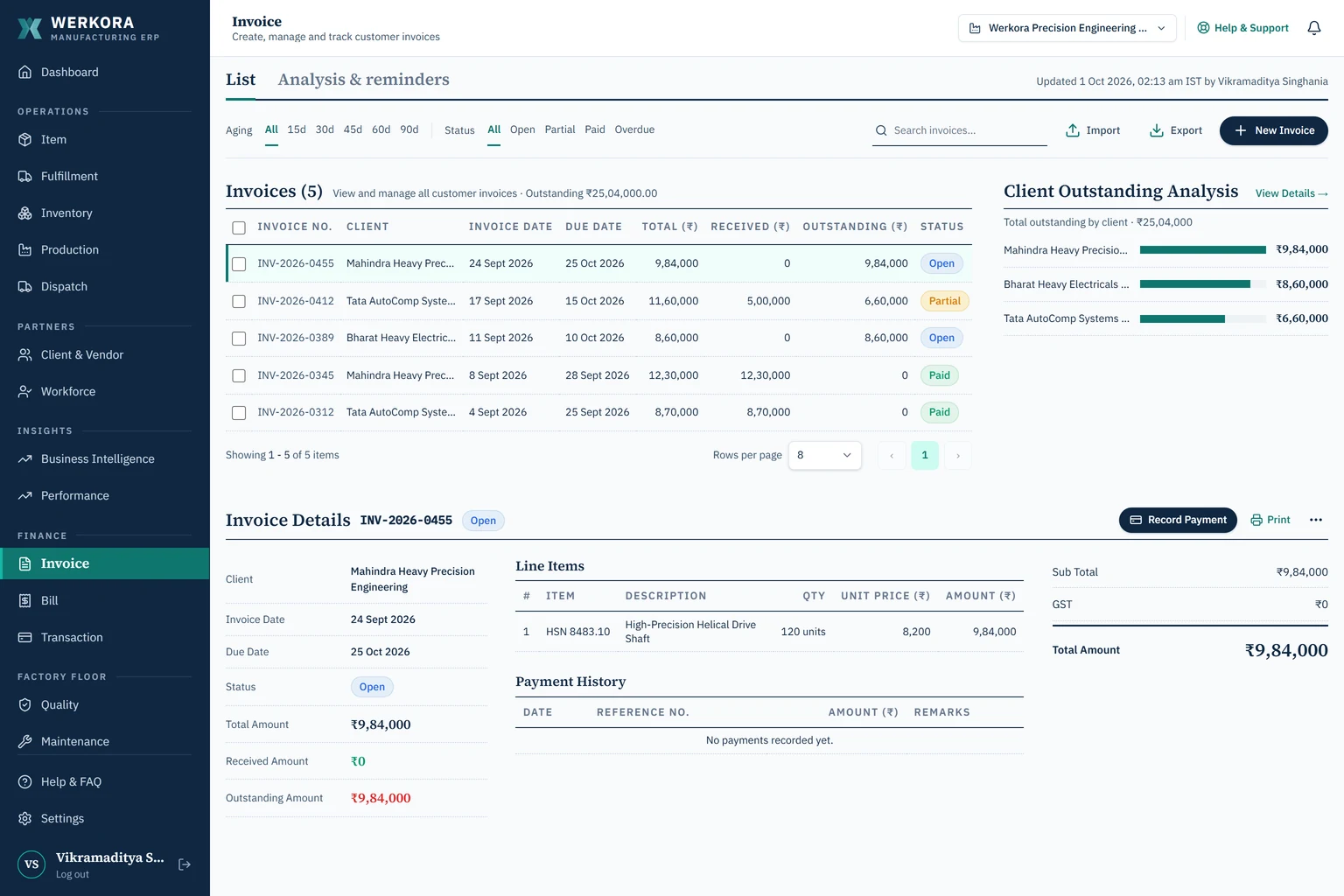
Werkora invoice module — GST e-invoicing and IRN status
AEO Quick Answer & Key Takeaway

Under Indian GST law, any business whose Aggregate Annual Turnover (AATO) exceeded ₹5 crore in any financial year from 2017-18 onwards is permanently mandated to generate e-invoices with an IRN and QR code. Turnover is calculated on a PAN-wide basis across all branches and export sales. Invoices issued without an IRN are legally invalid under Rule 48(4).

The Permanent Nature of the ₹5 Crore Threshold

Indian GST e-invoicing began in October 2020 for companies with turnover exceeding ₹500 crore. In successive phases, the threshold stepped down to ₹100 crore, ₹50 crore, ₹20 crore, ₹10 crore, and finally settled at ₹5 crore in August 2023.

Many MSME manufacturers misunderstand the ongoing nature of this mandate. The law specifies that if an enterprise exceeded ₹5 crore in aggregate turnover in any single preceding financial year since 2017-18, the requirement to issue e-invoices is permanent. A subsequent decline in revenue does not exempt the company.

Irreversible Obligation

Once your business crosses the ₹5 crore mark in any financial year since 2017-18, you remain permanently bound to generate IRNs for all B2B transactions.

Why Turnover is Calculated at the PAN Level

Under Section 2(6) of the CGST Act, Aggregate Annual Turnover (AATO) is calculated on an all-India PAN basis. It includes:

  • Taxable supplies across all state factory branches
  • Exempt and nil-rated goods shipments
  • Export sales (goods and services)
  • Inter-state stock transfers between distinct persons under the same PAN

A precision machining unit in Pune generating ₹3.5 crore and a sister assembly unit in Bengaluru generating ₹2.2 crore both fall under the mandatory e-invoicing rule because their combined PAN turnover is ₹5.7 crore.

Legal and Financial Penalties Under Rule 48(4)

Rule 48(4) of the CGST Rules establishes that an invoice issued by a mandated entity without an IRN is legally non-existent. This produces two immediate consequences:

  1. Buyer ITC Ineligibility: Your corporate customer cannot claim Input Tax Credit under Section 16(2)(a), leading to commercial disputes and withheld vendor payments.
  2. Statutory Penalties: Under Section 122(1), failure to issue a valid invoice attracts a penalty of 100% of the tax due or ₹10,000 per invoice, whichever is greater.

Streamlined Dispatch & Tax Invoicing in Werkora

Werkora structures all dispatch data to comply with Indian GST requirements. When the dispatch team confirms an order, Werkora validates HSN codes, calculates CGST, SGST, or IGST, attaches transporter information, and generates clean, print-ready tax invoices in seconds.

Because Werkora operates on a predictable unit pricing model of ₹4,999/unit/month (minimum 3 units, 10 users per unit), factories can operate all dispatch, store, and accounts desks without paying per-user software penalties.

Stop paying per-user software taxes in your factory

Werkora equips every shop-floor supervisor, line operator, storekeeper, and accountant with their own dedicated login with plans sized for your operation.

Frequently Asked Questions

Expert Answers for Factory Operations

If our turnover was ₹6 crore in 2021-22 but dropped to ₹3 crore in 2025-26, do we still need to e-invoice?

Yes. The e-invoicing threshold is retrospective and permanent. Crossing ₹5 crore in any financial year since GST inception permanently triggers e-invoicing compliance.

Does e-invoicing apply to B2C transactions?

No. The mandatory IRP registration applies to B2B supplies, exports, and supplies to SEZ units. B2C transactions do not require IRN generation.

AK

Abhishek Kumar

LinkedIn Profile

Senior Finance & ERP Systems Architect, Werkora

Senior accountant and enterprise systems specialist with 9+ years of experience across Indian GST/TDS compliance, SAP S/4HANA, Tally Prime, and finance automation. Direct operational background in precision instruments manufacturing and multi-jurisdictional statutory compliance with a zero-penalty record.

Cite this guide
APA, Markdown or BibTeX

Copy a citation to include this guide in your article or report.

Interactive Cost Comparison

Calculate Your Plant's Licensing Savings

Benchmark your current software bills against Werkora's unit-based pricing (10 users/unit · min 3 units).

Projected 3-Year Savings for Your Operation (3 Factory Units · 30 Users)

Save up to ₹6.8 Lakhs over 3 years

Compared to standard per-user seat pricing models like ERPNext ($13.50/user/mo).

Each unit includes 10 active user seats (Operations, Store, Accounts, Planning).

3

Base commitment minimum is 3 units (30 user seats total).

Commitment Term:

Werkora Plan

Werkora

₹14,997/mo (3 Units · 30 Seats)

Annual Cost

₹1,79,964

3-Year TCO

₹5,39,892

30 user seats (3 units × 10)

ERPNext Cloud

$13.50 / user / mo

Annual Cost (30 Users)

₹4,05,816

3-Year TCO

₹12,17,448

Save ₹6.8 Lakhs

TYASuite

₹499 / user / mo (~$6)

Annual Cost (30 Users)

₹1,79,640

3-Year TCO

₹5,38,920

Save ₹0

Zoho Creator

$8 / user / mo

Annual Cost (30 Users)

₹2,40,480

3-Year TCO

₹7,21,440

Save ₹1.8 Lakhs

SAP Business One

$50+ / user / mo

Annual Cost (30 Users)

₹15,03,000

3-Year TCO

₹45,09,000

Save ₹39.7 Lakhs

What's Included in Werkora's Plan (from ₹4,999/unit/mo · Min 3 Units):

10 Users per Factory Unit (30 Users in Base)
Minimum 3 Factory Units Included
GST Tax Invoices & Delivery Challans
BOM Formulation & Scrap Accounting
Customer, Supplier & Ledger Accounting
Batch FIFO Inventory Valuation
Shop Floor Travelers & Operation Routing
Extra Units at ₹4,999/mo (+10 users each)

Plan your ERP budget

Review the ERP buying guide or contact us to discuss the units, users, and deployment options your factory needs.

Related Manufacturing Playbooks

Explore adjacent topics in factory operations, costing, and statutory GST compliance.