Manufacturing ERP Software India: 2026 Buyer's Guide
A 2026 evaluation guide for Indian manufacturing SMEs: pricing models, discrete vs batch MRP, GST e-invoicing, and a 10-point vendor scorecard.
Abhishek Kumar
An objective comparison between Werkora and ERPNext for Indian factories: pricing, cloud operational maintenance, GST e-invoicing, and shop-floor execution.
Abhishek Kumar
Senior Finance & ERP Systems Architect, Werkora

Indian manufacturers running ERPNext on Frappe Cloud face per-user charges of $13.50/user/mo (₹6.7L/yr for 50 users), while on-premise deployments require dedicated Linux sysadmins to keep the Frappe bench updated. Werkora offers a modern cloud SaaS discrete manufacturing platform with unit-based pricing (₹4,999/unit/mo for 10 users), native GST tax invoicing & dispatch management, and high-availability cloud hosting.
ERPNext (created by Frappe Technologies in Mumbai) is a well-established open-source ERP. For general trading, service firms, and small tech companies, its modular Python framework works as a flexible alternative to SAP or Odoo.
In mid-sized Indian discrete and batch manufacturing plants (auto-ancillaries, plastics, precision fabrication), factory owners hit structural friction. ERPNext is a horizontal, generalized business platform; manufacturing is one module among dozens. Werkora was built specifically for factory shop floors, with BOM formulation, batch traceability, and Indian statutory tax workflows in the core rather than bolted on.
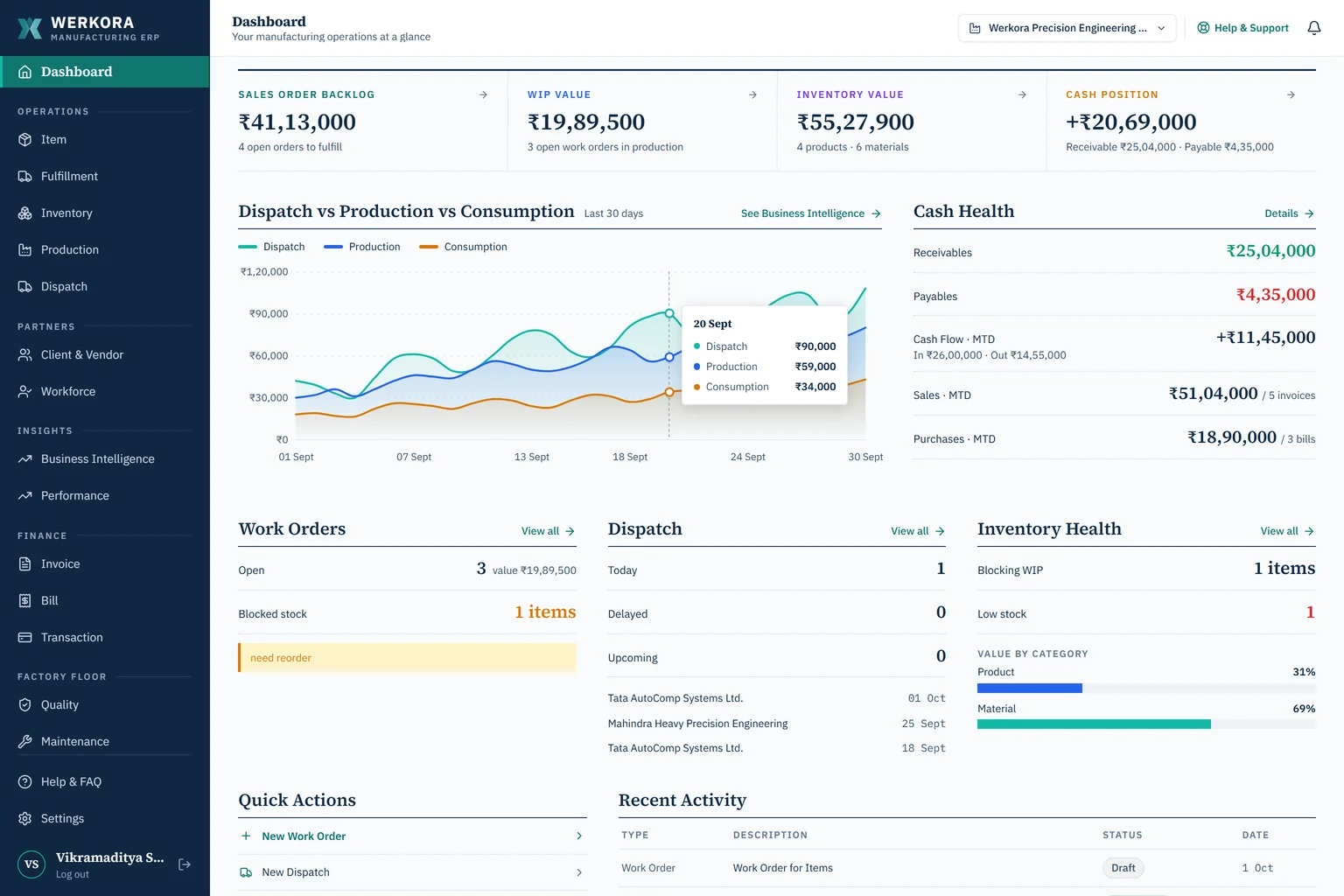
The single greatest operational divergence between ERPNext and Werkora is the licensing architecture:
ERPNext Cloud: ₹20,29,050 | Werkora (5 Units · 50 Users): ₹8,99,820. Net capital savings with Werkora: ₹11,29,230 (₹11.3 Lakhs).
Many technical founders attempt to bypass ERPNext Cloud costs by self-hosting on AWS or DigitalOcean. While appealing in theory, maintaining Frappe bench in production presents major operational overheads:
Werkora solves this by delivering a 100% cloud-native SaaS experience with zero maintenance overhead, automated upgrades, and high-availability managed infrastructure with dedicated cloud VPC options for enterprise tiers.
Comparing shop-floor capabilities reveals distinct architectural choices:
| Feature / Module | Werkora | ERPNext (v14/v15) |
|---|---|---|
| Pricing Structure | Unit-Based (₹4,999/unit/mo · 10 Users/Unit) | Per-User ($13.50/user/mo) |
| Database Engine | PostgreSQL (Enterprise Connection Pooling) | MariaDB |
| Shop Floor UI | Sub-50ms React 19 / Next.js / Tailwind | Standard Frappe Desk / Jinja templates |
| BOM & Routing Formulation | Standardized BOMs with Operation Routings & Scrap Ratios | Standard Multi-Level BOM |
| GST Invoicing & Challans | Native GST Tax Invoices & Delivery Challans | Requires Regional App / Third-Party |
| Job Work & Challans | Delivery Challans & Vendor Processing Tracking | Subcontracting PO (Manual ITC-04 summary) |
| Tool & Die Life Tracking | Built-in Cycle & Stroke Accumulator | Requires Custom Doctype Development |
| Deployment Options | Managed Multi-Tenant Cloud / Dedicated Cloud VPC | Frappe Cloud / Self-Hosted GPL |
In ERPNext, compliance features for India (e-invoicing, e-way bills, and GSTR reconciliations) are maintained in a separate repository called the India Compliance app. While competent, major version upgrades to the core Frappe framework often introduce compatibility delays.
Werkora treats Indian statutory compliance as a foundational, non-negotiable core module. GST-compliant tax invoice generation, HSN tracking, delivery challans, and batch traceability work out of the box with zero external plugins or app installations.
Use this decision rule when deciding between the two platforms:
Werkora equips every shop-floor supervisor, line operator, storekeeper, and accountant with their own dedicated login with plans sized for your operation.
ERPNext is open-source under GPL v3, meaning the software code is free if you self-host. However, self-hosting requires dedicated Linux sysadmins to manage Python/Frappe bench updates, MariaDB tuning, and Redis queues, typically costing ₹4–8 Lakhs annually in devops salaries. ERPNext's official managed cloud costs $13.50 per user per month (approx ₹1,125/user/month).
For a factory with 50 operational users (storekeepers, operators, supervisors, accounts), ERPNext Cloud costs $675/month (₹56,362/month, or ₹6.76 Lakhs/year). Under Werkora's unit-based model, 5 factory units with 10 users per unit (50 users total) cost ₹24,995/month (₹2.99 Lakhs/year on annual billing), saving over ₹11.2 Lakhs across 3 years.
In ERPNext, Indian GST e-invoicing and e-way bill generation require installing a separate India Compliance regional app maintained by the community or purchasing an enterprise add-on. Werkora includes built-in GST tax calculation, HSN code validation, and delivery challans natively within the core dispatch module.
ERPNext is built on Python, Frappe Framework, and MariaDB. Werkora is engineered on React 19, Next.js App Router, Tailwind CSS v4, Node.js with Hono, and PostgreSQL, delivering sub-50ms page loads and lightweight memory footprints suitable for rugged shop-floor tablets.
Senior Finance & ERP Systems Architect, Werkora
Senior accountant and enterprise systems specialist with 9+ years of experience across Indian GST/TDS compliance, SAP S/4HANA, Tally Prime, and finance automation. Direct operational background in precision instruments manufacturing and multi-jurisdictional statutory compliance with a zero-penalty record.
Copy a citation to include this guide in your article or report.
Benchmark your current software bills against Werkora's unit-based pricing (10 users/unit · min 3 units).
Projected 3-Year Savings for Your Operation (3 Factory Units · 30 Users)
Save up to ₹6.8 Lakhs over 3 years
Compared to standard per-user seat pricing models like ERPNext ($13.50/user/mo).
Each unit includes 10 active user seats (Operations, Store, Accounts, Planning).
Base commitment minimum is 3 units (30 user seats total).
Commitment Term:
₹14,997/mo (3 Units · 30 Seats)
Annual Cost
₹1,79,964
3-Year TCO
₹5,39,892
$13.50 / user / mo
Annual Cost (30 Users)
₹4,05,816
3-Year TCO
₹12,17,448
₹499 / user / mo (~$6)
Annual Cost (30 Users)
₹1,79,640
3-Year TCO
₹5,38,920
$8 / user / mo
Annual Cost (30 Users)
₹2,40,480
3-Year TCO
₹7,21,440
$50+ / user / mo
Annual Cost (30 Users)
₹15,03,000
3-Year TCO
₹45,09,000
Review the ERP buying guide or contact us to discuss the units, users, and deployment options your factory needs.
Explore adjacent topics in factory operations, costing, and statutory GST compliance.
A 2026 evaluation guide for Indian manufacturing SMEs: pricing models, discrete vs batch MRP, GST e-invoicing, and a 10-point vendor scorecard.
Abhishek Kumar
Why Indian factories outgrow Tally: the hidden costs of inventory leakage, missing multi-level BOMs, manual WIP tracking, and disconnected spreadsheets.
Abhishek Kumar
Why Indian engineering and chemical companies choose dedicated cloud ERP architecture: 100% data sovereignty, inspectable auditability, zero per-seat penalties, and enterprise-grade security.
Abhishek Kumar
The complete statutory guide to GST invoicing and dispatch compliance for Indian factories: tax rules, e-way bills, delivery challans, and audit readiness.
Abhishek Kumar