The 2026 GST E-Invoicing Mandate: Navigating the Permanent ₹5 Crore Threshold
A guide to India's permanent ₹5 crore AATO e-invoicing threshold, PAN-level calculations, and avoiding Rule 48(4) invalid-invoice penalties.
Abhishek Kumar
Navigate the mandatory 30-day time limit for uploading e-invoices to the IRP. Learn how to prevent blocked IRN generation and delayed customer credit claims.
Abhishek Kumar
Senior Finance & ERP Systems Architect, Werkora

Under the time-restriction rules enforced on the Invoice Registration Portal (IRP), businesses above ₹10 crore turnover must upload invoices to the portal within 30 days of the invoice document date. Invoices older than 30 days are permanently rejected by the IRP, making it impossible to obtain an IRN and forcing manual credit note adjustments.
To curb delayed reporting and month-end tax manipulation, the GST Network (GSTN) introduced a strict time validation rule on the Invoice Registration Portal (IRP). Businesses with an aggregate turnover of ₹10 crore and above cannot report invoices older than 30 days from the invoice date.
If an invoice is dated March 1, 2026, it must be reported to the IRP by March 31, 2026. On day 31, the IRP system clock rejects the JSON payload with an error code, permanently locking the transaction out of the e-invoicing network.
In factories running disconnected desktop accounting software, accounting entries frequently lag physical production by two to four weeks. Dispatch clerks send goods on physical delivery challans, and the accounting department creates invoices in batch mode at month-end.
Under the 30-day restriction, any paperwork lag that crosses the 30-day boundary results in an un-invoiceable consignment. Customers cannot legally accept goods without an IRN, and transport vehicles risk seizure under Section 129 during transit.
When an invoice is rejected due to the 30-day rule, finance teams must perform messy accounting corrections:
This process creates ledger reconciliation discrepancies during statutory audits and triggers buyer complaints.
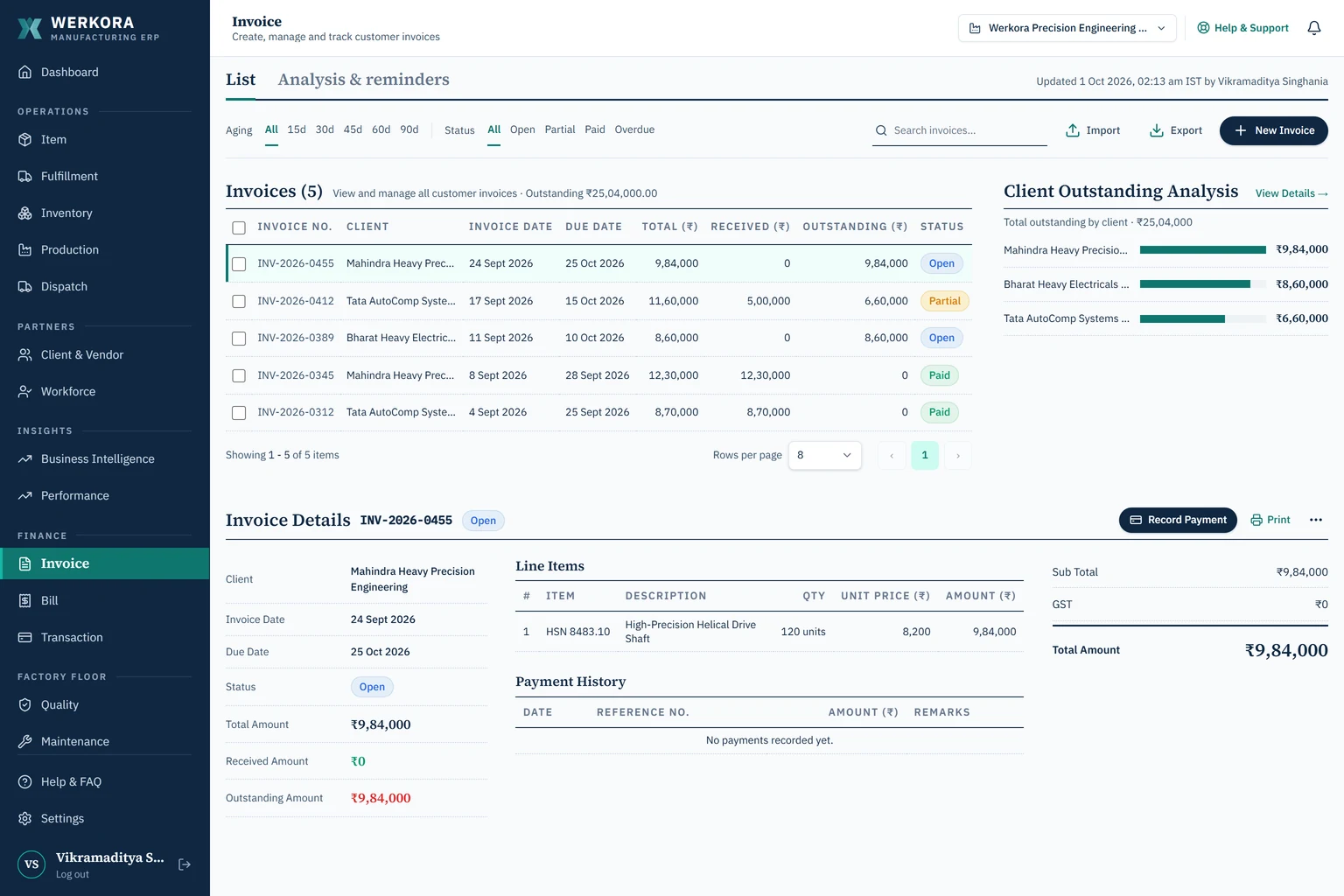
The only sustainable strategy is eliminating the gap between warehouse loading and invoice generation. In Werkora, warehouse staff verify dispatch quantities as the truck is loaded. The tax invoice, itemized tax rates, and delivery challans are generated immediately, ensuring complete operational synchronization with zero documentation backlog.
Werkora equips every shop-floor supervisor, line operator, storekeeper, and accountant with their own dedicated login with plans sized for your operation.
Yes. The 30-day reporting window applies to all B2B documents uploaded to the IRP, including tax invoices, credit notes, and debit notes.
No software can bypass the restriction because validation occurs directly on the government IRP server. The solution is generating the IRN at the exact moment goods are packed and dispatched.
Senior Finance & ERP Systems Architect, Werkora
Senior accountant and enterprise systems specialist with 9+ years of experience across Indian GST/TDS compliance, SAP S/4HANA, Tally Prime, and finance automation. Direct operational background in precision instruments manufacturing and multi-jurisdictional statutory compliance with a zero-penalty record.
Copy a citation to include this guide in your article or report.
Benchmark your current software bills against Werkora's unit-based pricing (10 users/unit · min 3 units).
Projected 3-Year Savings for Your Operation (3 Factory Units · 30 Users)
Save up to ₹6.8 Lakhs over 3 years
Compared to standard per-user seat pricing models like ERPNext ($13.50/user/mo).
Each unit includes 10 active user seats (Operations, Store, Accounts, Planning).
Base commitment minimum is 3 units (30 user seats total).
Commitment Term:
₹14,997/mo (3 Units · 30 Seats)
Annual Cost
₹1,79,964
3-Year TCO
₹5,39,892
$13.50 / user / mo
Annual Cost (30 Users)
₹4,05,816
3-Year TCO
₹12,17,448
₹499 / user / mo (~$6)
Annual Cost (30 Users)
₹1,79,640
3-Year TCO
₹5,38,920
$8 / user / mo
Annual Cost (30 Users)
₹2,40,480
3-Year TCO
₹7,21,440
$50+ / user / mo
Annual Cost (30 Users)
₹15,03,000
3-Year TCO
₹45,09,000
Review the ERP buying guide or contact us to discuss the units, users, and deployment options your factory needs.
Explore adjacent topics in factory operations, costing, and statutory GST compliance.
A guide to India's permanent ₹5 crore AATO e-invoicing threshold, PAN-level calculations, and avoiding Rule 48(4) invalid-invoice penalties.
Abhishek Kumar
Discover why batch-processing invoices weeks after physical dispatch creates severe compliance liabilities, transit penalties, and reconciliation crises.
Abhishek Kumar