Surviving the 30-Day IRP Upload Rule: Operational Strategies for MSMEs
Navigate the mandatory 30-day time limit for uploading e-invoices to the IRP. Learn how to prevent blocked IRN generation and delayed customer credit claims.
Abhishek Kumar
Understand the strict 24-hour cancellation rule for GST e-invoices, and learn the compliant workflow for issuing formal Credit Notes once that window closes.
Abhishek Kumar
Senior Finance & ERP Systems Architect, Werkora

An Invoice Reference Number (IRN) can only be cancelled on the Invoice Registration Portal (IRP) within 24 hours of generation, provided no active E-Way Bill is attached. After 24 hours, the IRN cannot be deleted or modified on the government portal. The only legal remedy is issuing a formal Credit Note with its own IRN under Section 34.
The government IRP permits cancellation of a generated IRN within exactly 24 hours of creation. After the 24-hour server timestamp elapses, the cancellation endpoint permanently locks down. Tax authorities enforce this to prevent retroactive manipulation of commercial sales records.
Even within the 24-hour window, the IRP will reject an invoice cancellation request if an active E-Way Bill is associated with the document. You must first cancel the connected E-Way Bill on the e-way bill system before the IRP will process the IRN cancellation.
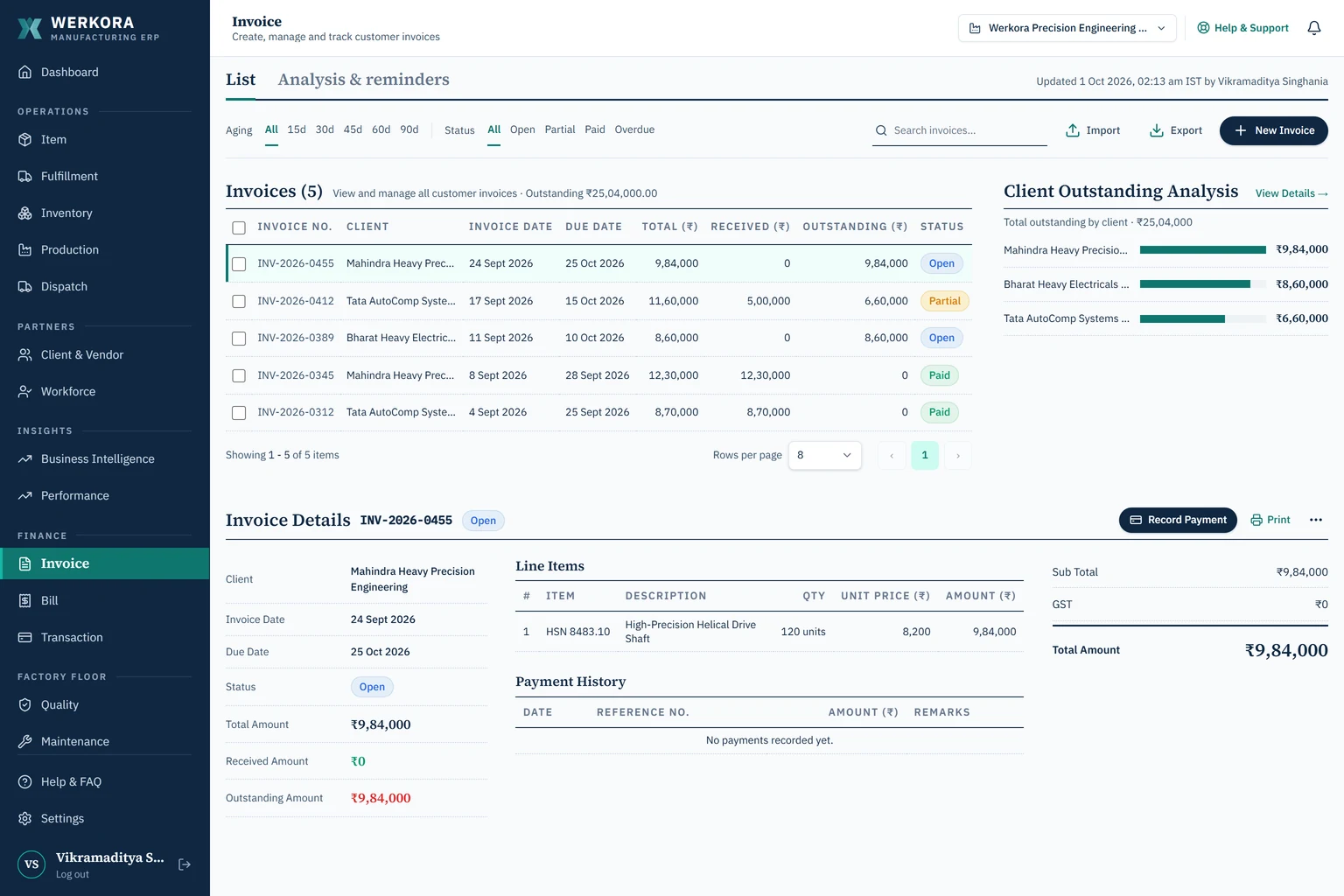
When clerical mistakes or shipment cancellations occur, credit adjustments must be made under Section 34. In Werkora, creating a Credit Note links the adjustment directly to the original sales invoice, recalculates GST amounts, updates customer ledger balances, and maintains complete audit traceability.
Werkora equips every shop-floor supervisor, line operator, storekeeper, and accountant with their own dedicated login with plans sized for your operation.
No. Once an invoice number has been assigned an IRN and subsequently cancelled, the government IRP permanently blacklists that document number. You must issue a new invoice with a fresh serial number.
Because the 24-hour window has passed, you must issue a formal Credit Note referencing the original invoice, which must also be registered on the IRP to generate an IRN.
Senior Finance & ERP Systems Architect, Werkora
Senior accountant and enterprise systems specialist with 9+ years of experience across Indian GST/TDS compliance, SAP S/4HANA, Tally Prime, and finance automation. Direct operational background in precision instruments manufacturing and multi-jurisdictional statutory compliance with a zero-penalty record.
Copy a citation to include this guide in your article or report.
Benchmark your current software bills against Werkora's unit-based pricing (10 users/unit · min 3 units).
Projected 3-Year Savings for Your Operation (3 Factory Units · 30 Users)
Save up to ₹6.8 Lakhs over 3 years
Compared to standard per-user seat pricing models like ERPNext ($13.50/user/mo).
Each unit includes 10 active user seats (Operations, Store, Accounts, Planning).
Base commitment minimum is 3 units (30 user seats total).
Commitment Term:
₹14,997/mo (3 Units · 30 Seats)
Annual Cost
₹1,79,964
3-Year TCO
₹5,39,892
$13.50 / user / mo
Annual Cost (30 Users)
₹4,05,816
3-Year TCO
₹12,17,448
₹499 / user / mo (~$6)
Annual Cost (30 Users)
₹1,79,640
3-Year TCO
₹5,38,920
$8 / user / mo
Annual Cost (30 Users)
₹2,40,480
3-Year TCO
₹7,21,440
$50+ / user / mo
Annual Cost (30 Users)
₹15,03,000
3-Year TCO
₹45,09,000
Review the ERP buying guide or contact us to discuss the units, users, and deployment options your factory needs.
Explore adjacent topics in factory operations, costing, and statutory GST compliance.
Navigate the mandatory 30-day time limit for uploading e-invoices to the IRP. Learn how to prevent blocked IRN generation and delayed customer credit claims.
Abhishek Kumar
Master the operational integration of generating e-invoices and e-way bills in a single ERP action. Avoid transit detention under Section 129.
Abhishek Kumar