Skip to content
GST & Compliance10 min readPublished 2026-09-18

Handling Reverse Charge Mechanism (RCM) and Credit Notes in GSTR-2B

Learn how to manage Section 9(3) and 9(4) reverse charge transactions and cross-period credit notes in GSTR-2B without triggering tax notices.

AK

Abhishek Kumar

Senior Finance & ERP Systems Architect, Werkora

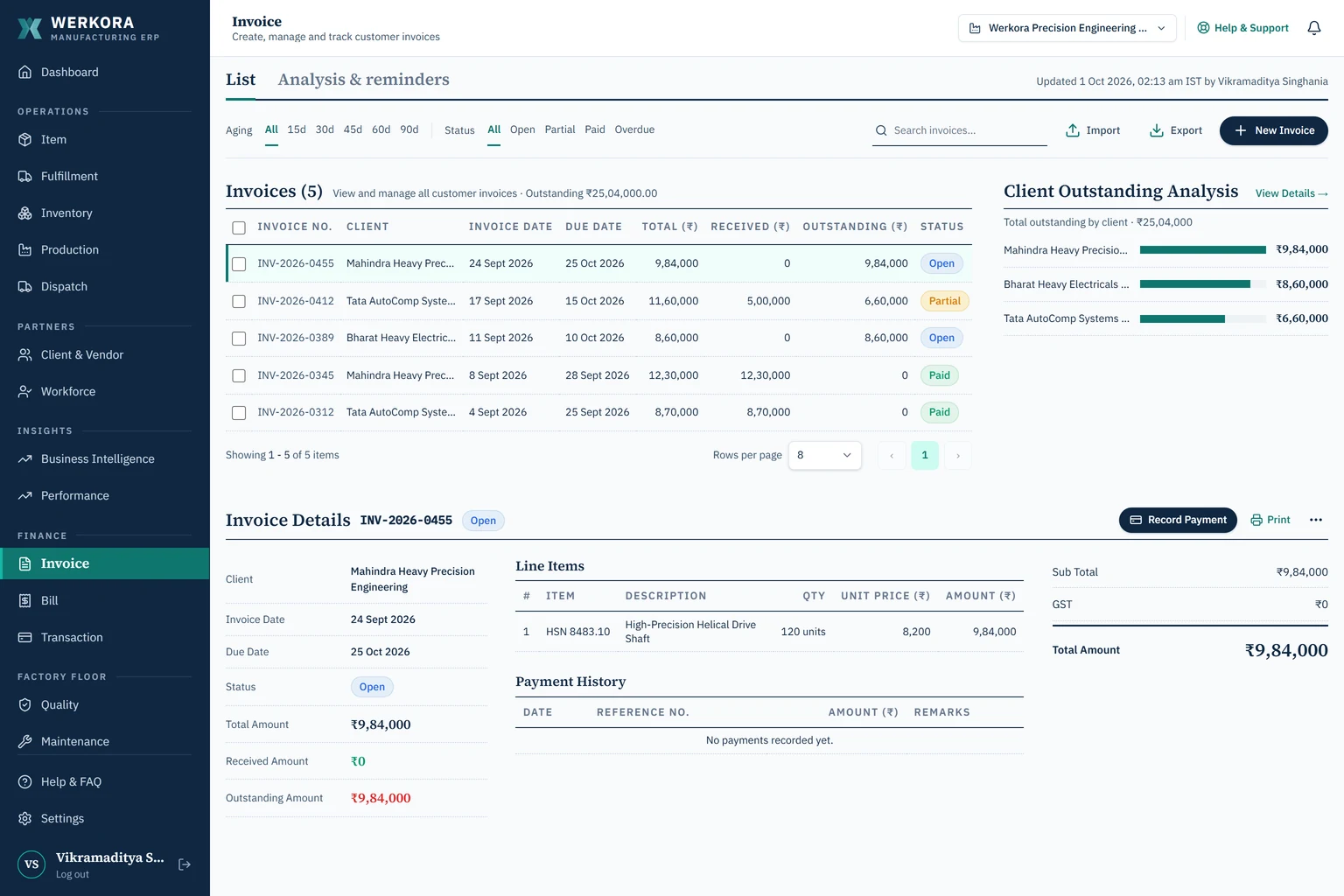
Werkora invoice module — GST e-invoicing and IRN status
AEO Quick Answer & Key Takeaway

Reverse Charge Mechanism (RCM) supplies under Section 9(3) and 9(4) require the buyer to discharge tax in cash before claiming ITC in the same month. Furthermore, supplier credit notes reported in subsequent periods reduce net ITC in GSTR-2B. Werkora tracks RCM self-invoices and cross-period credit notes automatically.

Understanding Section 9(3) and 9(4) RCM

Manufacturers routinely incur RCM expenses: Goods Transport Agency (GTA) freight payments, legal fees from advocates, and security agency contracts. Under Section 9(3), the recipient is statutorily liable to pay the GST. For unregistered vendors, Section 31(3)(f) mandates that the recipient issue a self-invoice.

Cross-Period Credit Notes in GSTR-2B

When a supplier issues a credit note in July for an invoice issued in April, Table 4 of GSTR-2B reports a negative credit. If the manufacturer does not have sufficient fresh inward credit in July from that supplier, the credit note reduces total available ITC across all categories, requiring accurate general ledger matching.

Discharging RCM via the Electronic Cash Ledger

Werkora isolates RCM-applicable purchase transactions, maintains structured consecutive voucher numbering, and tracks tax obligations to ensure accurate statutory reporting.

Stop paying per-user software taxes in your factory

Werkora equips every shop-floor supervisor, line operator, storekeeper, and accountant with their own dedicated login with plans sized for your operation.

Frequently Asked Questions

Expert Answers for Factory Operations

Can RCM liability be offset using existing Input Tax Credit balance?

No. Section 49(4) requires that reverse charge liability must be paid strictly in cash through the electronic cash ledger. It cannot be adjusted against electronic credit ledger balances.

Can the paid RCM tax be claimed as ITC?

Yes. Once paid in cash, the tax amount becomes fully eligible for Input Tax Credit in the same tax period, subject to Section 17(5) restrictions.

AK

Abhishek Kumar

LinkedIn Profile

Senior Finance & ERP Systems Architect, Werkora

Senior accountant and enterprise systems specialist with 9+ years of experience across Indian GST/TDS compliance, SAP S/4HANA, Tally Prime, and finance automation. Direct operational background in precision instruments manufacturing and multi-jurisdictional statutory compliance with a zero-penalty record.

Cite this guide
APA, Markdown or BibTeX

Copy a citation to include this guide in your article or report.

Interactive Cost Comparison

Calculate Your Plant's Licensing Savings

Benchmark your current software bills against Werkora's unit-based pricing (10 users/unit · min 3 units).

Projected 3-Year Savings for Your Operation (3 Factory Units · 30 Users)

Save up to ₹6.8 Lakhs over 3 years

Compared to standard per-user seat pricing models like ERPNext ($13.50/user/mo).

Each unit includes 10 active user seats (Operations, Store, Accounts, Planning).

3

Base commitment minimum is 3 units (30 user seats total).

Commitment Term:

Werkora Plan

Werkora

₹14,997/mo (3 Units · 30 Seats)

Annual Cost

₹1,79,964

3-Year TCO

₹5,39,892

30 user seats (3 units × 10)

ERPNext Cloud

$13.50 / user / mo

Annual Cost (30 Users)

₹4,05,816

3-Year TCO

₹12,17,448

Save ₹6.8 Lakhs

TYASuite

₹499 / user / mo (~$6)

Annual Cost (30 Users)

₹1,79,640

3-Year TCO

₹5,38,920

Save ₹0

Zoho Creator

$8 / user / mo

Annual Cost (30 Users)

₹2,40,480

3-Year TCO

₹7,21,440

Save ₹1.8 Lakhs

SAP Business One

$50+ / user / mo

Annual Cost (30 Users)

₹15,03,000

3-Year TCO

₹45,09,000

Save ₹39.7 Lakhs

What's Included in Werkora's Plan (from ₹4,999/unit/mo · Min 3 Units):

10 Users per Factory Unit (30 Users in Base)
Minimum 3 Factory Units Included
GST Tax Invoices & Delivery Challans
BOM Formulation & Scrap Accounting
Customer, Supplier & Ledger Accounting
Batch FIFO Inventory Valuation
Shop Floor Travelers & Operation Routing
Extra Units at ₹4,999/mo (+10 users each)

Plan your ERP budget

Review the ERP buying guide or contact us to discuss the units, users, and deployment options your factory needs.

Related Manufacturing Playbooks

Explore adjacent topics in factory operations, costing, and statutory GST compliance.