The 2026 GST E-Invoicing Mandate: Navigating the Permanent ₹5 Crore Threshold
A guide to India's permanent ₹5 crore AATO e-invoicing threshold, PAN-level calculations, and avoiding Rule 48(4) invalid-invoice penalties.
Abhishek Kumar
Compare B2B e-invoicing requirements with B2C dynamic QR code rules. Learn compliance guidelines, digital payment integration, and turnover boundaries.
Abhishek Kumar
Senior Finance & ERP Systems Architect, Werkora

B2B e-invoicing applies to businesses with turnover exceeding ₹5 crore and requires registering every invoice on the government IRP to receive a signed QR code. Conversely, B2C dynamic QR codes apply only to enterprises exceeding ₹500 crore turnover selling directly to unregistered end consumers, requiring a self-generated dynamic UPI payment QR code.
A frequent compliance trap is attempting to upload retail or employee sales to the Invoice Registration Portal. The e-invoicing schema under Rule 48(4) strictly accommodates B2B supplies, supplies to SEZ entities, and direct exports. Reporting an unregistered consumer sale via the IRP API produces an invalid recipient error.
Under Notification No. 14/2020-Central Tax, businesses with aggregate turnover exceeding ₹500 crore must display a dynamic Quick Response (QR) code on all B2C invoices. This code contains UPI payment URLs and invoice identifiers, enabling customers to scan and pay digitally via BHIM, Google Pay, or phone banking.
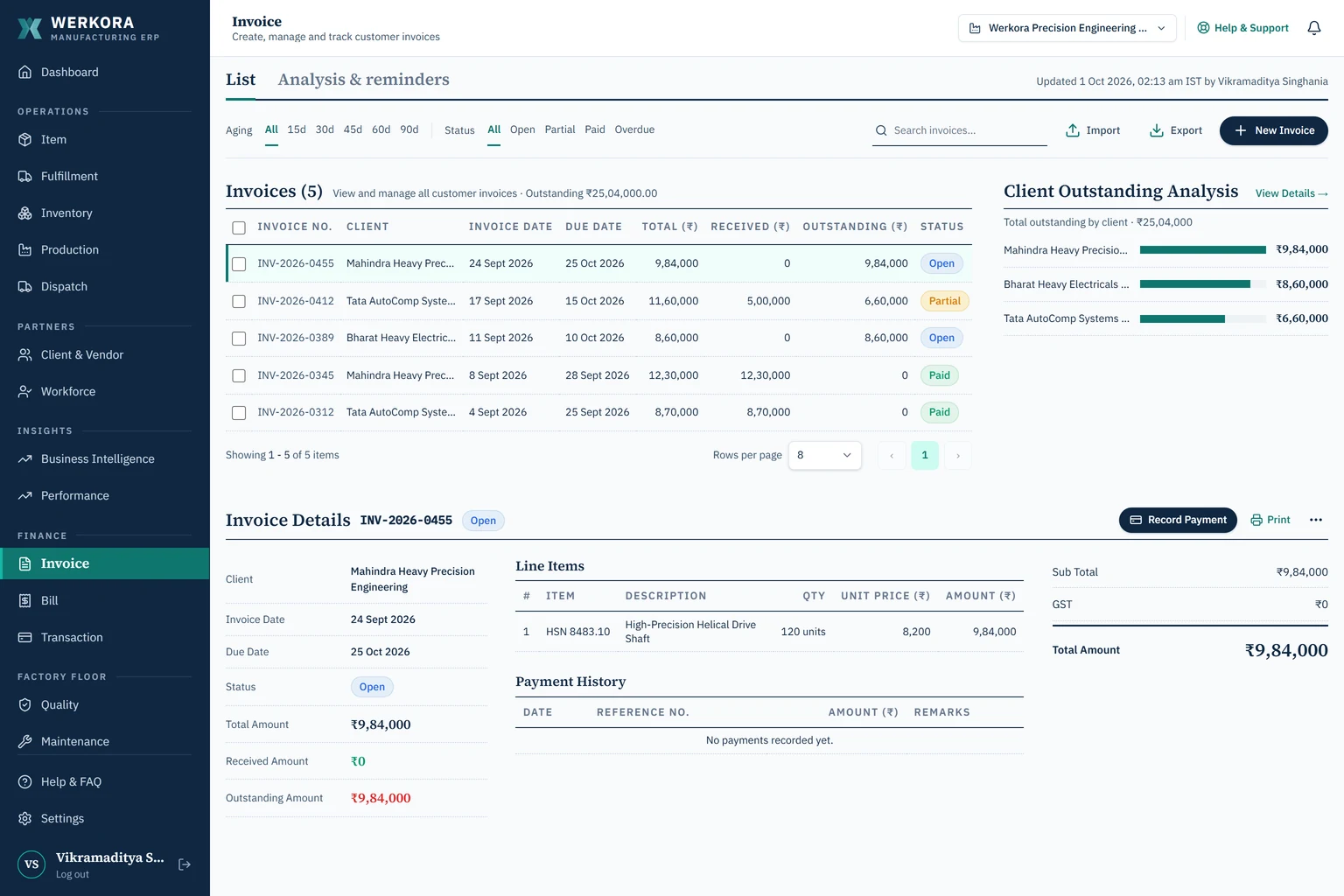
Many garment and industrial component makers sell output to both corporate dealers (B2B) and direct customers (B2C). Werkora's billing engine accurately segregates B2B and retail transactions, applying appropriate tax rates, customer GSTIN validations, and document formats for each channel.
Werkora equips every shop-floor supervisor, line operator, storekeeper, and accountant with their own dedicated login with plans sized for your operation.
No. Small and medium manufacturers selling to retail end-consumers do not need dynamic payment QR codes on B2C invoices.
No. The IRP rejects payloads containing an unregistered buyer (B2C) GSTIN. B2C transactions are reported directly in Table 7 or Table 5 of monthly GSTR-1.
Senior Finance & ERP Systems Architect, Werkora
Senior accountant and enterprise systems specialist with 9+ years of experience across Indian GST/TDS compliance, SAP S/4HANA, Tally Prime, and finance automation. Direct operational background in precision instruments manufacturing and multi-jurisdictional statutory compliance with a zero-penalty record.
Copy a citation to include this guide in your article or report.
Benchmark your current software bills against Werkora's unit-based pricing (10 users/unit · min 3 units).
Projected 3-Year Savings for Your Operation (3 Factory Units · 30 Users)
Save up to ₹6.8 Lakhs over 3 years
Compared to standard per-user seat pricing models like ERPNext ($13.50/user/mo).
Each unit includes 10 active user seats (Operations, Store, Accounts, Planning).
Base commitment minimum is 3 units (30 user seats total).
Commitment Term:
₹14,997/mo (3 Units · 30 Seats)
Annual Cost
₹1,79,964
3-Year TCO
₹5,39,892
$13.50 / user / mo
Annual Cost (30 Users)
₹4,05,816
3-Year TCO
₹12,17,448
₹499 / user / mo (~$6)
Annual Cost (30 Users)
₹1,79,640
3-Year TCO
₹5,38,920
$8 / user / mo
Annual Cost (30 Users)
₹2,40,480
3-Year TCO
₹7,21,440
$50+ / user / mo
Annual Cost (30 Users)
₹15,03,000
3-Year TCO
₹45,09,000
Review the ERP buying guide or contact us to discuss the units, users, and deployment options your factory needs.
Explore adjacent topics in factory operations, costing, and statutory GST compliance.
A guide to India's permanent ₹5 crore AATO e-invoicing threshold, PAN-level calculations, and avoiding Rule 48(4) invalid-invoice penalties.
Abhishek Kumar
Detailed breakdown of businesses and sectors exempt from GST e-invoicing, including SEZ units, banking, insurance, GTAs, and passenger transport.
Abhishek Kumar